Famous Faith · U.S. Presidents
James K. Polk
Determined leadership, territorial expansion, and the moral cost of ambition.
James K. Polk pursued a tightly focused presidential program and dramatically enlarged the United States. His administrative discipline is inseparable from a war of expansion, the extension of slaveholding interests, and questions about whose rights national ambition was allowed to override.
PRESIDENT 11
The essentials
James K. Polk at a glance
- Born
- November 2, 1795
- Died
- June 15, 1849
- Presidency
- March 4, 1845 – March 4, 1849
- Political party
- Democrat
- Church background
- Presbyterian upbringing; later Methodist identification and baptism
- Spouse
- January 1, 1824, to Sarah Childress (1803–1891)
- Children
- No children
- Other work
- Lawyer
- Presidential number
- 11
- Freemasonry
- Documented member
Basic biographical details: [1]. Family and religious qualifications are explained below.
The person behind the office
Life and family
Polk grew up in the South, studied at the University of North Carolina, and trained as a lawyer. He became a congressman, speaker of the House, and governor of Tennessee. His allegiance to Andrew Jackson helped shape his politics and earned him the nickname Young Hickory. He was an experienced public official even though his 1844 presidential nomination surprised many observers. [2] As a Democrat, Polk connected territorial growth with a broader program of trade and financial reform. He entered office determined to carry out specific goals within one term. His capacity for concentrated work impressed contemporaries, but efficiency does not settle the moral question of whether the ends he pursued were just. Political accomplishments require examination as well as enumeration. [3]
Spouse and children
Polk married Sarah Childress in 1824. They had no children. Sarah was an important political partner and White House hostess, and her Presbyterian commitments influenced the household. Their marriage cannot be reduced to a president absorbed in work and a wife arranging receptions: she helped sustain the social and political environment around an administration known for its relentless pace. Polk died in June 1849, only a few months after leaving office. [4] [1]
A public record
Major political accomplishments and decisions
- 01
Settled the Oregon boundary with Britain
Polk negotiated a settlement in 1846 that extended the boundary along the forty-ninth parallel through much of the disputed region. The agreement avoided a war with Britain. It also illustrates the difference between expansive campaign rhetoric and the compromises presidents make when governing. [5]
- 02
Expanded territory through war with Mexico
The Mexican-American War ended with the Treaty of Guadalupe Hidalgo in 1848 and major territorial transfers to the United States. These were enormous consequences, but territorial acquisition should not be described as an uncomplicated moral success. The war’s origins, civilian losses, and implications for slavery were intensely contested. [5]
- 03
Changed tariff and treasury policy
Polk supported the Walker Tariff and the restoration of an independent treasury system. These measures formed the domestic side of his program. His administration also completed the process by which Texas entered the Union, after John Tyler had signed the annexation resolution. [6]
Public evidence and its limits
Faith and documented statements
Polk’s religious story requires more than the Presbyterian label often printed in tables. The Miller Center describes a Presbyterian upbringing, a later Methodist religious experience, continued attendance with his Presbyterian family, and Methodist baptism near the end of his life. [4] These details should be attributed rather than turned into an embellished deathbed conversion narrative. Sarah’s strong religious practice is also not proof of her husband’s beliefs at every earlier stage. Famous Faith does not use a baptism report to make a confident pronouncement about salvation or to excuse the decisions of his administration. Biblical repentance involves accountability before God; it cannot be reduced to a historical anecdote that leaves the treatment of other people irrelevant. The distinction is particularly important when a politician’s religious story is used to sanctify national expansion.
Famous Faith’s biblical perspective
Public virtues and serious concerns
The historical actions are sourced. Their evaluation through Scripture expresses Famous Faith’s Christian editorial perspective; it is not a claim to know anyone’s eternal destiny.
Diligence and limits on personal ambition
Polk’s disciplined work and decision to leave after one term are worth acknowledging. Keeping a publicly stated limit can offer an example of restraint in the pursuit of office. Famous Faith sees a useful distinction between diligent service and the assumption that holding power is a personal entitlement. Even so, industriousness is not a biblical defense of every policy an industrious leader implements.
Expansion was not proof of divine approval
Polk’s war and territorial policies sharpened the struggle over slavery, while he himself remained an enslaver. [3] [2] Famous Faith rejects the idea that national success establishes God’s endorsement of conquest or racial bondage. The command to love one’s neighbor does not stop at an international border. Questions about truthfulness in the justification for war, the loss of life, and the rights of affected populations must stand beside the map of an enlarged republic.
Beyond the familiar name
Interesting facts and useful distinctions
A one-term program
Polk’s decision to seek his main objectives within one term is central to his presidential reputation. Recognizing that focus does not require accepting every claim that he fulfilled every objective without qualification. [3]
Term dates and ceremony dates differ
Polk’s term ended on March 4, 1849. Zachary Taylor’s public inauguration took place the following day because March 4 fell on a Sunday; the delayed ceremony did not extend Polk’s constitutional term.
A life in perspective
What this legacy asks of us
Polk’s presidency demonstrates how accomplishment and injustice can grow together. His ability to carry out a program deserves historical explanation, but Christian moral judgment cannot stop at effectiveness. The people displaced, enslaved, or killed in the process belong in the story just as surely as the legislation and treaties.
Our hope rests in Jesus Christ, not a president, party, lodge, or record of public service. Scripture teaches that all have sinned, that Christ died for sins and rose again, and that salvation is God’s gift through faith rather than an achievement we earn (Romans 3:23; 1 Corinthians 15:3–4; Ephesians 2:8–9). His call is to repentance and trust in him.
Sources and image credit
- Miller Center: Overview
- Miller Center: Life Before The Presidency
- Miller Center: Life In Brief
- Miller Center: Family Life
- Miller Center: Foreign Affairs
- Miller Center: Domestic Affairs
- First Kings Masonic District: Masonic Presidents
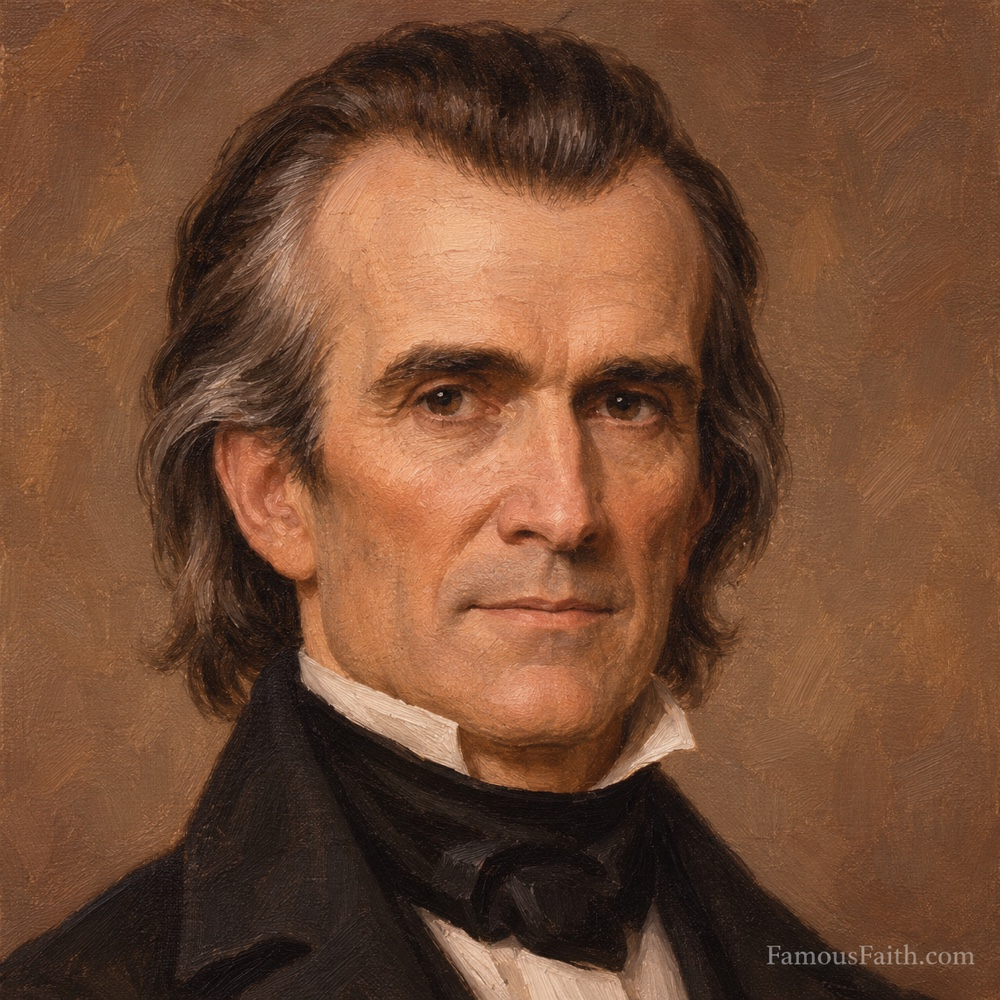
Portrait credit: Original AI-generated painted editorial illustration created for Famous Faith, with a subtle FamousFaith.com watermark. This is an artistic interpretation, not a historical photograph or an authenticated period painting.
Editorial approach: Documented actions and public statements are distinguished from Famous Faith’s biblical assessments. Public profession and church affiliation do not establish the condition of a person’s heart.