Famous Faith · U.S. Presidents
Harry S. Truman
An atomic-age presidency, civil rights, and a serious Masonic commitment.
Harry S. Truman took office at the end of World War II and helped establish the institutions of the Cold War. His civil-rights actions and Baptist profession stand beside the catastrophic human costs of atomic warfare and a well-documented leadership role in Freemasonry.
PRESIDENT 33
The essentials
Harry S. Truman at a glance
- Born
- May 8, 1884
- Died
- December 26, 1972
- Presidency
- April 12, 1945 – January 20, 1953
- Political party
- Democrat
- Church background
- Baptist
- Spouse
- June 28, 1919, to Elizabeth “Bess” Virginia Wallace (1885–1982)
- Children
- One daughter: Margaret
- Other work
- Farmer, Businessman, Public Official
- Presidential number
- 33
- Freemasonry
- Documented member and Missouri grand master
Basic biographical details: [1]. Family and religious qualifications are explained below.
The person behind the office
Life and family
Truman grew up in Missouri, worked in farming and business, and served as an artillery officer during World War I. His political career developed through local government and the Senate. He gained national standing through a committee investigating wartime spending, then became Franklin Roosevelt’s vice president in 1945. His preparation for the presidency was limited by how little he had been included in some of Roosevelt’s most important wartime decisions. [2] Roosevelt’s death made him president in April 1945. Truman then confronted the final defeat of Germany and Japan, the atomic bomb, economic reconversion, and deteriorating relations with the Soviet Union. He won the 1948 election despite widespread expectations that he would lose and served until January 1953. His administration’s decisions shaped American policy long after his term ended. [3]
Spouse and children
Truman married Elizabeth Virginia Wallace, known as Bess, in 1919. Their daughter Mary Margaret was born in 1924. Family loyalty remained a central part of his life, and his correspondence with Bess is an important historical record. Margaret pursued music and later became a writer. Truman’s protective response to criticism of her singing is a reminder that private affection and the restraint expected of a public official can come into tension. [4]
A public record
Major political accomplishments and decisions
- 01
Helped rebuild the postwar international order
The Truman Doctrine, Marshall Plan, and formation of NATO became central features of the emerging Cold War. His administration also supported the United Nations and recognized Israel. These policies involved different commitments and consequences rather than a single, uncomplicated program for peace. [5]
- 02
Acted against segregation in the armed forces
Executive Order 9981 in 1948 directed equality of treatment and opportunity in the military. Implementation took time, but the order was an important federal civil-rights action. Truman also pressed for broader measures that met strong resistance in Congress. [6]
- 03
Led through atomic war and the Korean conflict
Truman approved the use of atomic weapons against Japan and later committed American forces to Korea. The Korean armistice came under Eisenhower, after Truman left office. These decisions must be examined for both strategic purpose and human cost, not presented simply as victories on a presidential list. [5]
Public evidence and its limits
Faith and documented statements
Truman identified with the Baptist tradition and spoke publicly about religion, human dignity, and the freedom to worship. His 1949 inaugural address placed those freedoms within his account of the postwar struggle and repeatedly appealed to moral principles beyond government power. [1] [7] Famous Faith distinguishes those documented religious statements from a judgment about the state of his soul. His church identification should also not obscure his long and substantive Masonic involvement. The Truman Library’s records establish a commitment that went beyond receiving a ceremonial compliment. For a Christian profile, both parts of his public religious history matter. Political achievements and a familiar denominational label do not make a lodge’s spiritual framework compatible with the gospel.
Famous Faith’s biblical perspective
Public virtues and serious concerns
The historical actions are sourced. Their evaluation through Scripture expresses Famous Faith’s Christian editorial perspective; it is not a claim to know anyone’s eternal destiny.
Equal protection required federal action
Truman’s military desegregation order deserves recognition as an important challenge to institutional racial discrimination. Famous Faith regards impartial treatment as consistent with biblical justice and human dignity. The moral significance lies in the protection of people whose opportunities had been restricted, not merely in the political courage attributed to the president who signed the order.
Atomic warfare demands sober moral scrutiny
The bombings of Hiroshima and Nagasaki caused devastating civilian suffering. Their justification and possible alternatives remain subjects of historical debate. [5] Famous Faith refuses to treat mass loss of human life as a footnote to national victory. Decisions made in a terrible war require context, but context does not remove the duty to consider innocent lives, proportionality, and the limits of claims that an outcome justified every means used to secure it.
Beyond the familiar name
Interesting facts and useful distinctions
The 1948 result surprised many observers
Truman’s victory over Thomas Dewey contradicted widespread predictions. The election belongs in his political story without implying that an unexpected outcome was proof of divine approval. [3]
One war ended after his term
Truman began American participation in the Korean War, but the 1953 armistice was reached after Eisenhower took office. Accurate dates matter when assigning responsibility and credit. [5]
A life in perspective
What this legacy asks of us
Truman’s decisiveness is inseparable from decisions with immense human consequences. His civil-rights actions deserve acknowledgment, while atomic warfare and Masonic theology require serious moral and spiritual examination. A Christian profile should not allow admiration for toughness to replace a careful judgment of what that toughness served.
Our hope rests in Jesus Christ, not a president, party, lodge, or record of public service. Scripture teaches that all have sinned, that Christ died for sins and rose again, and that salvation is God’s gift through faith rather than an achievement we earn (Romans 3:23; 1 Corinthians 15:3–4; Ephesians 2:8–9). His call is to repentance and trust in him.
Sources and image credit
- Miller Center: Overview
- Miller Center: Life Before The Presidency
- Miller Center: Life In Brief
- Miller Center: Family Life
- Miller Center: Foreign Affairs
- Miller Center: Domestic Affairs
- Truman Library: Inaugural Address, January 20, 1949
- Truman Library: Papers as Senator and Vice President
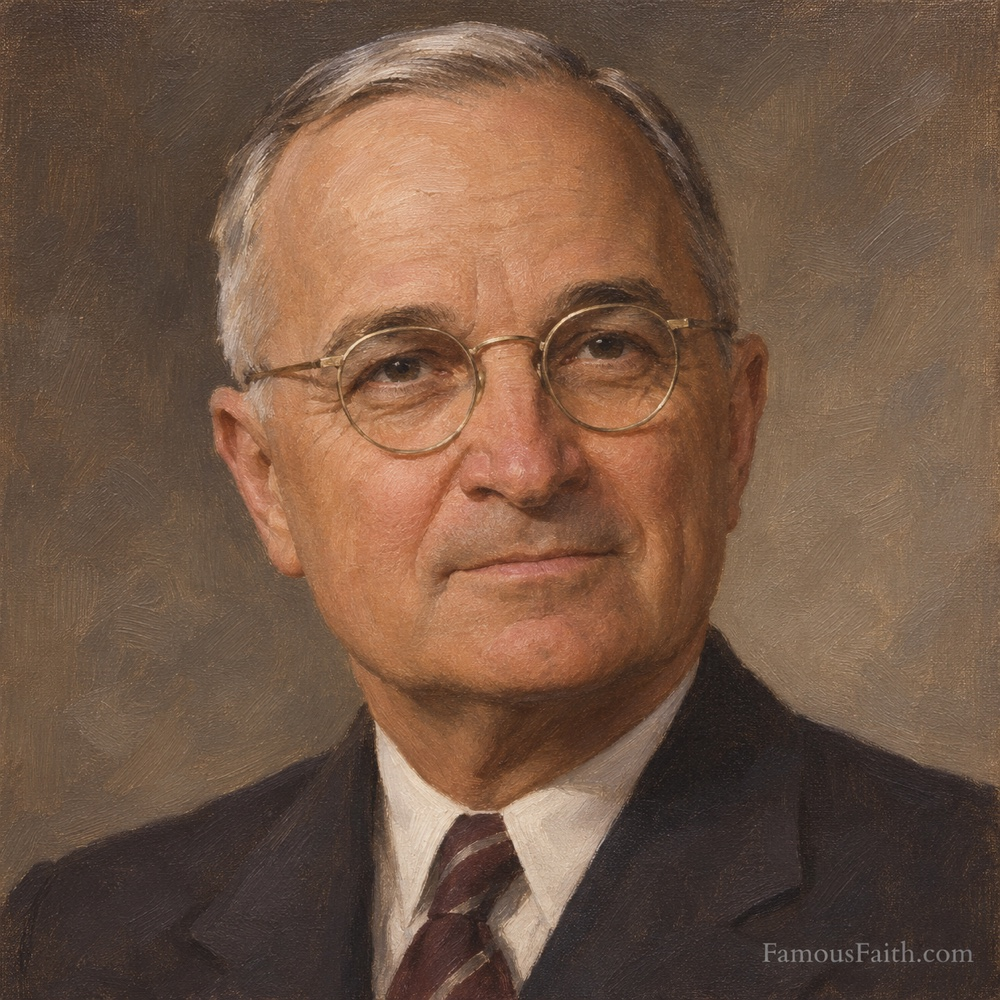
Portrait credit: Original AI-generated painted editorial illustration created for Famous Faith, with a subtle FamousFaith.com watermark. This is an artistic interpretation, not a historical photograph or an authenticated period painting.
Editorial approach: Documented actions and public statements are distinguished from Famous Faith’s biblical assessments. Public profession and church affiliation do not establish the condition of a person’s heart.