Famous Faith · U.S. Presidents
George Washington
Faith, the founding, and a complicated legacy.
America’s first president helped establish a republic. His life also raises enduring questions about religious conviction, human freedom, and the distance between public ideals and personal conduct.
01 / FIRST PRESIDENT · 1789–1797
The essentials
George Washington at a glance
- Born
- February 22, 1732
Popes Creek, Virginia - Died
- December 14, 1799
Age 67 · Mount Vernon, Virginia - Presidency
- April 30, 1789–March 4, 1797
Two terms · Vice president: John Adams - Political party
- None / nonpartisan
Neither Democrat nor Republican - Church background
- Anglican / Episcopalian
Served in parish leadership - Spouse
- Martha Dandridge Custis
Married January 6, 1759 - Children
- No biological children
Stepfather to Martha’s two surviving children - Other work
- Surveyor, planter, military commander, and Virginia legislator
- Freemasonry
- Documented member
Initiated November 4, 1752
Sources: biographical facts, family, party affiliation, church background, and Masonic membership. Birth date follows the modern Gregorian calendar.
The man behind the office
A soldier, a husband, and a founder
George Washington’s national importance began before the presidency. A Virginia surveyor and plantation owner, he gained military experience in the French and Indian War, served in the House of Burgesses, and later commanded the Continental Army during the American Revolution. His persistence helped keep the American cause alive through defeats and shortages before the decisive allied victory at Yorktown. He presided over the Constitutional Convention in 1787 and became the first president under the new Constitution in 1789. [5]
His reputation rests partly on the power he chose to surrender. Washington resigned his military commission after the Revolution and eventually left the presidency after two terms. These decisions helped establish that American leadership should answer to civilian institutions and should not become a lifetime entitlement. His achievements deserve attention alongside the people whose labor and losses made his world possible. [6]
Marriage to Martha
Washington married the widowed Martha Dandridge Custis in 1759. She brought two surviving children from her first marriage into the household. Martha also joined her husband at military winter encampments during the Revolution, becoming an important presence in his wartime life. [2]
Children and grandchildren
George and Martha had no biological children together. He helped raise John “Jacky” Parke Custis and Martha “Patsy” Parke Custis. After Jacky’s death, the Washingtons raised his two youngest children, Eleanor “Nelly” Parke Custis and George Washington Parke Custis. Calling Washington simply “childless” misses his substantial family responsibilities. [7]
A republic takes shape
Major political accomplishments
- 1787
Presided over the Constitutional Convention
Washington brought stature and credibility to the convention that drafted the Constitution. He presided over its proceedings; he was not its sole author. His support helped give the proposed government legitimacy. [6]
- 1789–1791
Helped make the new government function
He established the first presidential cabinet and worked with Congress to put the new constitutional system into operation. He also signed the law creating the First Bank of the United States, backing Alexander Hamilton’s approach to national finance amid considerable disagreement. [8]
- 1793
Kept the country out of a major European war
His neutrality policy sought to protect a young, vulnerable nation while Britain and revolutionary France fought. Remaining outside that conflict gave the United States time to strengthen its institutions and economy. [5]
- 1794
Asserted federal authority during the Whiskey Rebellion
Washington called out militia forces against resistance to the federal whiskey tax. The episode demonstrated the government’s capacity to enforce its laws, while also raising lasting questions about taxation and the use of executive power. [8]
- 1796–1797
Established the example of a voluntary departure
He declined a third term and transferred presidential authority to John Adams. His Farewell Address urged national unity and warned about destructive factionalism and foreign influence. The two-term limit was an example he set, not a constitutional requirement during his lifetime. [9]
Democrat or Republican? Neither. Washington never represented a political party. His administration increasingly aligned with policies associated with the Federalists, but describing him as a member of today’s Republican or Democratic Party would be inaccurate. Read the historical context.
What the record shows
Religion and statements of faith
Washington belonged to the Anglican tradition, which developed into the Episcopal Church in the independent United States. He attended worship and served as a vestryman and churchwarden. During military service, he supported chaplains, encouraged worship, and rebuked behavior such as profanity and gambling. These are documented expressions of respect for religion, rather than evidence that religion was absent from his life. [4]
He was also comparatively private about his personal theology. His public writings often spoke of God’s providence and the importance of moral conduct. Church affiliation, civic virtue, and references to divine help should be reported accurately without treating them as a complete statement of his beliefs about salvation or every Christian doctrine. Famous Faith does not claim to know the condition of his heart. [10]
“to acknowledge the providence of Almighty God, to obey his will”
“religion and morality are indispensable supports”
The Thanksgiving proclamation called Americans to gratitude, prayer, and repentance, including prayer for forgiveness of national wrongdoing. It appointed November 26, 1789, as a day of thanksgiving under the new Constitution. That is more precise than saying Washington invented all American Thanksgiving observances. [12] [13]
In his 1790 letter to Newport’s Hebrew congregation, he defended liberty of conscience and a government that gives “to bigotry no sanction, to persecution no assistance.” The letter also used the biblical image of people living securely under their own vine and fig tree. It remains an important statement of protection for religious minorities. [14]
Famous Faith’s biblical perspective
Public virtues and serious moral failures
The historical actions below are sourced. Their evaluation through Scripture expresses Famous Faith’s Christian editorial perspective. A political achievement is not, by itself, proof of biblical faithfulness.
Worth recognizing
Gratitude, prayer, and moral accountability
Washington’s call for national thanksgiving and repentance recognizes that a people should answer to a moral authority beyond their own success. Famous Faith sees that emphasis as consistent with biblical gratitude and confession, including 1 Thessalonians 5:18 and Proverbs 14:34. We can welcome those themes without assuming every religious statement he made was a full confession of Christian doctrine.
Worth recognizing
Restraint in power and protection from persecution
His willingness to relinquish office offers an example of restraint rather than personal entitlement. His defense of religious liberty also protected people who differed from the majority. From our perspective, leadership as service and respect for one’s neighbor fit the moral concerns of Mark 10:42–45 and Matthew 7:12. These comparisons are moral reflections, not claims that Washington built a government prescribed in detail by the Bible.
Serious concern
Slavery, human dignity, and the pursuit of escapees
Washington enslaved people and benefited from their coerced labor. As president, he signed the Fugitive Slave Act of 1793. After Ona Judge escaped from the presidential household in 1796, he pursued her return to slavery. Judge was legally part of the Custis estate associated with Martha; Washington’s involvement in trying to recover her remains part of his own record. [15]
Famous Faith regards race-based hereditary enslavement and the denial of another person’s freedom as grave violations of human dignity and neighbor-love. Genesis 1:27 grounds human worth in God’s image, while Matthew 7:12 challenges a system built on treatment its beneficiaries would not accept for themselves. The Bible’s ancient references to slavery do not excuse Washington’s participation in American chattel slavery.
His will did provide for the freedom of the people he legally owned, generally after Martha’s death, with immediate freedom for William Lee. Martha implemented the broader emancipation early in 1801. The provision did not cover everyone enslaved at Mount Vernon, including people held by the Custis estate. This was a consequential final decision, but it did not undo the decades of bondage or his failure to end slavery while president. [16]
Serious concern
Native nations, land, and the limits of promised justice
His administration pursued treaties and sometimes promised protection for Native lands, but it also used military force against Native resistance to American expansion. Federal protections repeatedly failed to stop settler incursions. A fair account must examine both the stated intentions and the harm experienced by Native communities. [17] In our biblical assessment, territorial ambition never removes the duties of justice, honest dealing, and care for vulnerable neighbors reflected in Micah 6:8.
Beyond the familiar portrait
Interesting facts—and a famous myth
Myth check
Did Washington really say, “I cannot tell a lie”?
The familiar saying belongs to the Washington cherry-tree legend. In the tale, young George damages his father’s tree and admits it. The episode appeared in the fifth edition of Mason Locke Weems’s biography in 1806, after Washington’s death, and is treated by Mount Vernon as a myth. It is not reliable evidence that the incident happened, and certainly does not establish that Washington never lied. Honesty is worth teaching; an invented anecdote should not be presented as historical proof. [20]
A different calendar
His birthday was once February 11
The family originally recorded his birth under the Julian calendar as February 11, 1731. The change to the Gregorian calendar and the new year’s dating convention produced the modern date, February 22, 1732. These describe the same birth, not two competing biographies. [21]
A remarkable election
His presidential elections were unanimous
Washington received every electoral vote cast for president in both of his elections. This describes the Electoral College’s votes; it does not mean every American could vote or that every citizen supported him. [8]
A small beginning
The first cabinet had four members
Washington’s original cabinet consisted of the secretaries of state, treasury, and war, plus the attorney general. The much larger cabinet familiar today developed over time. [3]
More than a title
He returned to life as a farmer
After leaving office, Washington returned to Mount Vernon and agricultural work. The estate was both his cherished home and a plantation sustained by enslaved labor—two realities that belong together when describing his private life. [22]
Reading his legacy honestly
Respect the achievement. Examine the whole life.
Washington’s contribution to American independence and constitutional government was substantial. His public acknowledgment of God and defense of religious liberty are also part of the record. So are his enslavement of other people, his administration’s treatment of Native nations, and his Freemasonry. A Christian profile should make room for admiration where it is warranted and moral clarity where it is needed. National importance does not place any person beyond the scrutiny of Scripture.
Sources & further reading
- Mount Vernon: Key Facts About George Washington
- Mount Vernon: Martha Washington
- Mount Vernon: Political Parties
- Mount Vernon: Washington and Religion
- Mount Vernon: George Washington’s Life
- National Archives: The Founding Fathers—Virginia
- Mount Vernon: Growing Up at Mount Vernon
- Mount Vernon: Ten Facts About Washington’s Presidency
- U.S. Senate: Washington’s Farewell Address; full text
- Mount Vernon: Religion
- Mount Vernon: Masonic Associations
- National Archives, archived White House: Thanksgiving Proclamation transcript
- National Archives: Congress Establishes Thanksgiving
- Founders Online: Letter to the Hebrew Congregation in Newport, August 18, 1790
- Mount Vernon: Ona Judge
- Mount Vernon: Slavery and Washington’s Will; emancipation details
- Mount Vernon: Native American Policy
- Mount Vernon: Washington and Freemasonry
- United Grand Lodge of England: Frequently Asked Questions; Grand Lodge of Ohio: Freemasonry and Religion
- Mount Vernon: The Cherry Tree Myth
- Mount Vernon: Washington’s Birthday and the Calendar Change
- Mount Vernon: Washington at Mount Vernon
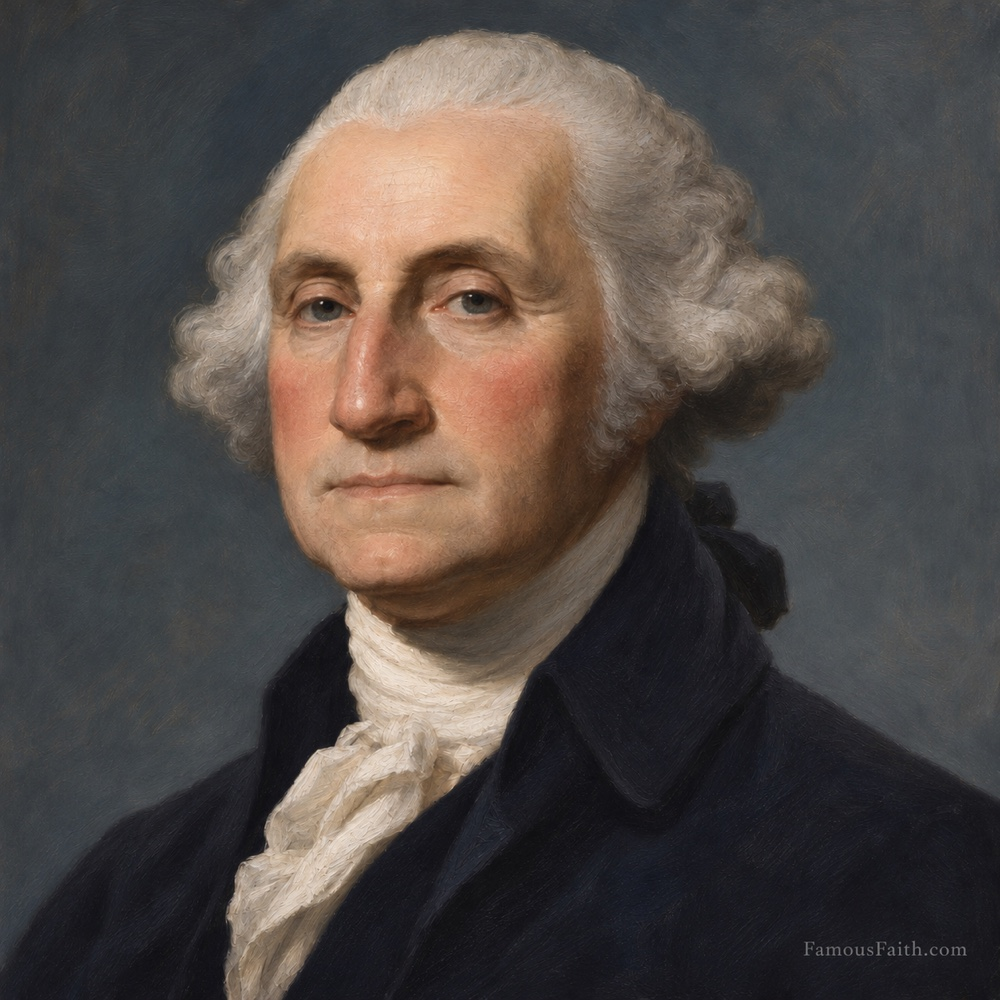
Portrait credit: AI-generated painted editorial illustration created for Famous Faith, with a subtle FamousFaith.com watermark. This is an artistic interpretation of George Washington, not a photograph, a historical portrait, or documentary evidence.
Editorial approach: Historical claims are distinguished from Famous Faith’s biblical assessments. Sources document public actions and statements; they do not establish the state of a person’s soul.