Famous Faith · U.S. Presidents
George W. Bush
Christian profession, humanitarian initiatives, and grave questions about war and presidential judgment.
George W. Bush spoke openly about Christian faith and led the country after the September 11 attacks. His presidency includes major education and health legislation, a large international AIDS initiative, wars in Afghanistan and Iraq, and the financial crisis of 2008. His profession and policies both deserve examination.
PRESIDENT 43
The essentials
George W. Bush at a glance
- Born
- July 6, 1946
- Died
- Living; profile checked November 7, 2026
- Presidency
- January 20, 2001 – January 20, 2009
- Political party
- Republican
- Church background
- Methodist
- Spouse
- November 5, 1977, to Laura Welch
- Children
- Two: twins Barbara and Jenna
- Other work
- Businessman, public official
- Presidential number
- 43
Basic biographical details: [1]. Family and religious qualifications are explained below.
The person behind the office
Life and family
Bush was born into a family already deeply involved in public affairs. He studied at Yale and Harvard, served as a pilot in the Texas Air National Guard, worked in the energy business, and became a part-owner of the Texas Rangers baseball team. He later won election as governor of Texas and was reelected before seeking the presidency. [2] A Republican, he served from 2001 to 2009 after the disputed 2000 election was resolved through the Electoral College outcome and litigation over Florida’s count. The attacks of September 11, 2001, radically changed the direction of his administration. His second term ended amid severe financial turmoil, leaving a record that combines influential domestic policies with costly and deeply contested uses of military power. [3]
Spouse and children
Bush married Laura Welch, a teacher and librarian, in 1977. Their twin daughters, Barbara and Jenna, were born in 1981. Both were in college during part of his presidency, and both participated in his 2004 reelection campaign. [4] His father, George H. W. Bush, had been the forty-first president, while his brother Jeb served as governor of Florida. These connections explain an important part of his environment and opportunities, but the younger Bush’s decisions must be evaluated as his own record. [2]
A public record
Major political accomplishments and decisions
- 01
Launched a major international AIDS initiative
In 2003 Bush proposed the President’s Emergency Plan for AIDS Relief, known as PEPFAR, directing substantial American resources toward prevention, treatment, and care. The initiative is a concrete example of international humanitarian policy and should be remembered alongside, rather than obscured by, the wars of his administration. [5]
- 02
Changed federal education and Medicare policy
He signed No Child Left Behind and legislation creating Medicare’s prescription-drug benefit. These measures changed the federal role in school accountability and access to medicines for older Americans. Their achievements, costs, and design limitations remain distinct questions that deserve evaluation beyond their political branding. [6]
- 03
Directed the response to September 11 and invaded Iraq
The United States invaded Afghanistan after the attacks and Iraq in 2003. The administration’s central claims about Iraqi weapons of mass destruction were not borne out by the weapons findings after the invasion. The wars and their aftermath imposed enormous human costs and raised serious questions about evidence, planning, and responsibility. [7]
Public evidence and its limits
Faith and documented statements
Bush’s listed church affiliation is Methodist, and Christian faith was a conspicuous part of his public identity. His biographical account describes religious change and sobriety in adulthood rather than a life without earlier struggles. [1] [3] His 2007 Christmas message explicitly commemorated the birth of Jesus Christ and connected the season to service and care for people in need. [8] These are documented elements of his public profession. Famous Faith distinguishes that profession from a claim that God endorsed an administration’s strategy. A leader’s stated dependence on Christ must be considered alongside truthfulness, treatment of vulnerable people, restraint in the use of force, and willingness to acknowledge serious mistakes. Political identification with Christians is never an exemption from biblical scrutiny.
Famous Faith’s biblical perspective
Public virtues and serious concerns
The historical actions are sourced. Their evaluation through Scripture expresses Famous Faith’s Christian editorial perspective; it is not a claim to know anyone’s eternal destiny.
Protecting life includes practical care
Famous Faith recognizes Bush’s opposition to abortion and his stated concern for protecting life in debates about embryonic stem-cell research. [6] We also see humanitarian assistance to people affected by AIDS as a substantial expression of concern for lives beyond national borders. [5] A Christian defense of life should include both moral conviction and practical help for those suffering, without treating good works as a means of salvation.
War requires truthful justification and accountability
The failure to find the Iraqi weapons stockpiles central to the administration’s case for invasion is a grave part of this record. [7] Famous Faith believes that decisions placing soldiers and civilians in mortal danger demand rigorous honesty, careful evidence, and responsibility for consequences. This does not require claiming knowledge of every official’s private intentions. It does require refusing to excuse bad reasoning or destructive results merely because the president professed Christian faith.
Beyond the familiar name
Interesting facts and useful distinctions
The second father-and-son presidential pair
George H. W. Bush and George W. Bush followed John Adams and John Quincy Adams as a father-and-son pair of presidents. The younger Bush’s term was not a continuation of his father’s administration. [3]
A baseball connection before the White House
Before his governorship and presidency, Bush was involved in ownership of the Texas Rangers. His pre-presidential career included business and sport as well as politics. [2]
A life in perspective
What this legacy asks of us
Bush’s presidency warns against evaluating Christian leadership by profession alone. Humanitarian initiatives, protection of life, the burdens of war, and failures of judgment all belong in the account. Famous Faith’s standard is not whether a leader makes Christians feel represented, but whether words and actions withstand the demands of truth, justice, humility, and love of neighbor.
Our hope rests in Jesus Christ, not a president, party, lodge, or record of public service. Scripture teaches that all have sinned, that Christ died for sins and rose again, and that salvation is God’s gift through faith rather than an achievement we earn (Romans 3:23; 1 Corinthians 15:3–4; Ephesians 2:8–9). His call is to repentance and trust in him.
Sources and image credit
- Miller Center: Overview
- Miller Center: Life Before The Presidency
- Miller Center: Life In Brief
- Miller Center: Family Life
- Archived Bush White House: PEPFAR fact sheet, July 2, 2003
- Miller Center: Domestic Affairs
- Miller Center: Foreign Affairs
- Bush’s Christmas message, December 21, 2007
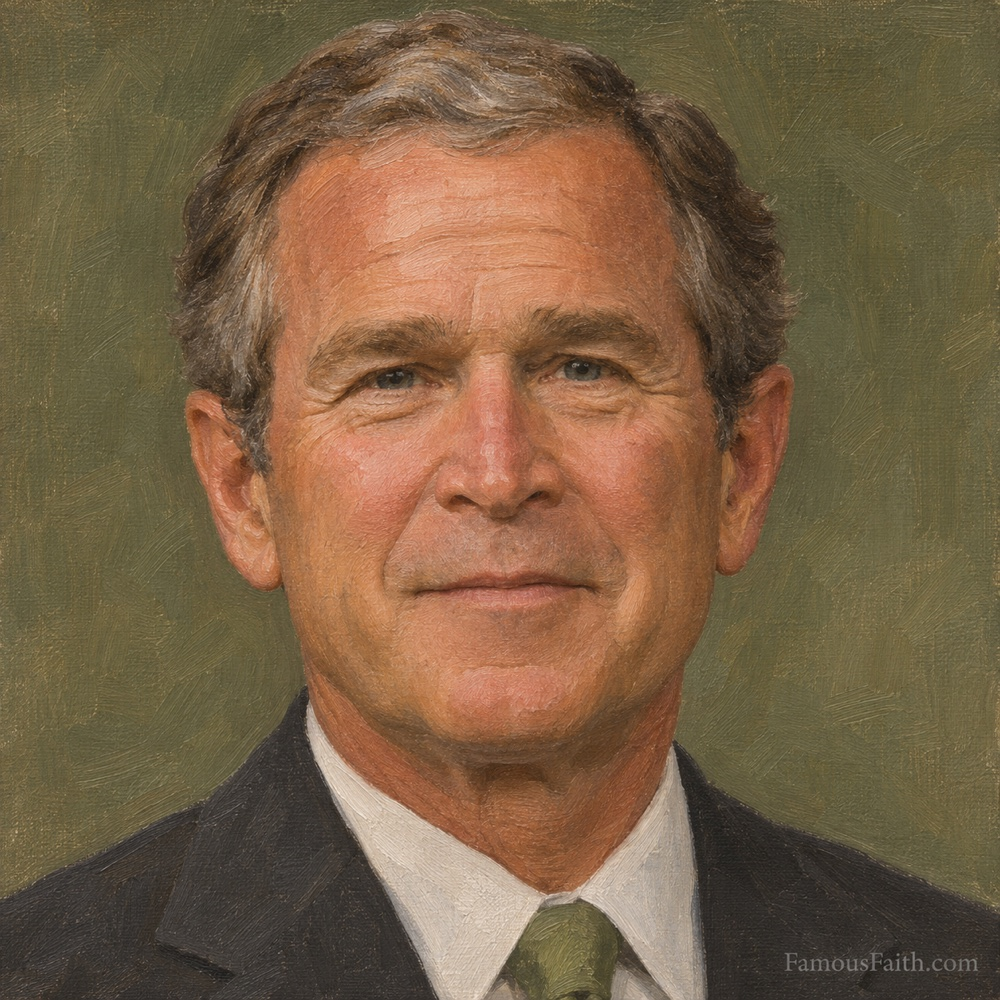
Portrait credit: Original AI-generated painted editorial illustration created for Famous Faith, with a subtle FamousFaith.com watermark. This is an artistic interpretation, not a historical photograph or an authenticated period painting.
Editorial approach: Documented actions and public statements are distinguished from Famous Faith’s biblical assessments. Public profession and church affiliation do not establish the condition of a person’s heart.