Famous Faith · U.S. Presidents
Franklin Pierce
Personal tragedy and a presidency that deepened the slavery crisis.
Franklin Pierce entered office after devastating family loss and promised national harmony. His support for the Kansas-Nebraska Act instead helped intensify the conflict over slavery, exposing the limits of a politics built on keeping powerful factions together.
PRESIDENT 14
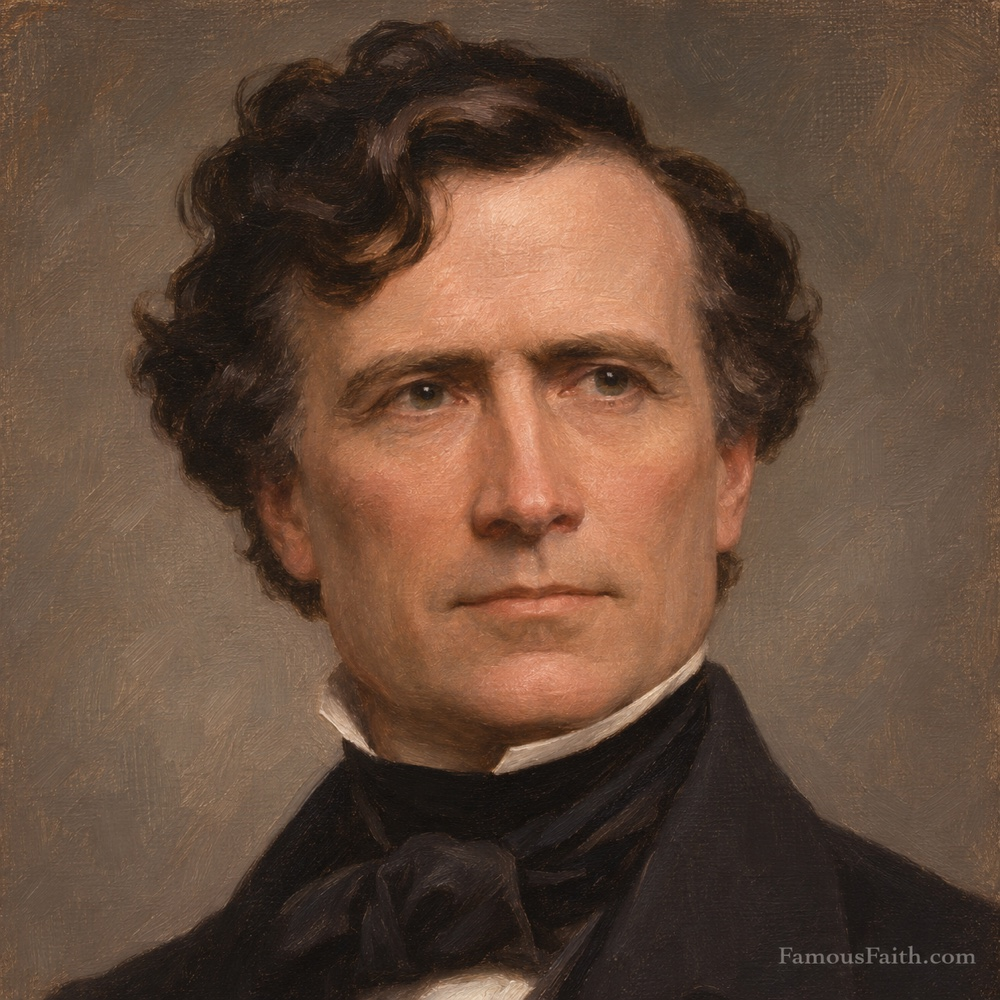
The essentials
Franklin Pierce at a glance
- Born
- November 23, 1804
- Died
- October 8, 1869
- Presidency
- March 4, 1853 – March 4, 1857
- Political party
- Democrat
- Church background
- Episcopalian
- Spouse
- November 19, 1834, to Jane Means Appleton (1806–1863)
- Children
- Three sons; all died before his presidency
- Other work
- Lawyer, Public Official
- Presidential number
- 14
Basic biographical details: [1]. Family and religious qualifications are explained below.
The person behind the office
Life and family
Pierce trained as a lawyer in New Hampshire and entered politics with the advantages of a prominent political family. He served in the state legislature, the House of Representatives, and the Senate, and later served in the Mexican-American War. He was sociable and experienced in party politics, but his eventual nomination reflected a divided Democratic convention seeking a candidate acceptable to competing interests. [2] His election in 1852 offered an opportunity to address a country increasingly divided over slavery. Pierce favored national party unity and the enforcement of existing compromises. That approach left him vulnerable to demands that strengthened slaveholding power. The Kansas-Nebraska controversy then shattered hopes that the sectional struggle could be contained through another adjustment of political arrangements. [3]
Spouse and children
Pierce married Jane Means Appleton in 1834. Their sons Franklin and Frank Robert died young. Their surviving son, Benjamin, was killed in a train accident shortly before Pierce’s inauguration. Jane’s grief and poor health sharply limited White House social life. Her religious convictions were a source of solace, but Famous Faith does not interpret the family’s tragedies as evidence of a specific divine punishment or as an explanation that removes the president’s responsibility for public decisions. [4] [1]
A public record
Major political accomplishments and decisions
- 01
Signed the Kansas-Nebraska Act
Pierce supported and signed the 1854 law allowing the slavery question in those territories to be decided through popular sovereignty. The act overturned the Missouri Compromise restriction and intensified competition, intimidation, and violence in Kansas. Its importance is a consequence to explain, not an achievement to celebrate without moral qualification. [5]
- 02
Completed the Gadsden Purchase
The administration acquired additional land from Mexico through the agreement known as the Gadsden Purchase. The transaction was linked to interest in a southern railroad route and further territorial development. It formed part of a wider expansionist outlook shaped by sectional competition. [6]
- 03
Pursued commercial and diplomatic expansion
Relations with Japan advanced during Pierce’s administration through the expedition initiated under Fillmore. The administration also became associated with the Ostend Manifesto concerning Cuba. These episodes show both the reach of American trade ambitions and the influence of expansionist and slaveholding interests. [6]
Public evidence and its limits
Faith and documented statements
Pierce is commonly identified with an Episcopalian religious background, while Jane’s strong Congregational convictions are particularly visible in family accounts. The beliefs of one spouse should not be automatically assigned to the other. [1] [4] In his 1853 inaugural address, Pierce explicitly connected national security with acknowledged dependence on God and Providence. This is documented religious language, delivered in the shadow of personal bereavement and national anxiety. [7] Famous Faith reports it without assuming that a religious appeal validates the policies that followed. Christianity calls rulers to truth and justice, including when the pressure of party loyalty makes those obligations costly. A public invocation of God heightens the need for moral examination rather than ending it.
Famous Faith’s biblical perspective
Public virtues and serious concerns
The historical actions are sourced. Their evaluation through Scripture expresses Famous Faith’s Christian editorial perspective; it is not a claim to know anyone’s eternal destiny.
Compassion is appropriate without romanticizing office
The Pierce family’s grief deserves human sympathy. Christians should resist using suffering as an occasion for ridicule or speculative judgment about God’s hidden purposes. At the same time, personal sorrow and the responsibility of public office are different questions. Compassion for a bereaved parent need not become an excuse for decisions that damaged other families and communities.
Popular sovereignty did not make enslavement just
The Kansas-Nebraska Act treated the extension of slavery as a question for political decision rather than a wrong against the people who would be enslaved. [5] Famous Faith rejects the idea that a vote can make human bondage morally legitimate. Biblical human dignity is not created by a local majority. Pierce’s commitment to party harmony helped empower a policy that further endangered that dignity and contributed to national violence.
Beyond the familiar name
Interesting facts and useful distinctions
A northern president backed a southern priority
Pierce’s New Hampshire origins did not determine his position on slavery. His presidency demonstrates why geography and party affiliation alone are inadequate guides to a person’s moral choices. [3]
His party did not renominate him
The Democrats selected James Buchanan in 1856 rather than offering Pierce a second nomination. The damage from the slavery controversy followed a president elected only four years earlier with a decisive electoral victory. [8]
A life in perspective
What this legacy asks of us
Pierce’s record warns that affability, experience, and a desire for agreement do not supply the moral clarity a crisis requires. His presidency deserves sympathy for its private suffering and criticism for its public failures. Those judgments can coexist without turning tragedy into either condemnation or absolution.
Our hope rests in Jesus Christ, not a president, party, lodge, or record of public service. Scripture teaches that all have sinned, that Christ died for sins and rose again, and that salvation is God’s gift through faith rather than an achievement we earn (Romans 3:23; 1 Corinthians 15:3–4; Ephesians 2:8–9). His call is to repentance and trust in him.
Sources and image credit
- Miller Center: Overview
- Miller Center: Life Before The Presidency
- Miller Center: Life In Brief
- Miller Center: Family Life
- Miller Center: Domestic Affairs
- Miller Center: Foreign Affairs
- Presidential statement: original transcript
- Miller Center: Impact And Legacy
Portrait credit: Original AI-generated painted editorial illustration created for Famous Faith, with a subtle FamousFaith.com watermark. This is an artistic interpretation, not a historical photograph or an authenticated period painting.
Editorial approach: Documented actions and public statements are distinguished from Famous Faith’s biblical assessments. Public profession and church affiliation do not establish the condition of a person’s heart.