Famous Faith · U.S. Presidents
Dwight D. Eisenhower
Military leadership, presidential prayer, and the responsibilities of power.
Dwight D. Eisenhower brought the authority of an Allied commander to the presidency. His religious profession, civil-rights enforcement, and emphasis on peace deserve attention alongside covert interventions and the dangers of national power he himself later warned about.
PRESIDENT 34
The essentials
Dwight D. Eisenhower at a glance
- Born
- October 14, 1890
- Died
- March 28, 1969
- Presidency
- January 20, 1953 – January 20, 1961
- Political party
- Republican
- Church background
- Presbyterian; baptized and joined the church in 1953
- Spouse
- July 1, 1916, to Mary “Mamie” Geneva Doud (1896–1979)
- Children
- Two sons: Doud Dwight, who died in childhood, and John
- Other work
- Soldier
- Presidential number
- 34
Basic biographical details: [1]. Family and religious qualifications are explained below.
The person behind the office
Life and family
Eisenhower grew up in Kansas and graduated from West Point. His military career developed gradually before World War II placed him in command of enormous Allied operations in Europe. He directed the coalition responsible for the 1944 Normandy landings and the defeat of Nazi Germany in Western Europe. These were military achievements before he became president, not actions of his later administration. [2] Elected as a Republican in 1952 and reelected in 1956, Eisenhower governed during Cold War tension, economic growth, and an intensifying civil-rights struggle. His public manner often emphasized steadiness, but his administration was actively involved in diplomacy, defense policy, domestic infrastructure, and covert action. The familiar image of a quiet decade should not obscure the difficult choices behind it. [3]
Spouse and children
Eisenhower married Mamie Doud in 1916. Their first son, Doud Dwight, died as a young child. Their second son, John, survived and later pursued military and diplomatic work. Repeated moves and long wartime separations shaped the marriage. Mamie’s public role and their family’s adjustments belong within the history of a career that often placed military duty ahead of the ordinary routines of home life. [4] [1]
A public record
Major political accomplishments and decisions
- 01
Reached an armistice in Korea
The Korean War’s armistice was signed in 1953, early in Eisenhower’s presidency. It stopped large-scale fighting without producing a final peace treaty. His administration then continued to manage the dangers of Cold War confrontation and nuclear competition. [5]
- 02
Built a major national highway program
Eisenhower signed the 1956 legislation that created the modern interstate highway program. The undertaking transformed transportation, defense planning, and development. Its benefits should be considered alongside the displacement and unequal local effects produced by particular highway projects. [6]
- 03
Enforced school desegregation at Little Rock
In 1957 Eisenhower used federal authority and troops to enforce court-ordered school integration in Little Rock. He also signed civil-rights legislation. The actions were significant, even though his approach to the wider movement was cautious and the laws did not immediately secure full equality. [6]
Public evidence and its limits
Faith and documented statements
Eisenhower’s religious upbringing preceded his Presbyterian membership. The Presbyterian Historical Society records his baptism and joining the church in February 1953, shortly after he became president. It is important to date that event rather than imply he had always belonged to the same denomination. [7] At his first inauguration, he offered a prayer asking God to make his administration’s dedication to the people complete. The prayer’s wording is preserved in the address. [8] Famous Faith recognizes a documented public profession while distinguishing it from certainty about salvation. A prayer for service places moral demands on governing: religious language should call officials to accountability, not turn national power into an object of faith.
Famous Faith’s biblical perspective
Public virtues and serious concerns
The historical actions are sourced. Their evaluation through Scripture expresses Famous Faith’s Christian editorial perspective; it is not a claim to know anyone’s eternal destiny.
Enforcing protection was more than a statement of principle
The use of federal authority at Little Rock helped protect students exercising rights recognized by the courts. Famous Faith regards that action as important because a promise of equal treatment requires practical protection. The episode also illustrates how a leader’s cautious personal style can coexist with a consequential decision to enforce the law against local obstruction.
Covert intervention raised serious questions of justice
Eisenhower’s administration supported covert operations against governments in Iran and Guatemala. [5] Famous Faith believes that fear of an adversary does not eliminate the moral duties owed to people in another nation. Assessing such actions requires attention to sovereignty, truthfulness, civilian consequences, and the tendency to treat strategic advantage as sufficient justification. National security is a real responsibility, but it is not a moral exemption.
Beyond the familiar name
Interesting facts and useful distinctions
The general and the president
Eisenhower’s command in World War II preceded his election by years. Keeping the two careers distinct avoids crediting his presidency with military decisions made while he served in a different office. [2]
A warning at the end of office
His farewell address warned about the influence of a military-industrial complex. The warning came from a former general and president, making it an especially important part of his reflection on the institutions he had led. [9]
A life in perspective
What this legacy asks of us
Eisenhower’s life invites appreciation of service, restraint, and constitutional enforcement without forgetting the costs of covert power. His own prayer and later warning provide standards against which to examine his administration. Christian judgment should remain concerned with the people affected by national decisions, including those beyond American borders.
Our hope rests in Jesus Christ, not a president, party, lodge, or record of public service. Scripture teaches that all have sinned, that Christ died for sins and rose again, and that salvation is God’s gift through faith rather than an achievement we earn (Romans 3:23; 1 Corinthians 15:3–4; Ephesians 2:8–9). His call is to repentance and trust in him.
Sources and image credit
- Miller Center: Overview
- Miller Center: Life Before The Presidency
- Miller Center: Life In Brief
- Miller Center: Family Life
- Miller Center: Foreign Affairs
- Miller Center: Domestic Affairs
- Presbyterian Historical Society: Eisenhower, Peace and Presbyterianism
- Presidential statement: original transcript
- Miller Center: Impact And Legacy
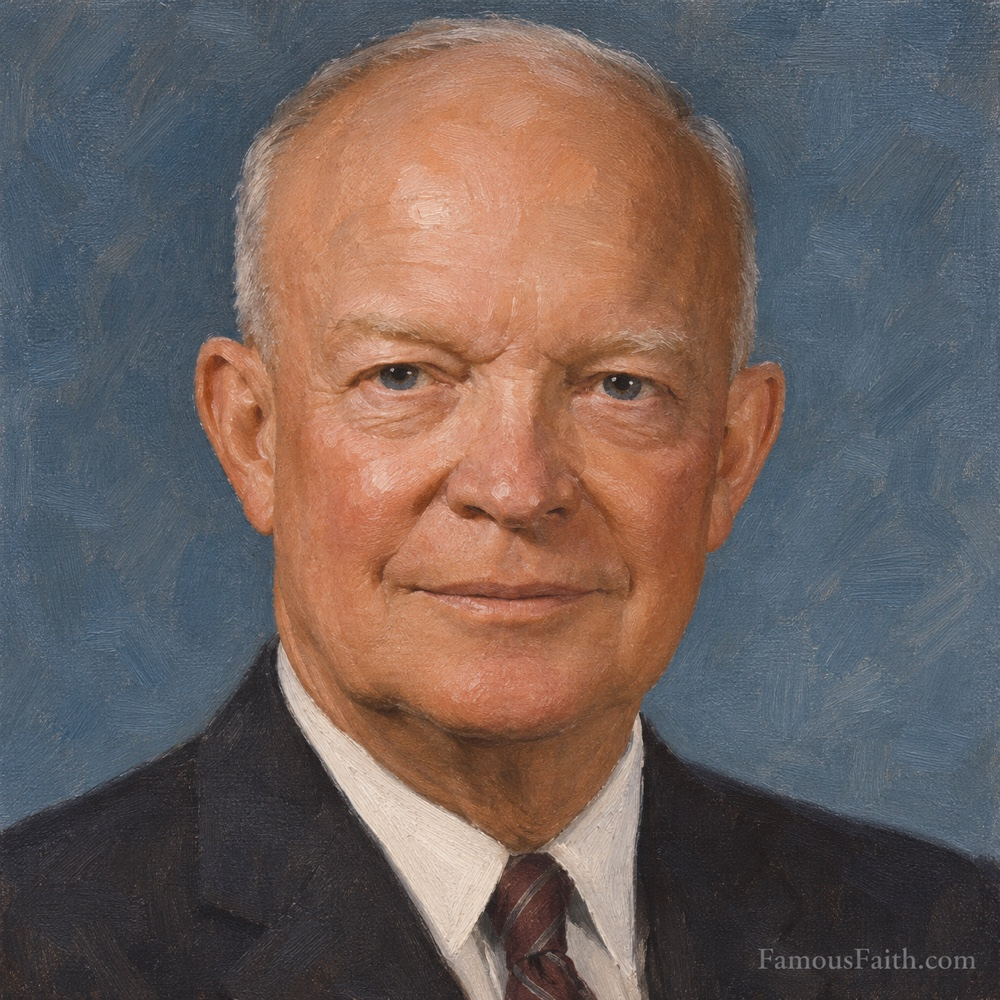
Portrait credit: Original AI-generated painted editorial illustration created for Famous Faith, with a subtle FamousFaith.com watermark. This is an artistic interpretation, not a historical photograph or an authenticated period painting.
Editorial approach: Documented actions and public statements are distinguished from Famous Faith’s biblical assessments. Public profession and church affiliation do not establish the condition of a person’s heart.