Famous Faith · U.S. Presidents
Chester A. Arthur
A patronage politician who signed a landmark reform.
Chester A. Arthur reached the presidency through a political system built on patronage, then signed a major civil-service reform. His record also includes Chinese exclusion, demonstrating how administrative improvement can coexist with serious failures of equal treatment.
PRESIDENT 21
The essentials
Chester A. Arthur at a glance
- Born
- October 5, 1829
- Died
- November 18, 1886
- Presidency
- September 19, 1881 – March 4, 1885
- Political party
- Republican
- Church background
- Episcopalian
- Spouse
- October 25, 1859, to Ellen Lewis Herndon (1837–1880)
- Children
- Three: William, Chester Alan Jr., and Ellen; William died in childhood
- Other work
- Lawyer
- Presidential number
- 21
Basic biographical details: [1]. Family and religious qualifications are explained below.
The person behind the office
Life and family
Arthur was born in Vermont and grew up in the household of a Baptist minister. He attended Union College, trained as a lawyer, and became involved in New York politics. His legal work included cases connected with Black civil rights, while his political rise depended heavily on the patronage network associated with Senator Roscoe Conkling. His public career therefore contained tensions well before he entered the White House. [2] As collector of the Port of New York, Arthur held an office central to federal revenue and political influence. He became James Garfield’s vice president through a Republican effort to balance rival factions. Garfield’s death in September 1881 made Arthur president. Many critics expected a party boss’s ally to govern narrowly for his faction, making his later support for reform an important development. [3]
Spouse and children
Arthur married Ellen Lewis Herndon in 1859. They had three children: William Lewis Herndon, Chester Alan Jr., and Ellen Herndon. William died young, and Ellen died in 1880, before Arthur became president. He entered the White House as a widower, with his son and daughter part of the family life surrounding his term. His sister helped perform public household duties. Personal bereavement is important context, but it does not fully explain the choices of his administration. [4]
A public record
Major political accomplishments and decisions
- 01
Signed the Pendleton Civil Service Reform Act
The 1883 law created a merit-based system for some federal employment and limited abuses associated with political assessments and patronage. Its initial reach was limited; it did not instantly transform every government job. Arthur’s support nevertheless marked a consequential departure from the system that had advanced his career. [5]
- 02
Helped begin modernization of the Navy
Arthur supported the construction of new steel ships and administrative changes in naval organization. The program was still modest, but it helped establish the foundation of a more modern fleet. Later naval expansion should not all be credited to measures enacted during his term. [6]
- 03
Approved Chinese exclusion after an initial veto
Arthur rejected an earlier, longer exclusion proposal but signed a revised ten-year restriction in 1882. The distinction belongs in the record, yet it does not remove his responsibility for approving a discriminatory policy directed at Chinese laborers. The legislation reflected powerful racial and economic hostility. [5]
Public evidence and its limits
Faith and documented statements
Arthur’s father was a Baptist preacher, while Arthur himself is generally identified with the Episcopal tradition. A parent’s ministry and a later church association are different kinds of evidence; neither supplies a complete statement of a president’s private convictions. [2] [1] His brief address on assuming office emphasized the tragedy of Garfield’s death, public responsibility, and continuity in government. The document used here does not provide a detailed first-person confession of Christian doctrine, and Famous Faith will not manufacture one. [7] We report the religious background that can be established and assess his conduct through Scripture separately. An attractive public manner, a respectable household, or association with a church cannot settle questions about faithfulness in the use of power.
Famous Faith’s biblical perspective
Public virtues and serious concerns
The historical actions are sourced. Their evaluation through Scripture expresses Famous Faith’s Christian editorial perspective; it is not a claim to know anyone’s eternal destiny.
Reform can require turning against an old system
Arthur’s support for civil-service reform demonstrates that a political figure can act against expectations formed by his earlier alliances. Famous Faith welcomes efforts to reduce the treatment of government as a source of private rewards. Biblical stewardship involves competence, impartiality, and protection against the temptation to use public resources for a faction’s benefit.
Chinese exclusion denied equal dignity
The law Arthur signed singled out Chinese laborers for exclusion in a climate of racial hostility. [5] Famous Faith regards ethnic prejudice and the treatment of neighbors as an inferior class as serious violations of biblical human dignity. Questions about immigration rules can be debated without making an ethnic group a scapegoat. Arthur’s initial veto and his reforms elsewhere do not eliminate the need to criticize the policy he ultimately approved.
Beyond the familiar name
Interesting facts and useful distinctions
Unexpected reform from a machine politician
Arthur’s background made his support for the Pendleton Act surprising to contemporaries. The contrast is more informative than a simple story that he entered office with an established record of opposition to patronage. [5]
Civil-rights work preceded the presidency
As a young lawyer, Arthur participated in litigation involving the rights of Black Americans. That earlier work deserves notice without being used to excuse the racial discrimination he later accepted in immigration policy. [2]
A life in perspective
What this legacy asks of us
Arthur’s presidency offers an example of change without a complete moral transformation. He moved beyond the expectations of his patronage background in one important area, while signing a law that entrenched discrimination in another. A Christian profile should be specific enough to recognize the reform and equally specific about the injustice.
Our hope rests in Jesus Christ, not a president, party, lodge, or record of public service. Scripture teaches that all have sinned, that Christ died for sins and rose again, and that salvation is God’s gift through faith rather than an achievement we earn (Romans 3:23; 1 Corinthians 15:3–4; Ephesians 2:8–9). His call is to repentance and trust in him.
Sources and image credit
- Miller Center: Overview
- Miller Center: Life Before The Presidency
- Miller Center: Life In Brief
- Miller Center: Family Life
- Miller Center: Domestic Affairs
- Miller Center: Foreign Affairs
- Presidential statement: original transcript
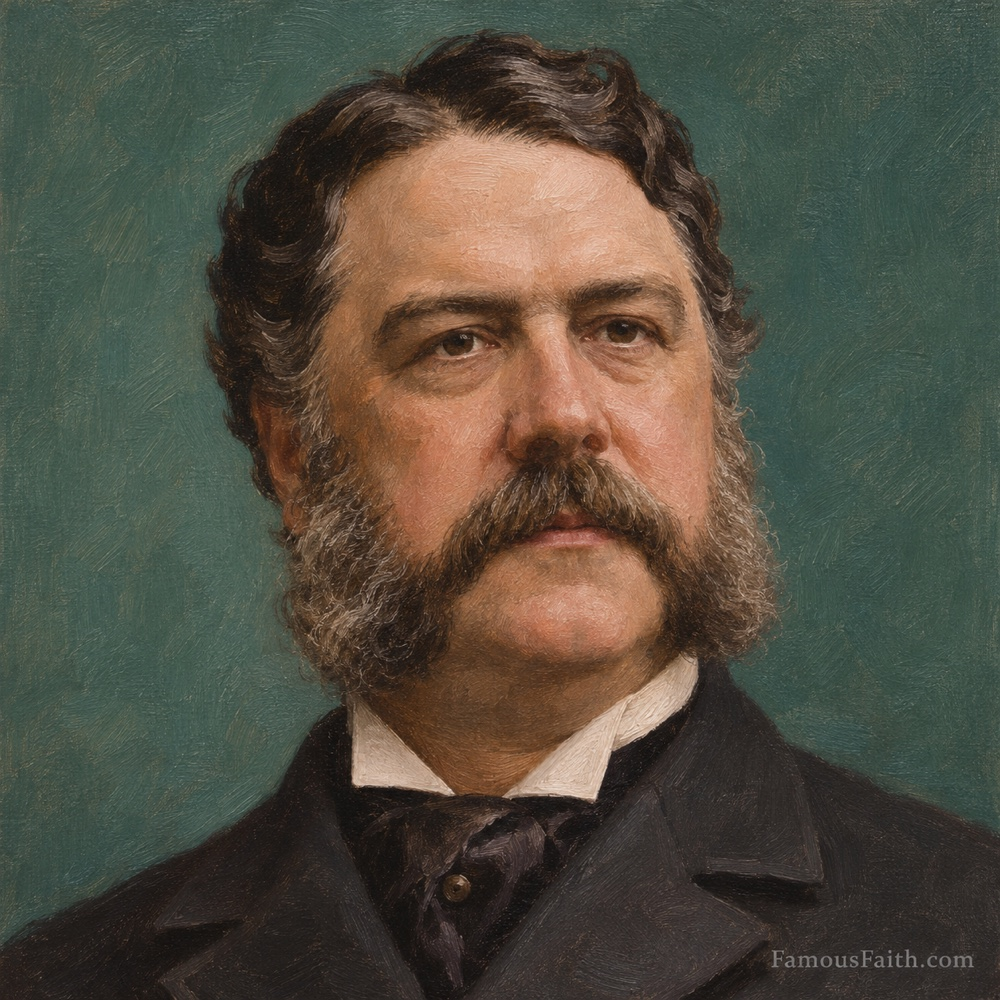
Portrait credit: Original AI-generated painted editorial illustration created for Famous Faith, with a subtle FamousFaith.com watermark. This is an artistic interpretation, not a historical photograph or an authenticated period painting.
Editorial approach: Documented actions and public statements are distinguished from Famous Faith’s biblical assessments. Public profession and church affiliation do not establish the condition of a person’s heart.