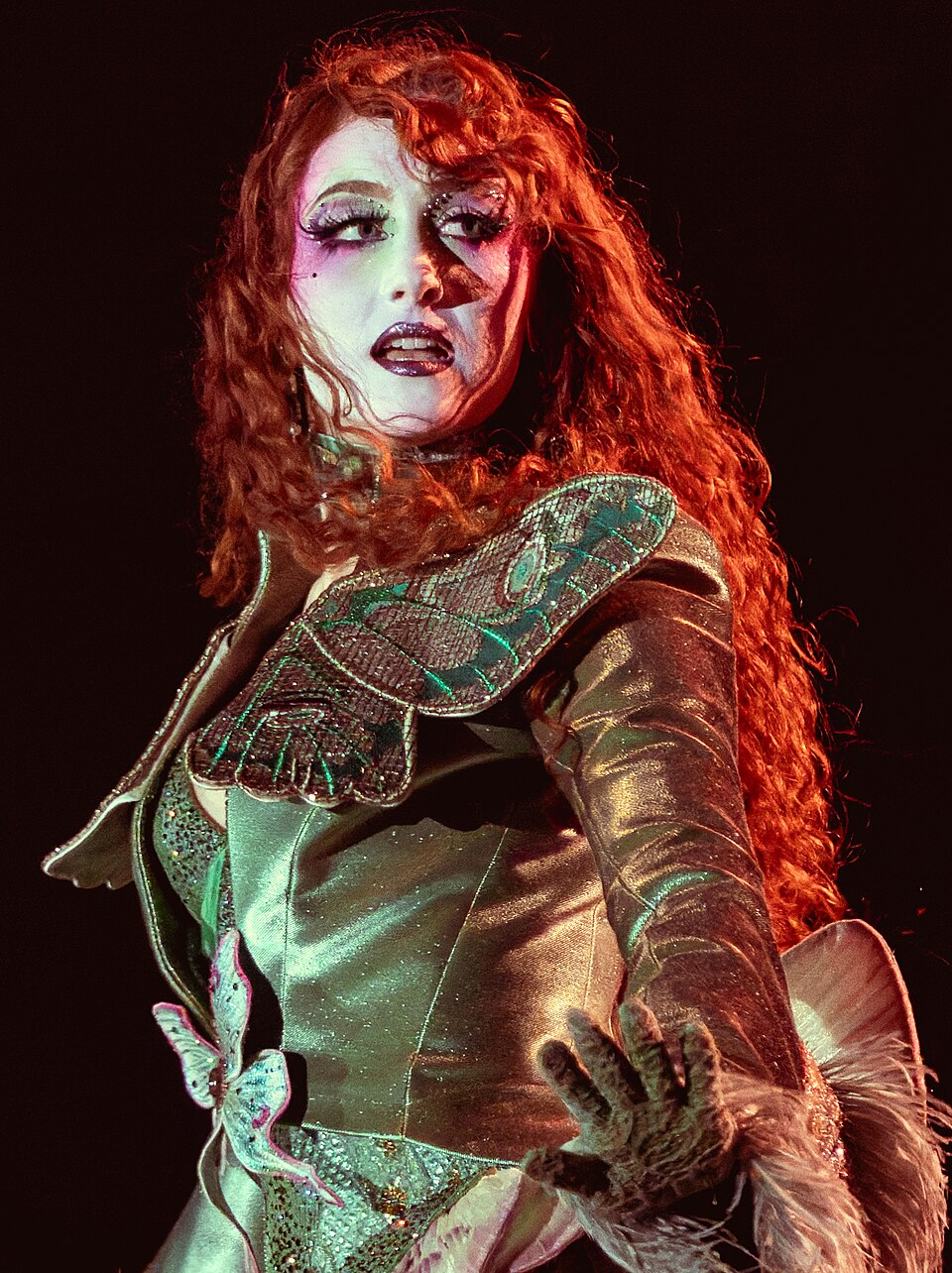
Chappell Roan became a major pop star with bold costumes, theatrical performances, and songs about identity and relationships. Her childhood was very different from her stage image. She grew up in a conservative Christian home in Missouri.
Roan has spoken openly about that background. She has also made clear that she does not currently identify with the Christian church. Her story includes both appreciation for Christian community and pain connected to restrictions she felt growing up.
Was Chappell Roan raised Christian?
Yes. Roan, whose birth name is Kayleigh Rose Amstutz, grew up in a strict Christian household. Profiles describe church as a major part of family life. She attended services several times a week, went to Bible camp, and listened to Christian music.
In interviews, Roan described feeling limited by expectations around her, especially as she began understanding her sexuality and artistic identity. She told the Associated Press that the pendulum of her public style swung far in the other direction because she had once felt restricted.
Does Chappell Roan still identify as Christian?
In a Vanity Fair interview, Roan said she did not identify with the Christian church at that time. She also said she was glad to have known that community because it helped her understand the people in it.
She did not say she had never encountered Christianity. She described a close religious upbringing followed by distance from the church. Other interviews suggest her relationship with religion is still developing.
We should describe that journey without mocking her or minimizing pain she experienced. Christians can disagree with her beliefs and choices while treating her as a person made in God’s image.
Why do people leave churches?
People leave churches for many reasons. Some reject Christian teaching. Some have unanswered questions. Others have been hurt by hypocrisy, cruelty, control, or abuse. A church can teach true words in an unloving way, and that failure can leave deep wounds.
Christians should listen when someone describes harm. Jesus strongly confronted religious hypocrisy. At the same time, the failures of Christians do not decide whether Jesus is true. Christ should be examined by His own words, character, death, and resurrection.
So, what is Chappell Roan’s religion?
The best public evidence says that Roan was raised in a conservative Christian environment but does not currently identify with the Christian church. It would not be accurate to present her as a professing Christian.
Her beliefs may continue to change. Only God knows her thoughts and the full story of her experiences. Our goal is not to declare the final condition of her soul. It is to report her words fairly and explain the hope Christians find in Jesus.
What is the gospel?
The gospel begins with a hard truth: every person has sinned and fallen short of God’s glory (Romans 3:23). That includes church leaders, parents, artists, writers, and everyone reading. Christians do not stand above others as if they earned God’s love.
God’s answer to sin is Jesus Christ. Jesus welcomed outsiders, confronted proud religious leaders, died for sinners, and rose from the dead. Salvation is by grace through faith, not by religious performance (Ephesians 2:8–9).
John 3:16 says whoever believes in Christ will have eternal life. Romans 10:9 says those who confess Jesus as Lord and believe God raised Him from the dead will be saved. Repentance means turning from sin and toward God. Faith means resting our hope in what Jesus has done.
Someone wounded by a church may find that message difficult to hear. Christians should share it patiently and live it honestly. The sins of people who use Christ’s name are real, but Jesus Himself remains full of truth and grace.
We can pray for Chappell Roan without treating her as a project or pretending we know her heart. We can also ask whether our own lives make the gospel clearer or harder for others to see.
Sources
Image credit: Raph_PH, via Wikimedia Commons, licensed under CC BY 4.0. Image cropped.
.jpg)