Famous Faith · U.S. Presidents
Calvin Coolidge
Restraint, religious conviction, and the exclusions beneath prosperity.
Calvin Coolidge became associated with fiscal restraint and the prosperity of the 1920s. His Congregational background and language of service deserve attention alongside immigration restrictions and the unequal reach of citizenship and opportunity during his presidency.
PRESIDENT 30
The essentials
Calvin Coolidge at a glance
- Born
- July 4, 1872
- Died
- January 5, 1933
- Presidency
- August 2, 1923 – March 4, 1929
- Political party
- Republican
- Church background
- Congregationalist
- Spouse
- October 4, 1905, to Grace Anna Goodhue (1879–1957)
- Children
- Two sons: John and Calvin Jr.; Calvin Jr. died in 1924
- Other work
- Lawyer
- Presidential number
- 30
Basic biographical details: [1]. Family and religious qualifications are explained below.
The person behind the office
Life and family
Coolidge studied at Amherst College, practiced law, and advanced through local and state politics in Massachusetts. His handling of the Boston police strike brought national attention while he was governor. He became Warren Harding’s vice president and succeeded him when Harding died in August 1923. His reserved style contrasted with the scandal and uncertainty associated with the previous administration. [2] He won the 1924 election and supported a government that spent less, reduced taxes, and generally favored business development. Prosperity during much of his term reinforced his public reputation. A historical assessment must also consider the uneven distribution of its benefits and the vulnerabilities visible before the crash that occurred after he left office. He chose not to seek another elected term in 1928. [3]
Spouse and children
Coolidge married Grace Anna Goodhue in 1905. Their sons were John and Calvin Jr. Grace’s sociability complemented his restrained manner, while the death of Calvin Jr. in 1924 was a profound personal loss during the presidency. Famous Faith does not use that grief to speculate about a specific divine purpose or to reduce the remainder of his public life to a single emotional explanation. The family’s experience deserves compassion and historical care. [4] [1]
A public record
Major political accomplishments and decisions
- 01
Pursued tax reduction and spending restraint
Coolidge supported revenue legislation and a restrained federal budget under Treasury Secretary Andrew Mellon. These choices reflected a definite view of government’s economic role. Their effect must be assessed in relation to different households and industries, rather than assuming that national growth benefited everyone in the same way. [5]
- 02
Signed the Indian Citizenship Act
The 1924 act declared citizenship for Native Americans born within the territorial United States who were not already citizens. It did not immediately remove every state-level barrier to voting or settle the broader questions of tribal sovereignty and federal treatment of Native communities. [6]
- 03
Supported international financial and peace agreements
His administration participated in efforts to stabilize European finances and supported the Kellogg-Briand Pact renouncing war as an instrument of policy. The pact expressed an aspiration without providing sufficient enforcement to prevent later aggression. Diplomatic intention and lasting effectiveness are different judgments. [7]
Public evidence and its limits
Faith and documented statements
Coolidge’s church background was Congregationalist. His public moral language emphasized duty, responsibility, and the limits of merely material success. A religious affiliation still does not supply complete knowledge of his private spiritual life, and Famous Faith does not turn it into an assurance about salvation. [1] In his 1925 inaugural address, he related the exercise of political power to moral obligations and to an authority beyond government itself. That public framework deserves to be read in the document’s full context rather than reduced to an isolated inspirational quotation. [8] Christians should also test the reach of such moral language: a call to character or service becomes inadequate when it overlooks the dignity of people excluded by law or by social practice.
Famous Faith’s biblical perspective
Public virtues and serious concerns
The historical actions are sourced. Their evaluation through Scripture expresses Famous Faith’s Christian editorial perspective; it is not a claim to know anyone’s eternal destiny.
Stewardship requires honesty about limits
Coolidge’s concern for public expenditure can be evaluated within a biblical understanding of stewardship. Government resources are not a private fund for officials or their allies. Famous Faith also insists that a low-spending policy is not automatically a complete Christian social ethic. The treatment of workers, families in distress, and excluded communities remains part of the moral account.
National-origins restrictions entrenched discrimination
Coolidge signed the Immigration Act of 1924, which imposed restrictive national-origins quotas and discriminatory exclusions. [9] Famous Faith rejects treating ethnicity or ancestry as a measure of human worth. Governments may debate immigration rules, but those rules should not turn particular peoples into an inferior category. The act’s exclusions stand beside citizenship legislation in a presidency whose promises and protections reached different groups very unequally.
Beyond the familiar name
Interesting facts and useful distinctions
The oath after a nighttime succession
Coolidge’s father administered an oath after news of Harding’s death reached the family in Vermont. His constitutional succession began with Harding’s death on August 2, while the familiar ceremony occurred in the early hours of August 3. [3]
A birthday shared with Independence Day
Coolidge was born on July 4, 1872. The date is a straightforward biographical fact, not evidence that his political ideas carried a special divine or national endorsement. [1]
A life in perspective
What this legacy asks of us
Coolidge’s restraint and seriousness deserve examination without nostalgia that excludes the people left outside the era’s prosperity. A Christian account can recognize stewardship and citizenship measures while criticizing discriminatory restrictions. Economic confidence and a sober public style do not establish that a government has fulfilled the full demands of justice.
Our hope rests in Jesus Christ, not a president, party, lodge, or record of public service. Scripture teaches that all have sinned, that Christ died for sins and rose again, and that salvation is God’s gift through faith rather than an achievement we earn (Romans 3:23; 1 Corinthians 15:3–4; Ephesians 2:8–9). His call is to repentance and trust in him.
Sources and image credit
- Miller Center: Overview
- Miller Center: Life Before The Presidency
- Miller Center: Life In Brief
- Miller Center: Family Life
- Miller Center: Domestic Affairs
- National Archives: Indian Citizenship Act of 1924
- Miller Center: Foreign Affairs
- Presidential statement: original transcript
- U.S. House History: The Immigration Act of 1924
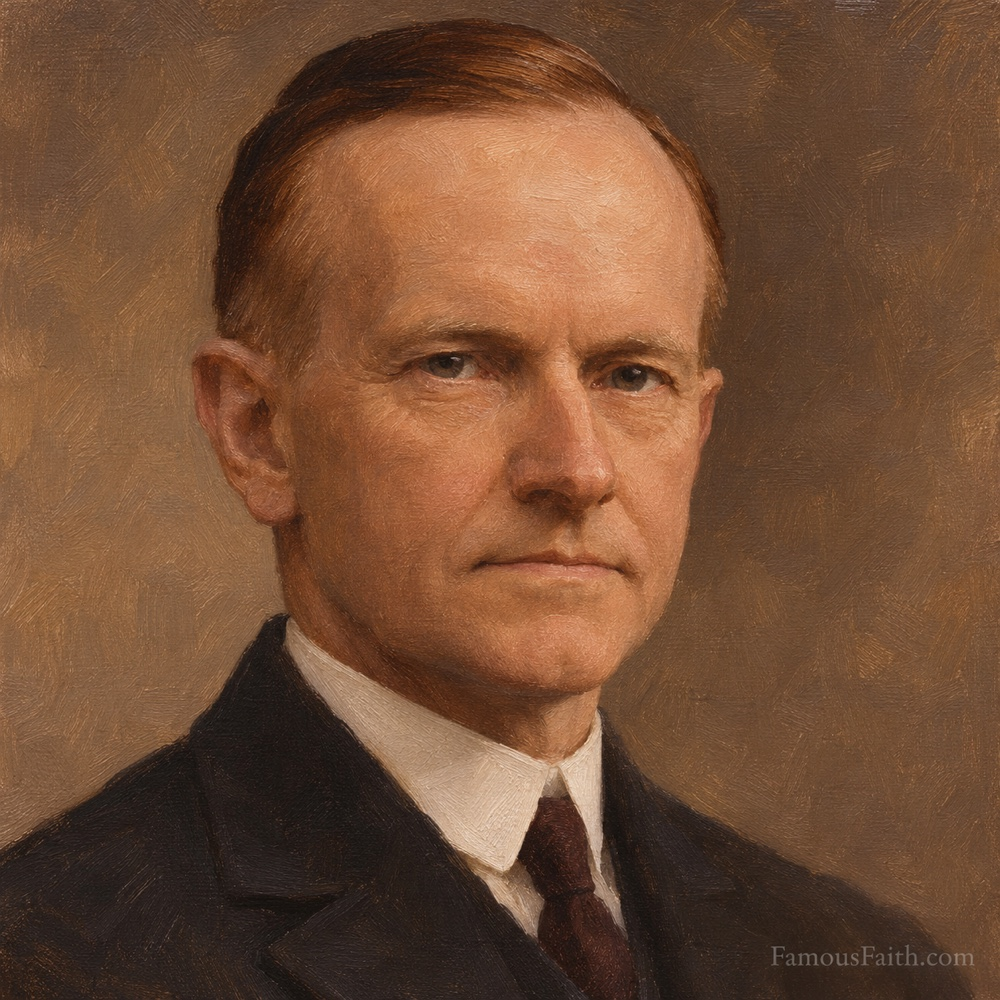
Portrait credit: Original AI-generated painted editorial illustration created for Famous Faith, with a subtle FamousFaith.com watermark. This is an artistic interpretation, not a historical photograph or an authenticated period painting.
Editorial approach: Documented actions and public statements are distinguished from Famous Faith’s biblical assessments. Public profession and church affiliation do not establish the condition of a person’s heart.