Famous Faith · U.S. Presidents
Andrew Johnson
Reconstruction, racial injustice, and the failure of presidential leadership.
Andrew Johnson rose from poverty to the presidency after Lincoln’s assassination. His loyalty to the Union during the Civil War did not translate into a commitment to equal citizenship for formerly enslaved people, and his presidency became a major obstacle to a just Reconstruction.
PRESIDENT 17
The essentials
Andrew Johnson at a glance
- Born
- December 29, 1808
- Died
- July 31, 1875
- Presidency
- April 15, 1865 – March 4, 1869
- Political party
- Democrat / Unionist; elected vice president on the National Union ticket
- Church background
- No formal affiliation
- Spouse
- May 17, 1827, to Eliza McCardle (1810–1876)
- Children
- Five: Martha, Charles, Mary, Robert, and Andrew
- Other work
- Tailor; Public Official
- Presidential number
- 17
- Freemasonry
- Documented member
Basic biographical details: [1]. Family and religious qualifications are explained below.
The person behind the office
Life and family
Johnson worked as a tailor and built his early political career in Tennessee. His limited schooling and origins outside the planter elite became central to his public identity. He served as a local official, state legislator, congressman, governor, and senator. His rise demonstrated substantial political ability, even as his racial views and attachment to the social order imposed severe limits on the freedom he was willing to support. [2] When Tennessee seceded, Johnson remained loyal to the United States. Lincoln later appointed him military governor of Tennessee, and the National Union coalition selected him as vice-presidential candidate in 1864. After Lincoln’s assassination in April 1865, Johnson inherited the responsibility for rebuilding the Union and defining the practical meaning of emancipation. His conflicts with Congress became the dominant feature of his presidency. [3]
Spouse and children
Johnson married Eliza McCardle in 1827. They had five children: Martha, Charles, Mary, Robert, and Andrew. Eliza’s poor health limited her public appearances during his presidency. Their daughters helped perform White House hostess duties, and grandchildren were part of a busy presidential household. Eliza also supported Johnson’s education and private life, although the familiar claim that she simply taught an entirely illiterate husband to read compresses a more complicated history. [4] [2]
A public record
Major political accomplishments and decisions
- 01
Maintained Union loyalty during secession
Johnson’s refusal to follow Tennessee into the Confederacy was a consequential choice. His wartime role as military governor helped make him attractive to a coalition seeking to display national unity. That record should be recognized without assuming that Union loyalty implied a commitment to racial equality. [3]
- 02
Pursued a lenient presidential Reconstruction
Johnson offered broad pardons and supported the rapid restoration of southern state governments. The approach returned power to many former Confederate elites while leaving freed people exposed to coercion and discriminatory Black Codes. Its consequences help explain Congress’s determination to impose a different Reconstruction program. [5]
- 03
Survived impeachment
The House impeached Johnson in 1868 after a prolonged struggle over authority and Reconstruction, with the removal of Secretary of War Edwin Stanton at its center. The Senate did not reach the required two-thirds vote to convict. Acquittal did not resolve the moral failures at issue in his racial policies. [6]
- 04
Acquired Alaska through diplomacy
Secretary of State William Seward negotiated the 1867 purchase of Alaska from Russia during Johnson’s presidency. The transaction was a major territorial development achieved through a treaty and congressional funding, although its consequences for Alaska Native peoples belong in the history as well as its strategic importance. [7]
Public evidence and its limits
Faith and documented statements
The Miller Center records no formal religious affiliation for Johnson. Accounts describe occasional attendance with his wife and interest in different churches, but these details do not establish a complete personal confession of Christian doctrine. Famous Faith will not create a conversion story where the evidence used here does not provide one. [1] [4] His 1865 pardon proclamation prescribed an oath invoking Almighty God for those seeking its benefits. That is evidence of religious language in government, not necessarily a personal account of Johnson’s faith. [8] The distinction matters: a public document can use sacred language while its practical effect favors people who previously held power over others. Christian assessment must examine the justice of the policy as well as the solemnity of the words.
Famous Faith’s biblical perspective
Public virtues and serious concerns
The historical actions are sourced. Their evaluation through Scripture expresses Famous Faith’s Christian editorial perspective; it is not a claim to know anyone’s eternal destiny.
Unionism was a meaningful but limited virtue
Remaining loyal when a state seceded required a consequential break with powerful neighbors. Famous Faith can acknowledge that courage without extending it into a general endorsement. A person can act well in one crisis and fail gravely in another. Political biographies should leave room for that combination rather than forcing an entire life into either heroism or villainy.
He obstructed protection for freed people
Johnson vetoed civil-rights and Freedmen’s Bureau legislation and resisted congressional efforts to secure the rights of Black Americans. [5] Famous Faith regards this obstruction as a serious moral failure. Emancipation without meaningful protection left people exposed to violence, exploitation, and exclusion. The biblical requirement of impartial justice does not permit a government to restore the comfort of former rulers while dismissing the safety of those they had enslaved.
Beyond the familiar name
Interesting facts and useful distinctions
A Democrat on Lincoln’s ticket
The National Union ticket of 1864 was a wartime coalition. Johnson’s place beside Lincoln should not be used to label his entire career Republican or to erase his Democratic political identity. [3]
He returned to the Senate
Johnson was elected to the Senate again after his presidency and returned briefly in 1875 before his death. His public career therefore extended beyond the impeachment trial most closely associated with his name. [6]
A life in perspective
What this legacy asks of us
Johnson’s presidency shows that preserving a national government and establishing justice within it are related but distinct tasks. He supported the Union while obstructing the protection of millions newly freed from slavery. A Christian reading of Reconstruction must center their dignity and safety rather than treating reconciliation among powerful white politicians as the whole story.
Our hope rests in Jesus Christ, not a president, party, lodge, or record of public service. Scripture teaches that all have sinned, that Christ died for sins and rose again, and that salvation is God’s gift through faith rather than an achievement we earn (Romans 3:23; 1 Corinthians 15:3–4; Ephesians 2:8–9). His call is to repentance and trust in him.
Sources and image credit
- Miller Center: Overview
- Miller Center: Life Before The Presidency
- Miller Center: Life In Brief
- Miller Center: Family Life
- Miller Center: Domestic Affairs
- Miller Center: Impact And Legacy
- Miller Center: Foreign Affairs
- Presidential statement: original transcript
- First Kings Masonic District: Masonic Presidents
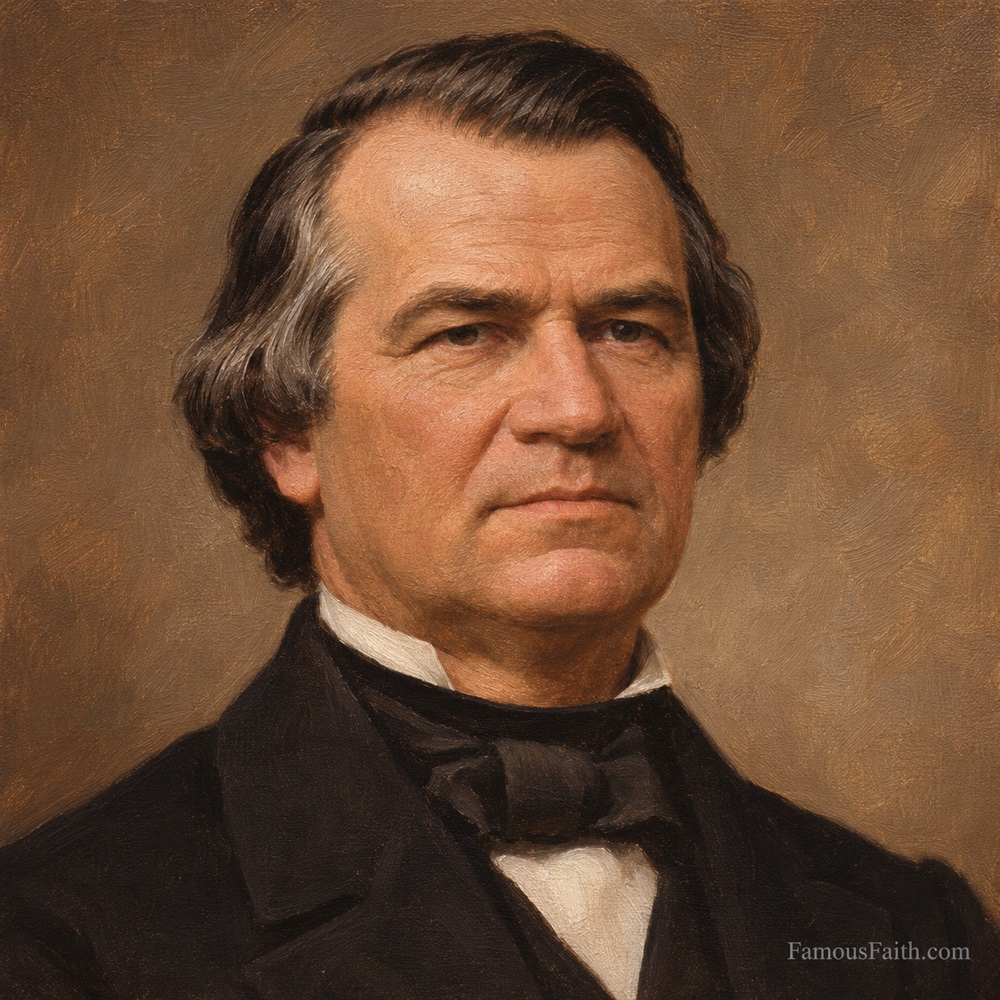
Portrait credit: Original AI-generated painted editorial illustration created for Famous Faith, with a subtle FamousFaith.com watermark. This is an artistic interpretation, not a historical photograph or an authenticated period painting.
Editorial approach: Documented actions and public statements are distinguished from Famous Faith’s biblical assessments. Public profession and church affiliation do not establish the condition of a person’s heart.