Famous Faith · U.S. Presidents
Andrew Jackson
Popular power, personal faith, and the injustice of removal.
Andrew Jackson reshaped the presidency and the Democratic Party. His military fame and appeal to white voters stood beside enslavement, violent conflict, and removal policies whose consequences demand an especially serious Christian moral assessment.
PRESIDENT 7
The essentials
Andrew Jackson at a glance
- Born
- March 15, 1767
- Died
- June 8, 1845
- Presidency
- March 4, 1829 – March 4, 1837
- Political party
- Democrat
- Church background
- Presbyterian; joined the Hermitage church after his presidency
- Spouse
- August 1791 (2nd ceremony, January 17, 1794), to Rachel Donelson Robards (1767–1828)
- Children
- No biological children; adoptive father and guardian, including Andrew Jackson Jr. and Lyncoya
- Other work
- Lawyer, Soldier
- Presidential number
- 7
- Freemasonry
- Documented member and former grand master
Basic biographical details: [1]. Family and religious qualifications are explained below.
The person behind the office
Life and family
Jackson grew up amid the violence of the Revolutionary era and lost his immediate family while young. He studied law, moved to Tennessee, and served as a lawyer, judge, congressman, senator, and military commander. His victory over British forces at New Orleans made him a national figure. His campaigns against Native peoples were another central part of that military career and should not disappear behind the heroic nickname Old Hickory. [2] Jackson won the presidency in 1828 after losing the contested election of 1824. His supporters helped build the Democratic Party as a powerful national organization. His appeal to ordinary voters operated within a political system that still excluded women, most Black Americans, and many Native people. Popular democracy for one constituency was not universal political equality. [3]
Spouse and children
Jackson married Rachel Donelson Robards amid uncertainty about the legal completion of her earlier divorce; they married again in 1794. Rachel died after his 1828 election and before he entered the White House. They had no biological children. The household included their adopted son Andrew Jackson Jr., the Native child Lyncoya, and relatives for whom Jackson acted as guardian or supporter. These relationships do not erase the violence and coercion in his wider dealings with Native communities. [4]
A public record
Major political accomplishments and decisions
- 01
Expanded the political reach of the presidency
Jackson presented himself as a direct representative of the electorate and used the veto assertively. His administration and party organization helped define a more forceful model of presidential leadership. The same developments raised enduring questions about patronage, personal loyalty, and limits on executive power. [5]
- 02
Confronted the nullification crisis
When South Carolina claimed authority to nullify federal tariffs, Jackson rejected the claim and defended the Union. Congressional action combined the threat of enforcement with a tariff compromise. The episode is distinct from Jackson’s support for states’ interests in other controversies. [3]
- 03
Defeated renewal of the Second Bank’s charter
Jackson vetoed the bank’s recharter and moved federal deposits away from it. Supporters saw resistance to concentrated privilege; opponents saw dangerous executive action and financial disruption. The Bank War was consequential even though its consequences cannot be reduced to a simple victory for economic fairness. [5]
Public evidence and its limits
Faith and documented statements
Jackson’s Presbyterian affiliation must be dated carefully. The Hermitage records that he became a member of its church in 1838, after leaving the presidency, fulfilling a promise connected with Rachel. A later church membership should not be projected backward as proof that every presidential decision expressed Christian obedience. [6] His public life also included language of Providence and moral responsibility, but this profile does not invent a detailed conversion account from general religious expressions. Famous Faith can acknowledge a reported profession and still scrutinize the actions of a public official. Christian faith calls people to repentance; it is not a way to shield a leader’s record from examination. Biblical evaluation must take both public words and the treatment of neighbors seriously.
Famous Faith’s biblical perspective
Public virtues and serious concerns
The historical actions are sourced. Their evaluation through Scripture expresses Famous Faith’s Christian editorial perspective; it is not a claim to know anyone’s eternal destiny.
Strength in office needs moral limits
Presidential resolve can protect constitutional order, as the nullification controversy illustrates. Yet resolve is not automatically righteousness. Scripture warns against rulers who treat power as personal possession. Famous Faith measures political strength by truthfulness, restraint, and justice for vulnerable people, rather than by the ability to defeat opponents or reward loyal supporters.
Indian removal and slavery were grave wrongs
Jackson promoted and signed the Indian Removal Act and used federal power to advance removal. The Cherokee Trail of Tears occurred under his successor, Martin Van Buren, but grew from a policy Jackson championed. Jackson also enslaved people. [5] [2] Famous Faith regards forced dispossession and human bondage as profound violations of neighbor-love and human dignity. The inclusion of a Native child in his own household does not excuse policies that harmed Native nations.
Beyond the familiar name
Interesting facts and useful distinctions
The removal timeline matters
Jackson’s law and policies helped prepare the ground for removal; the best-known Cherokee forced march took place in 1838–1839 under Van Buren. Accurate dates strengthen the moral account rather than weakening it. [3]
A widower in the White House
Rachel never served as first lady because she died before his inauguration. Other relatives, including Emily Donelson, helped perform the household’s public duties. [4]
A life in perspective
What this legacy asks of us
Jackson’s popularity and military reputation cannot carry the weight of a Christian verdict on his life. His record asks whether a political movement’s celebration of its own people can become indifference toward everyone outside it. The gospel calls for truth, repentance, and a love of neighbor that is broader than party loyalty.
Our hope rests in Jesus Christ, not a president, party, lodge, or record of public service. Scripture teaches that all have sinned, that Christ died for sins and rose again, and that salvation is God’s gift through faith rather than an achievement we earn (Romans 3:23; 1 Corinthians 15:3–4; Ephesians 2:8–9). His call is to repentance and trust in him.
Sources and image credit
- Miller Center: Overview
- Miller Center: Life Before The Presidency
- Miller Center: Life In Brief
- Miller Center: Family Life
- Miller Center: Domestic Affairs
- Andrew Jackson’s Hermitage: Hermitage Church
- First Kings Masonic District: Masonic Presidents
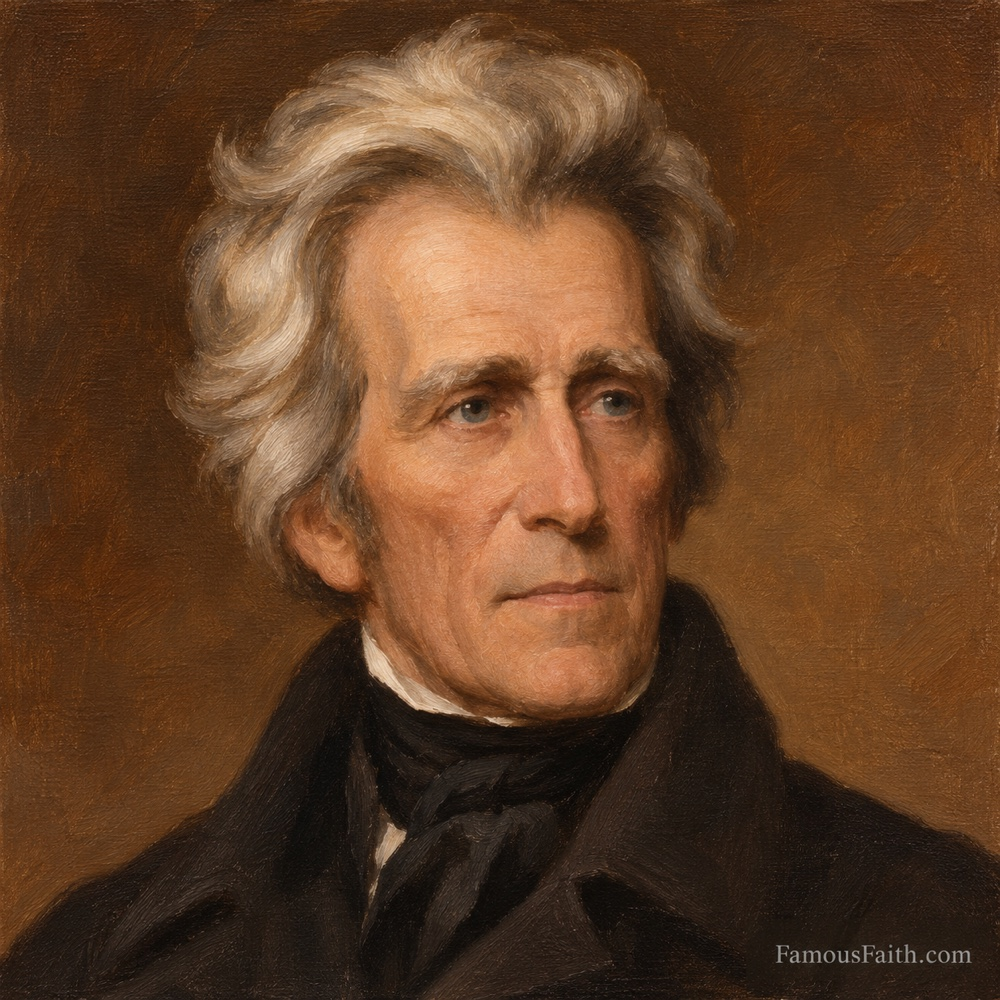
Portrait credit: Original AI-generated painted editorial illustration created for Famous Faith, with a subtle FamousFaith.com watermark. This is an artistic interpretation, not a historical photograph or an authenticated period painting.
Editorial approach: Documented actions and public statements are distinguished from Famous Faith’s biblical assessments. Public profession and church affiliation do not establish the condition of a person’s heart.