The profile · Actor
Carrie Coon
Carrie Coon’s interest in language reaches beyond learning lines. Family experiences led her toward Spanish, literature, and questions about whose voices get heard. Theater and screen work gave that curiosity another form.
- Stage home
- Steppenwolf ensemble member since 2019[1]
- Early Broadway recognition
- Tony nomination for Who’s Afraid of Virginia Woolf?[1]
- Studies
- English and Spanish literature[2]
- Known television roles
- Nora Durst; Gloria Burgle; Bertha Russell[1][3]
The person behind the work
An interest in the world beyond home
Carrie Coon has described how her adopted sister’s arrival from El Salvador opened a door to Spanish and another part of the world. In a 2020 Golden Globes interview, she recalled the family learning simple phrases and her own later interest in the language. She went on to study English and Spanish literature and wrote about Latin American poets.[2]
The connection between language and acting is easy to hear in her work. A character’s words can reveal education, ambition, caution, or a need to be understood. Coon’s performances often make those differences feel precise without turning them into a display of technique. A controlled sentence can carry as much force as a raised voice.
Theater remains a major part of the story. She joined Steppenwolf’s ensemble in 2019 after appearing in several of its productions. Her performance in Who’s Afraid of Virginia Woolf? traveled to Broadway and brought a Tony nomination. Later television recognition did not replace that stage background; it added another place to use it.[1]
A career in range
Selected work, at a glance
2012–2013 Broadway production
Who’s Afraid of Virginia Woolf?
Honey
A stage performance that brought a Tony nomination.[1]
2014–2017
The Leftovers
Nora Durst
Grief and uncertainty give the performance unusual emotional weight.[3]
2022 onward
The Gilded Age
Bertha Russell
Social ambition, family, and power meet in a carefully managed public world.[3]
A performance worth listening to
Different kinds of authority
The Leftovers, Fargo, and The Gilded Age place Coon in sharply different worlds. In one she is Nora Durst, living with extraordinary loss. In another she is police officer Gloria Burgle. As Bertha Russell, she moves through a social world where status can be a form of power. Her career makes a good case for looking past a performer’s most recent role.[3]
In Bedford & New Canaan Magazine, Coon remembered growing up on a family farm near Akron and finding an early interest in theater. She eventually played the lead in a school production of Our Town. That smaller beginning is a useful companion to her later roles: an interest became a skill through chances to perform.[4]
A practical way to explore her work is to listen for the distance between a character’s words and their needs. Does the polished sentence protect a fear? Does a blunt answer hide an injury? These questions can make a familiar scene feel new without requiring any specialist knowledge of acting.
A closer look
Three ways into the work
Begin with Nora’s silences
The Leftovers gives Coon room to hold more than one feeling at a time. Notice when the performance refuses an easy emotional answer. The series has strong language, sexual content, violence, and disturbing themes.
Listen to the pressure in The Nest
Ordinary household conversations can become contests over what is true. Watch how a partner responds when a confident story no longer matches the life around it. The film contains mature material.
Watch Bertha work a room
The Gilded Age uses manners and conversation as tools of influence. Bertha’s authority is not only in what she says, but in the timing and certainty with which she says it. That makes a useful contrast with Nora’s grief.
Influence and outlook
Catholic roots and concern for people in this life
Coon has spoken about a Catholic upbringing. In the Golden Globes conversation, she connected her interest in Latin American writing with Archbishop Óscar Romero and the idea that the church should help oppressed people in their present lives. That is a more specific detail than a simple religious label: it tells readers what caught her attention.[2]
A later interview with Bedford & New Canaan Magazine also returned to morality in her childhood. These comments describe influences she has chosen to discuss. They leave space for the difference between an upbringing, an interest in theology, and a person’s full beliefs now.[4]
Listen to the person
In their own words
December 2020
“acting is very much rooted in language”
Famous Faith’s Christian perspective
Beyond the Spotlight
Coon’s interest in language and care for oppressed people raises questions that belong together: whose voice is heard, and what do we owe one another? The Bible calls love of neighbor part of a faithful life. It also brings justice closer than the failures of distant institutions, asking us to face our own choices.
The Ten Commandments forbid lying, stealing, adultery, and coveting, while calling us to honor God (Exodus 20). Sin is breaking his law (1 John 3:4). The wrong may be public or quiet; our need for forgiveness is shared. Jesus warned about judgment and hell. That should deepen concern for people, not become a reason to dismiss their present suffering.
The gospel joins that seriousness with God’s love. Jesus Christ, his sinless Son, died on the cross for sinners and rose bodily from the dead. Through faith in him, God offers forgiveness and peace by grace. Neither religious effort nor service to others can buy that gift (Romans 5:8; Ephesians 2:8–10).
Repentance turns our mind and heart from sin and rebellion toward God. We learn to trust who he is and the love he has made known to us through Jesus Christ. It normally changes our conduct as we learn to tell the truth, seek justice, and treat people with mercy. These are fruits of grace, not a way to earn salvation. A reader can come honestly to Jesus, trust him, and begin to love others from the security of being forgiven.
This section shares Famous Faith’s Christian beliefs. It does not speak for Carrie Coon.
People connected to the story
Follow the connections

Elizabeth Olsen
They play sisters in His Three Daughters, alongside Natasha Lyonne. The film offers a close view of three actors sharing a family story.[5]
Read the profile →
Jeremy Renner
Coon’s Proxima Midnight and Renner’s Hawkeye belong to the Avengers film ensemble. Their other work leads in very different directions.
Read the profile →
Kevin Feige
Her Infinity War credit connects with Feige’s producing work. Her own profile centers on language, theater, and the wider career.[1]
Read the profile →Watch in context
A conversation about The Nest
Published by SAG-AFTRA Foundation. Watch on YouTube ↗
Sources and further reading
- Steppenwolf Theatre — Carrie Coon biography
- Golden Globes — Carrie Coon on language and her background (2020; archived)
- Carrie Coon — Screen roles and filmography
- Bedford & New Canaan Magazine — Carrie Coon interview
- Netflix Tudum — His Three Daughters
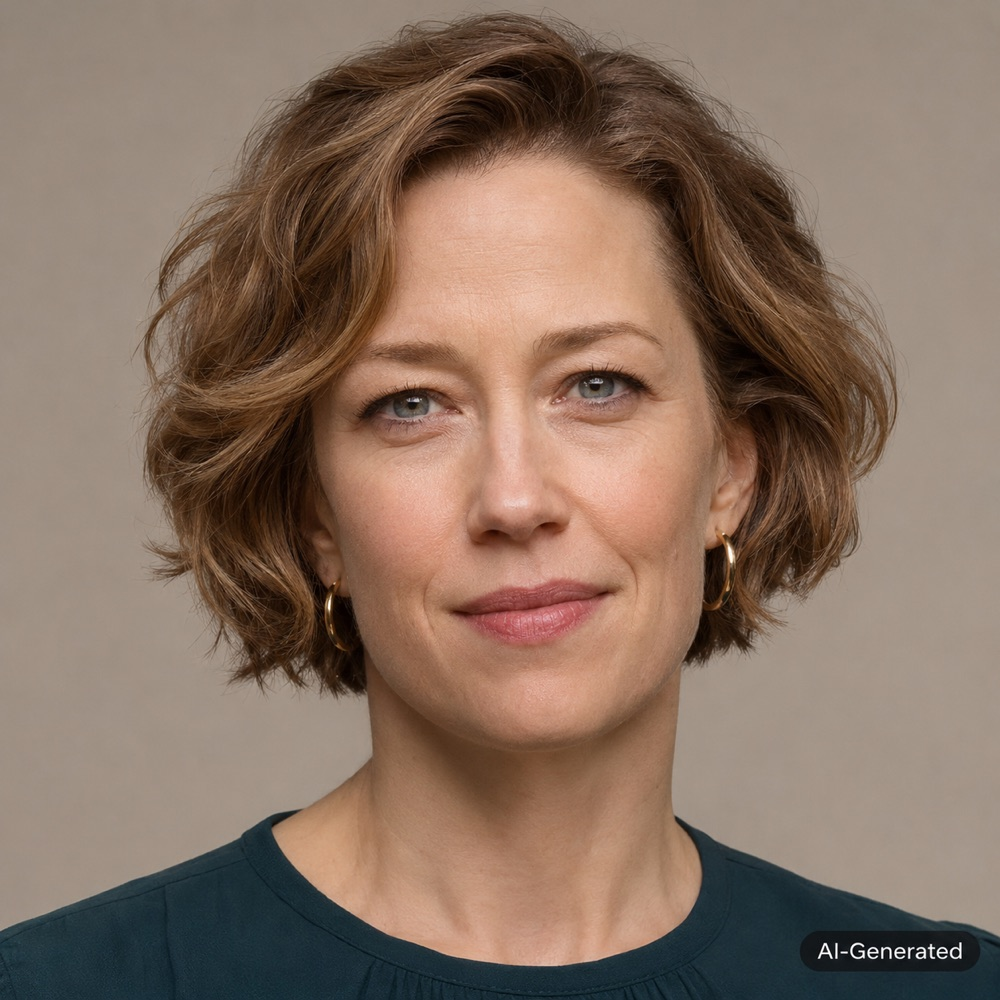
Artwork: Original AI-generated portrait of Carrie Coon, created for Famous Faith; not a photograph. The other AI-generated portraits shown here were also created for Famous Faith. No endorsement is implied.
Film and book titles identify the works discussed. A career credit is not a recommendation that every reader watch or read that work.