Famous Faith · U.S. Presidents
George H. W. Bush
Public service, a changing world, and an Episcopal president’s language of humility.
George H. W. Bush brought extensive government experience to the presidency during the end of the Cold War. His record includes disability-rights legislation, international coalition building, military intervention, and a public appeal to service. Famous Faith considers both accomplishments and the moral responsibilities of power.
PRESIDENT 41
The essentials
George H. W. Bush at a glance
- Born
- June 12, 1924
- Died
- November 30, 2018
- Presidency
- January 20, 1989 – January 20, 1993
- Political party
- Republican
- Church background
- Episcopalian
- Spouse
- January 6, 1945, to Barbara Pierce (1925-2018)
- Children
- Six: George W., Robin, Jeb, Neil, Marvin, and Dorothy
- Other work
- Businessman, public official
- Presidential number
- 41
Basic biographical details: [1]. Family and religious qualifications are explained below.
The person behind the office
Life and family
Bush served as a naval aviator during World War II before attending Yale and entering the oil business. He moved into Republican politics and held an unusually broad set of national and international positions: congressman, ambassador to the United Nations, head of the American liaison office in China, director of the Central Intelligence Agency, and vice president under Ronald Reagan. [2] He won the presidency in 1988 and served from 1989 to 1993. His administration confronted the collapse of Soviet power and major changes in Europe, along with recession and intense domestic political pressure. Bill Clinton defeated him in 1992. His career illustrates both the advantages of experience and the fact that familiarity with government does not settle every question about wise leadership. [3]
Spouse and children
Bush married Barbara Pierce in January 1945 while on leave from wartime naval service. They had six children: George W., Pauline Robinson, known as Robin, John Ellis, known as Jeb, Neil, Marvin, and Dorothy. Robin died of leukemia as a young child, a loss that remained important in the family’s life. [4] Two sons later held major executive offices: George W. became president and Jeb became governor of Florida. Family relationships and political achievement belong in the biography without turning public office into a measure of a family’s spiritual worth. [1] [4]
A public record
Major political accomplishments and decisions
- 01
Signed the Americans with Disabilities Act
Bush signed the ADA in 1990, a landmark law addressing discrimination against people with disabilities. He also signed the Clean Air Act Amendments of 1990. Both involved work with Congress and illustrate how substantial domestic legislation can emerge across party lines. [5]
- 02
Navigated the end of the Cold War
His administration worked through the collapse of communist governments in Eastern Europe, German reunification, and the dissolution of the Soviet Union. Bush’s cautious diplomacy was an important part of the American response, although the people and governments involved had agency of their own. [6]
- 03
Led a coalition in the Gulf War
After Iraq invaded Kuwait, Bush helped assemble an international coalition that expelled Iraqi forces in 1991. His presidency also included the 1989 invasion of Panama. Military outcomes require consideration of civilian consequences and the purposes and limits of force, as well as strategic objectives. [6]
Public evidence and its limits
Faith and documented statements
Bush’s church affiliation was Episcopalian. [1] His 1989 inaugural address began with a prayer asking God for guidance and for the capacity to use power in service of people. He presented service, generosity, and a purpose larger than the self as qualities the country needed. [7] These are documented expressions of religious belief, not merely later impressions about his personality. Famous Faith recognizes the value of humility and care for neighbors while resisting the inference that presidential prayer confers God’s approval on every policy. His profession should be judged through the content of what he said and the actions for which he was responsible, not through political family connections or a reputation for personal courtesy.
Famous Faith’s biblical perspective
Public virtues and serious concerns
The historical actions are sourced. Their evaluation through Scripture expresses Famous Faith’s Christian editorial perspective; it is not a claim to know anyone’s eternal destiny.
Human dignity includes people easily overlooked
Famous Faith sees opposition to discrimination against people with disabilities as consistent with the biblical conviction that human worth is not measured by productivity, strength, or convenience. The ADA is a concrete part of Bush’s public record in that area. [5] Public policy can be examined in detail while affirming the underlying obligation to treat vulnerable neighbors with respect and practical consideration.
A successful military campaign is still a moral responsibility
The Gulf War and the invasion of Panama should not be assessed solely by whether military objectives were achieved. [6] Our Christian perspective asks about legitimate authority, truthful justification, restraint, and civilian life. Even when force is defended as necessary, the people harmed do not become invisible. Presidential confidence and international support do not remove the duty to examine the means as well as the ends.
Beyond the familiar name
Interesting facts and useful distinctions
A president before a president
He was the father of George W. Bush, the forty-third president. Their presidencies and policy records are distinct; a family connection does not make one an extension of the other. [1]
A career beyond elected office
His service in intelligence and diplomacy preceded his presidency. Those appointments help explain why foreign affairs occupied such a prominent place in his administration. [2]
A life in perspective
What this legacy asks of us
Bush’s presidency combined major international transitions with significant domestic legislation and a difficult political ending. His language of service and humility offers a useful standard against which to examine the use of power, including his own. Famous Faith gives credit for concrete good while keeping military decisions, public accountability, and care for vulnerable people open to serious moral scrutiny.
Our hope rests in Jesus Christ, not a president, party, lodge, or record of public service. Scripture teaches that all have sinned, that Christ died for sins and rose again, and that salvation is God’s gift through faith rather than an achievement we earn (Romans 3:23; 1 Corinthians 15:3–4; Ephesians 2:8–9). His call is to repentance and trust in him.
Sources and image credit
- Miller Center: Overview
- Miller Center: Life Before The Presidency
- Miller Center: Life In Brief
- Miller Center: Family Life
- Miller Center: Domestic Affairs
- Miller Center: Foreign Affairs
- Presidential statement: original transcript
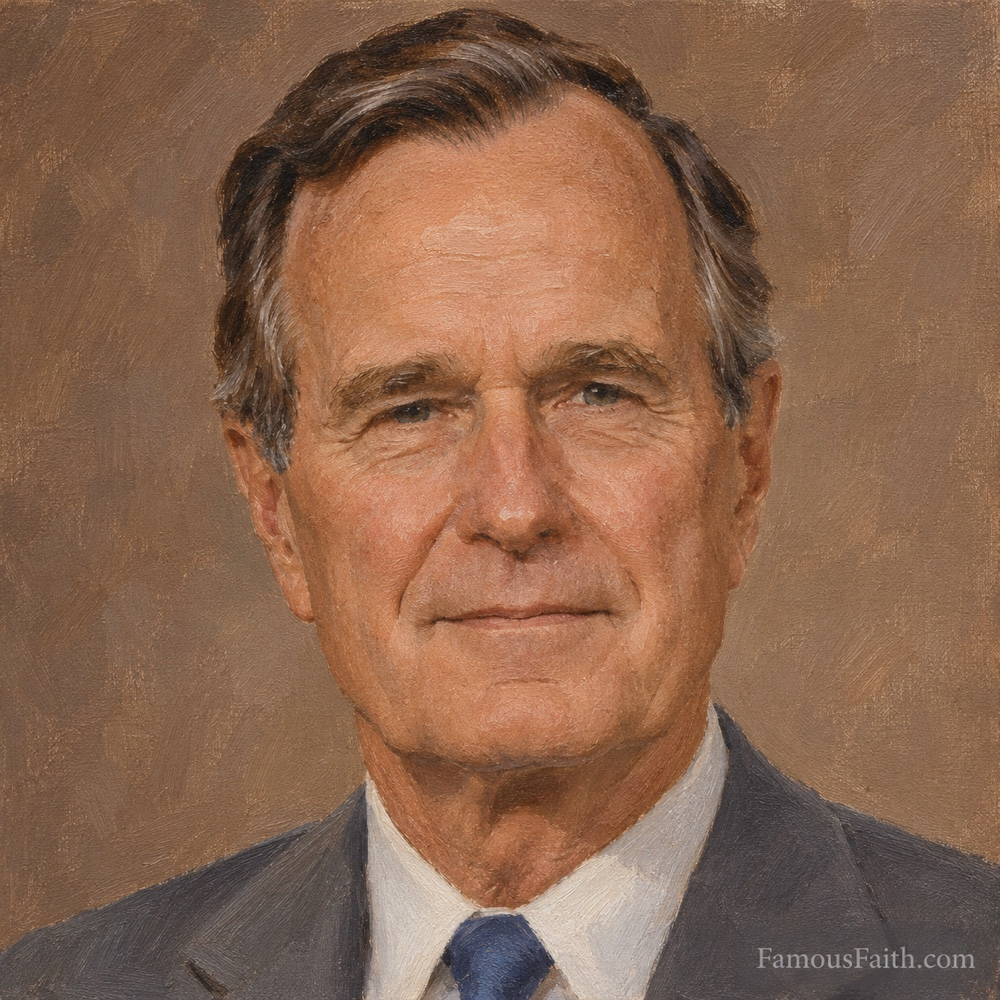
Portrait credit: Original AI-generated painted editorial illustration created for Famous Faith, with a subtle FamousFaith.com watermark. This is an artistic interpretation, not a historical photograph or an authenticated period painting.
Editorial approach: Documented actions and public statements are distinguished from Famous Faith’s biblical assessments. Public profession and church affiliation do not establish the condition of a person’s heart.