Famous Faith · U.S. Presidents
Jimmy Carter
A Baptist president, a difficult term, and decades of service after the White House.
Jimmy Carter made Christian faith unusually visible in modern presidential politics. His record includes Middle East peacemaking, human-rights advocacy, severe economic and international setbacks, and a long humanitarian life after his presidency. Famous Faith examines the actions as well as the profession.
PRESIDENT 39
The essentials
Jimmy Carter at a glance
- Born
- October 1, 1924
- Died
- December 29, 2024
- Presidency
- January 20, 1977 – January 20, 1981
- Political party
- Democratic
- Church background
- Baptist
- Spouse
- Eleanor Rosalynn Smith (b. August 18, 1927), July 7, 1946
- Children
- Four: Jack, Chip, Jeff, and Amy
- Other work
- Soldier; Farmer, Warehouseman, Public Official, Professor
- Presidential number
- 39
Basic biographical details: [1]. Family and religious qualifications are explained below.
The person behind the office
Life and family
Carter grew up in rural Georgia, attended the United States Naval Academy, and served as a naval officer before returning to the family agricultural business. Local politics led to the Georgia Senate and then the governorship. His emergence as a national Democratic candidate depended partly on an outsider identity at a time when Watergate had weakened public confidence in Washington. [2] He defeated Gerald Ford in 1976 and served one presidential term, from 1977 to 1981. Inflation, energy problems, and the Iranian hostage crisis damaged his standing, and Ronald Reagan defeated him in 1980. His public service continued for decades through the Carter Center and other humanitarian work. [3] He died on December 29, 2024, at the age of 100. [4]
Spouse and children
He married Rosalynn Smith in 1946. Their four children were John, known as Jack; James, known as Chip; Donnel Jeffrey, known as Jeff; and Amy. Amy lived in the White House while her older brothers were adults. Rosalynn was an active political partner rather than merely a ceremonial presence. [5] She died before her husband; the Carter Center’s announcement of his death identified all four children as survivors. [4]
A public record
Major political accomplishments and decisions
- 01
Helped negotiate a historic peace framework
Carter brought Egyptian President Anwar Sadat and Israeli Prime Minister Menachem Begin together at Camp David in 1978. The negotiations helped produce the Egypt–Israel peace treaty in 1979. These were substantial diplomatic achievements requiring participation and risk from all three leaders. [6]
- 02
Changed the policy agenda at home
His administration addressed energy dependence and supported changes in regulation and the organization of the federal government. These efforts belong alongside the economic problems of his term: a president’s proposed solutions and the results experienced by households both matter in evaluating leadership. [7]
- 03
Made human rights central to diplomacy
Carter sought to give human rights a greater place in American foreign policy and secured ratification of the Panama Canal treaties. His administration also faced contradictions and limits, including the Iranian revolution and the prolonged detention of American hostages. Their release occurred on January 20, 1981, as his presidency ended. [6]
Public evidence and its limits
Faith and documented statements
Carter’s Baptist identity was a sustained part of his public life, not simply an inaugural reference to God. The Carter Center records that he taught Sunday school at Maranatha Baptist Church. [8] In his 1977 inaugural address he invoked Micah 6:8, emphasizing justice, mercy, and humility before God. That is a documented statement of the biblical terms in which he wished his presidency to be understood. [9] Famous Faith welcomes serious engagement with Scripture while recognizing that a public profession does not make every interpretation or policy correct. His faith should be described through what he actually said and did, with the same moral scrutiny applied to presidents whose religious language was less explicit.
Famous Faith’s biblical perspective
Public virtues and serious concerns
The historical actions are sourced. Their evaluation through Scripture expresses Famous Faith’s Christian editorial perspective; it is not a claim to know anyone’s eternal destiny.
Peacemaking and practical help deserve recognition
Famous Faith sees patient peacemaking and service to vulnerable neighbors as worthy of Christian attention. Carter’s later work with Habitat for Humanity involved actual building and advocacy for decent housing. Habitat’s own tribute describes his and Rosalynn’s repeated service. [10] Such work illustrates the importance of doing good with one’s time and influence; it should never be presented as earning salvation.
Good intentions require honest evaluation
The hostage crisis and other foreign-policy difficulties exposed the limits of presidential influence. [6] From our biblical perspective, moral language cannot replace prudent decisions or responsibility for consequences. A Christian assessment should neither ridicule Carter’s profession because policies failed nor excuse poor judgment because he spoke openly about faith. Justice, truthfulness, humility, and protection of neighbors remain standards by which leadership can be tested.
Beyond the familiar name
Interesting facts and useful distinctions
A Habitat volunteer, not its founder
Carter is closely associated with Habitat for Humanity, but he did not found the organization. Its own account identifies the Carters as volunteers and describes the first Carter work project in 1984. [10]
A Nobel Prize after the presidency
He received the Nobel Peace Prize in 2002 for work extending well beyond his term in office. The award recognized decades of conflict resolution, human-rights advocacy, and development work. [8]
A life in perspective
What this legacy asks of us
Carter’s life invites a distinction between success in office and the whole record of a person’s service. His diplomatic achievements and humanitarian commitments deserve recognition, while failures and disputed judgments remain open to examination. For Famous Faith, the enduring question is whether profession bears fruit in truthful, humble love of God and neighbor; neither political defeat nor public admiration settles that question.
Our hope rests in Jesus Christ, not a president, party, lodge, or record of public service. Scripture teaches that all have sinned, that Christ died for sins and rose again, and that salvation is God’s gift through faith rather than an achievement we earn (Romans 3:23; 1 Corinthians 15:3–4; Ephesians 2:8–9). His call is to repentance and trust in him.
Sources and image credit
- Miller Center: Overview
- Miller Center: Life Before The Presidency
- Miller Center: Life In Brief
- The Carter Center: announcement of Jimmy Carter’s death
- Miller Center: Family Life
- Miller Center: Foreign Affairs
- Miller Center: Domestic Affairs
- The Carter Center: Jimmy Carter biography
- Presidential statement: original transcript
- Habitat for Humanity: remembering Jimmy Carter
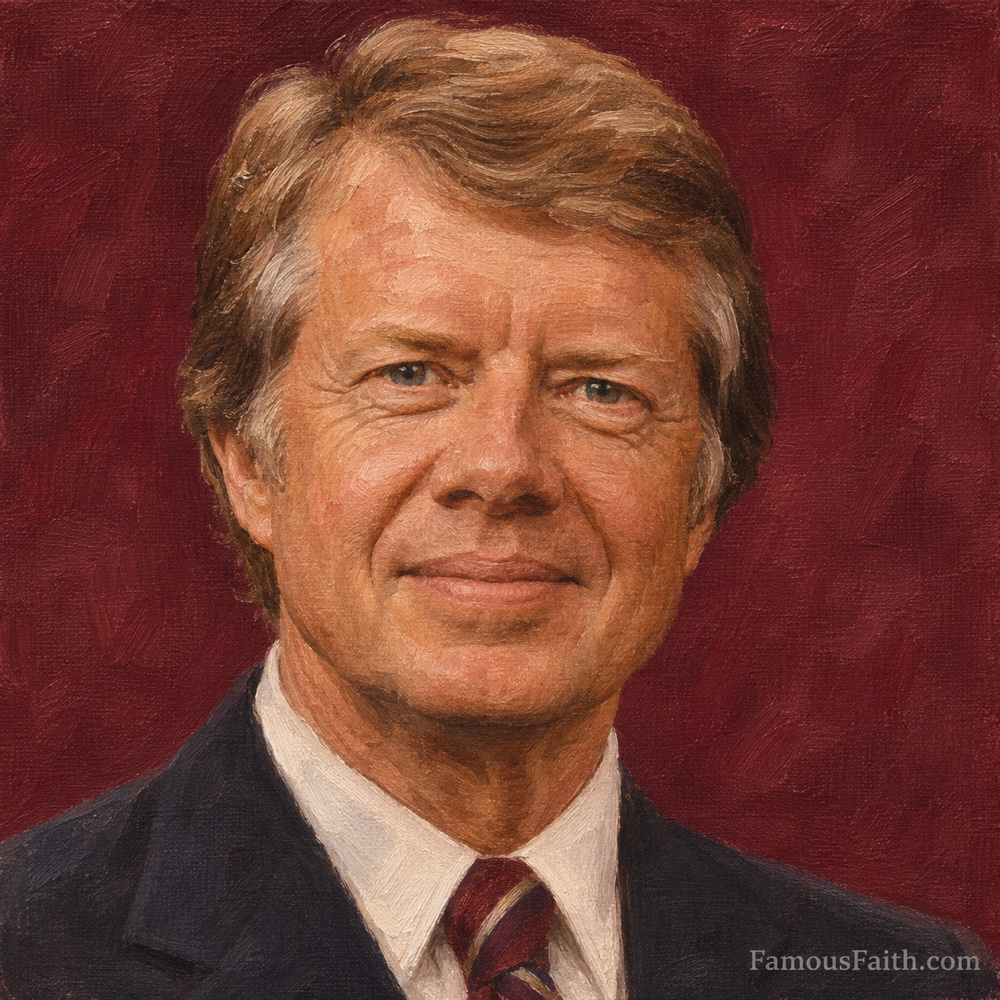
Portrait credit: Original AI-generated painted editorial illustration created for Famous Faith, with a subtle FamousFaith.com watermark. This is an artistic interpretation, not a historical photograph or an authenticated period painting.
Editorial approach: Documented actions and public statements are distinguished from Famous Faith’s biblical assessments. Public profession and church affiliation do not establish the condition of a person’s heart.