Famous Faith · U.S. Presidents
Gerald Ford
Reconciliation after Watergate and the difficult boundary between mercy and accountability.
Gerald Ford became president through an extraordinary succession and tried to restore public confidence after Watergate. His pardon of Nixon remains central to his legacy, alongside economic difficulty, the end of the Vietnam War, Episcopal faith, and documented Freemasonry.
PRESIDENT 38
The essentials
Gerald Ford at a glance
- Born
- July 14, 1913
- Died
- December 26, 2006
- Presidency
- August 9, 1974 – January 20, 1977
- Political party
- Republican
- Church background
- Episcopalian
- Spouse
- October 15, 1948, to Elizabeth "Betty" Bloomer Warren (1918–2011)
- Children
- Four: Michael, John, Steven, and Susan
- Other work
- Lawyer, Public Official
- Presidential number
- 38
- Freemasonry
- Documented member
Basic biographical details: [1]. Family and religious qualifications are explained below.
The person behind the office
Life and family
Born Leslie Lynch King Jr., Ford grew up in Michigan under the name of the stepfather who raised him. He attended the University of Michigan and Yale Law School, served in the Navy during World War II, and built a long Republican career in the House of Representatives. His reputation rested on congressional relationships and a relatively straightforward public manner rather than executive experience. [2] After Vice President Spiro Agnew resigned, Nixon nominated Ford as vice president under the Twenty-fifth Amendment. Congress confirmed him in 1973. Nixon’s resignation then made Ford president in August 1974. He entered office without having been elected to either of those national executive positions, although he had repeatedly been elected to the House. He lost the 1976 presidential election to Jimmy Carter. [3]
Spouse and children
Ford married Elizabeth Bloomer Warren, known as Betty, in 1948. Their children were Michael, John, Steven, and Susan. Betty became a public figure whose candor and later work on health and recovery extended far beyond the presidency. Their children supported his career while also expressing independent views, including disagreement over major political decisions. The family’s public life was not simply a chorus of agreement with the president. [4]
A public record
Major political accomplishments and decisions
- 01
Restored continuity after a presidential resignation
Ford assumed office peacefully during a crisis of confidence in government. His accessible manner and commitment to regular constitutional processes helped establish a different tone. Restoring trust, however, required more than a contrast in personality with his predecessor. [3]
- 02
Pardoned Richard Nixon
Ford granted Nixon a pardon in September 1974, arguing that the country needed to move beyond the unresolved criminal questions of the former presidency. The decision was lawful and intensely controversial. Its moral and political costs should be examined rather than assumed away by the language of healing. [5]
- 03
Managed a difficult international transition
His administration took part in the Helsinki process and confronted the collapse of South Vietnam in 1975. The evacuation and admission of refugees belong in that history alongside the limits of American commitments. At home, inflation and unemployment created serious economic pressure. [6] [5]
Public evidence and its limits
Faith and documented statements
Ford’s religious affiliation was Episcopalian. In his April 1975 foreign-policy address, he described prayer for guidance before discussing the urgent choices facing the country and closed by asking God to guide it toward right action. The transcript provides direct evidence of his public religious language. [1] [7] Famous Faith distinguishes those expressions from a claim that every act of reconciliation or foreign policy was thereby divinely approved. Ford’s Masonic membership must also be stated plainly. A church affiliation and a reputation for decency do not resolve the theological concerns raised by the lodge’s religious framework, nor do they provide historians with certainty about personal salvation.
Famous Faith’s biblical perspective
Public virtues and serious concerns
The historical actions are sourced. Their evaluation through Scripture expresses Famous Faith’s Christian editorial perspective; it is not a claim to know anyone’s eternal destiny.
Mercy does not make accountability unnecessary
Ford’s desire to reduce national bitterness is understandable. Christians take forgiveness seriously, but personal forgiveness, criminal justice, public accountability, and an executive pardon are different things. Famous Faith therefore sees the Nixon pardon as a decision requiring moral examination rather than a simple illustration that mercy always means ending legal consequences.
Leadership after defeat should remember displaced people
The end of the Vietnam War created danger and displacement for people who had relied on American commitments. [6] Famous Faith believes the responsibilities of a powerful country do not vanish when a policy fails. Honesty about limits must be joined to practical care for refugees and others left exposed by the withdrawal of protection.
Beyond the familiar name
Interesting facts and useful distinctions
Never elected to the presidency or vice presidency
Ford reached both offices through constitutional succession and confirmation. That distinction should not be misstated as a claim that he had never been elected to public office at all. [3]
A birth name and a public name
Ford was born Leslie Lynch King Jr. His later name reflected the family in which he grew up, a useful biographical distinction when checking records and avoiding duplicate profiles. [2]
A life in perspective
What this legacy asks of us
Ford’s presidency shows that a reputation for decency does not make difficult questions disappear. His effort to restore stability deserves recognition; the effects of the pardon, economic choices, and international withdrawal deserve scrutiny. A Christian assessment should examine the substance of mercy and responsibility rather than relying on a reassuring public image.
Our hope rests in Jesus Christ, not a president, party, lodge, or record of public service. Scripture teaches that all have sinned, that Christ died for sins and rose again, and that salvation is God’s gift through faith rather than an achievement we earn (Romans 3:23; 1 Corinthians 15:3–4; Ephesians 2:8–9). His call is to repentance and trust in him.
Sources and image credit
- Miller Center: Overview
- Miller Center: Life Before The Presidency
- Miller Center: Life In Brief
- Miller Center: Family Life
- Miller Center: Domestic Affairs
- Miller Center: Foreign Affairs
- Presidential statement: original transcript
- First Kings Masonic District: Masonic Presidents
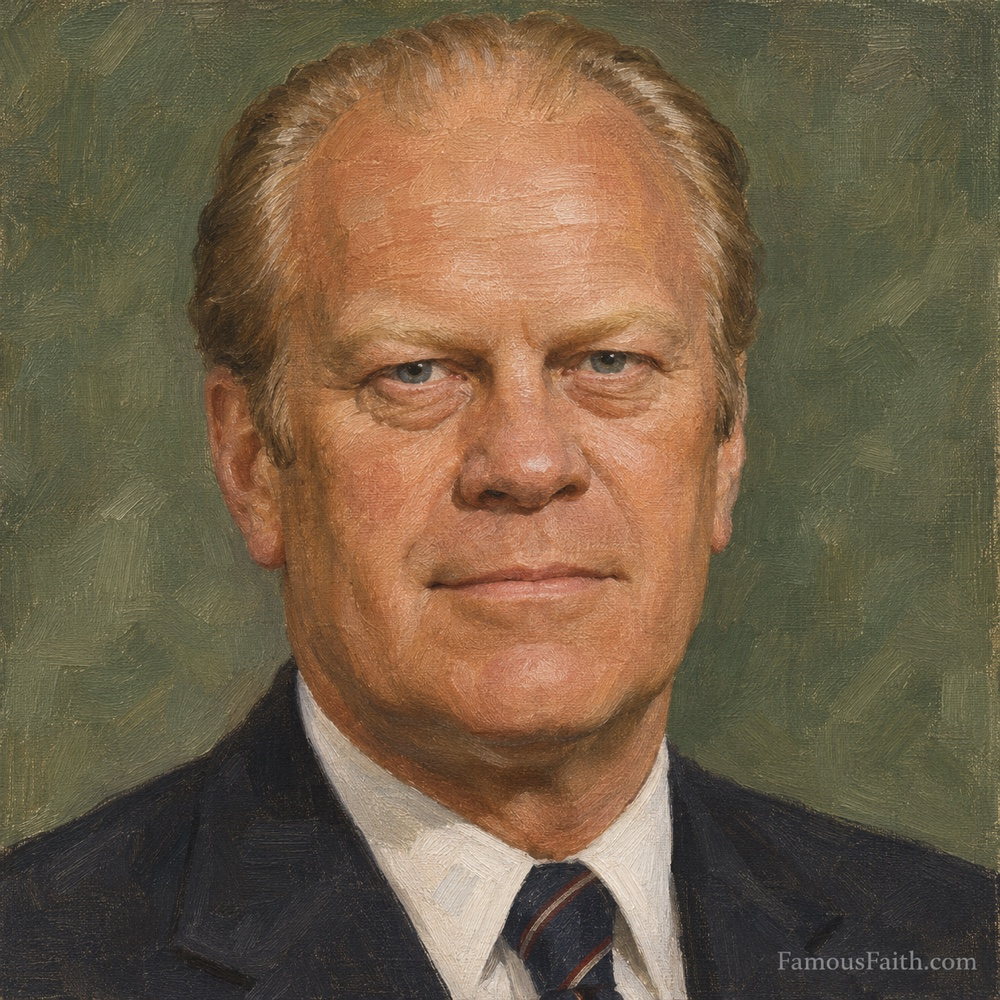
Portrait credit: Original AI-generated painted editorial illustration created for Famous Faith, with a subtle FamousFaith.com watermark. This is an artistic interpretation, not a historical photograph or an authenticated period painting.
Editorial approach: Documented actions and public statements are distinguished from Famous Faith’s biblical assessments. Public profession and church affiliation do not establish the condition of a person’s heart.