Famous Faith · U.S. Presidents
Franklin D. Roosevelt
National crisis, public faith, and the unequal reach of protection.
Franklin D. Roosevelt transformed the federal government during the Great Depression and led the United States through most of World War II. His public religious language and social reforms stand beside grave failures of equal protection, especially the incarceration of Japanese Americans.
PRESIDENT 32
The essentials
Franklin D. Roosevelt at a glance
- Born
- January 30, 1882
- Died
- April 12, 1945
- Presidency
- March 4, 1933 – April 12, 1945
- Political party
- Democrat
- Church background
- Episcopalian
- Spouse
- March 17, 1905, to Anna Eleanor Roosevelt (1884–1962)
- Children
- Six children with Eleanor; one son died in infancy
- Other work
- Public Official, Lawyer
- Presidential number
- 32
- Freemasonry
- Documented member
Basic biographical details: [1]. Family and religious qualifications are explained below.
The person behind the office
Life and family
Roosevelt was born into a wealthy New York family, studied at Harvard, and entered public life as a state senator and assistant secretary of the Navy. Illness in 1921 left him with lasting paralysis, but he returned to politics and became governor of New York. His experience of disability belongs in his biography without being turned into an explanation for every policy or an occasion for speculative medical claims. [2] Elected as a Democrat in 1932, he took office during a banking and economic emergency. His New Deal expanded federal responsibility for relief, recovery, and social protection. The outbreak of war in Europe and the Pacific later brought a different national emergency. He won four presidential elections and died in April 1945, before the final Allied victory. [3]
Spouse and children
Roosevelt married Anna Eleanor Roosevelt in 1905. They had six children, including one son who died in infancy. Eleanor developed a major public career of her own as an advocate, writer, and political participant. Eleanor discovered his affair with Lucy Mercer in 1918. Their marriage continued, but the betrayal changed their relationship. [2] Its public partnership should not be mistaken for an uncomplicated private marriage. The Roosevelt children sometimes served in roles connected with the administration and the war. [4]
A public record
Major political accomplishments and decisions
- 01
Responded to banking failure and unemployment
Roosevelt’s early administration acted on banking confidence, emergency relief, and public employment. Programs such as the Civilian Conservation Corps and later work-relief measures brought the federal government into more direct contact with the economic lives of ordinary households. Results varied, and the Depression did not disappear immediately. [5]
- 02
Established lasting social and labor protections
The Social Security Act and the Wagner Act were major components of the New Deal. They helped change expectations of federal responsibility for old-age security, unemployment, and labor relations. Important exclusions and unequal access remained, so their benefits should not be described as universal from the start. [5]
- 03
Led the wartime alliance
Roosevelt supported the Allies before American entry and led the United States after Pearl Harbor. He worked with Allied leaders on military strategy and the shape of the postwar order, including the project that became the United Nations. He died before the war ended and before that organization formally began. [6]
Public evidence and its limits
Faith and documented statements
Roosevelt was Episcopalian. His public speeches repeatedly used religious language, and his first inaugural address ended with a request for God’s blessing, protection, and guidance. That appeal is documented in the transcript and belongs within the religious history of his presidency. [1] [7] Famous Faith does not infer from an invocation that every New Deal measure or wartime decision expressed Christian obedience. Public prayer should direct attention toward accountability, not shield a leader from it. Roosevelt’s Masonic membership must likewise be acknowledged alongside his church affiliation. A Christian profile should neither erase the religious evidence because of political criticism nor use the religious evidence to excuse wrongdoing.
Famous Faith’s biblical perspective
Public virtues and serious concerns
The historical actions are sourced. Their evaluation through Scripture expresses Famous Faith’s Christian editorial perspective; it is not a claim to know anyone’s eternal destiny.
Relief and resistance to tyranny addressed real needs
The effort to relieve destitution and resist the Axis powers involved profound questions of human welfare and freedom. Famous Faith can recognize the moral seriousness of those responsibilities without endorsing every program or military decision. Care for suffering neighbors and resistance to oppression remain worthy aims, even where policy effectiveness and unintended consequences require further debate.
Japanese American incarceration was a grave injustice
Roosevelt signed Executive Order 9066, which enabled exclusion and the mass incarceration of people of Japanese ancestry, including American citizens. [8] Famous Faith regards punishment based on ancestry rather than individual wrongdoing as a serious violation of impartial justice and human dignity. Wartime fear does not remove a government’s responsibility to protect the rights of the people it governs.
Public service did not excuse marital betrayal
Roosevelt’s relationship with Lucy Mercer violated the fidelity owed within his marriage. [2] Famous Faith regards marital faithfulness as a serious responsibility. Achievements in relief or wartime leadership do not make private betrayal morally insignificant, just as a private failure does not justify erasing every public achievement.
Beyond the familiar name
Interesting facts and useful distinctions
Four elections, not four completed terms
Roosevelt won the presidency four times but died early in his fourth term. The Twenty-second Amendment’s later term limit did not govern those elections. [3]
The war ended under Truman
Roosevelt’s death in April 1945 brought Harry S. Truman to office. Germany’s surrender, the atomic bombings, and Japan’s surrender occurred afterward, and should not be dated as presidential actions taken by Roosevelt. [6]
A life in perspective
What this legacy asks of us
Roosevelt’s long presidency changed expectations of government at home and American power abroad. Its scale makes precision especially important. A Christian assessment should recognize relief and wartime leadership while confronting discriminatory incarceration, resisting the temptation to equate a leader’s historical importance with moral innocence.
Our hope rests in Jesus Christ, not a president, party, lodge, or record of public service. Scripture teaches that all have sinned, that Christ died for sins and rose again, and that salvation is God’s gift through faith rather than an achievement we earn (Romans 3:23; 1 Corinthians 15:3–4; Ephesians 2:8–9). His call is to repentance and trust in him.
Sources and image credit
- Miller Center: Overview
- Miller Center: Life Before The Presidency
- Miller Center: Life In Brief
- Miller Center: Family Life
- Miller Center: Domestic Affairs
- Miller Center: Foreign Affairs
- Presidential statement: original transcript
- National Archives: Executive Order 9066 and Japanese American Incarceration
- First Kings Masonic District: Masonic Presidents
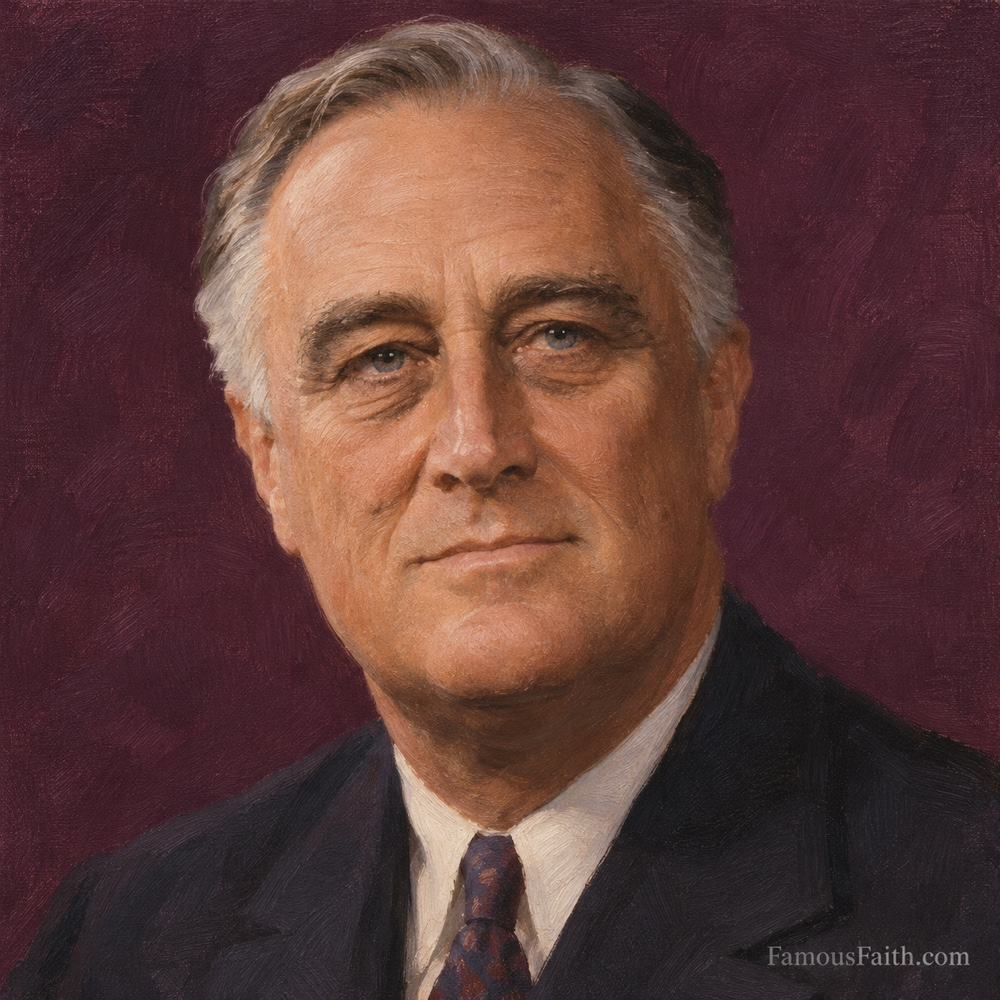
Portrait credit: Original AI-generated painted editorial illustration created for Famous Faith, with a subtle FamousFaith.com watermark. This is an artistic interpretation, not a historical photograph or an authenticated period painting.
Editorial approach: Documented actions and public statements are distinguished from Famous Faith’s biblical assessments. Public profession and church affiliation do not establish the condition of a person’s heart.