Famous Faith · U.S. Presidents
Herbert Hoover
Humanitarian service and the limits of a president’s response to catastrophe.
Herbert Hoover organized extraordinary humanitarian relief before reaching the White House. The Great Depression then overwhelmed his presidency. His record deserves more accuracy than either the claim that he did nothing or the assumption that a generous private life made his public response sufficient.
PRESIDENT 31
The essentials
Herbert Hoover at a glance
- Born
- August 10, 1874
- Died
- October 20, 1964
- Presidency
- March 4, 1929 – March 4, 1933
- Political party
- Republican
- Church background
- Society of Friends (Quaker)
- Spouse
- February 10, 1899, to Lou Henry (1875–1944)
- Children
- Two sons: Herbert Jr. and Allan
- Other work
- Engineer
- Presidential number
- 31
Basic biographical details: [1]. Family and religious qualifications are explained below.
The person behind the office
Life and family
Hoover was born into a Quaker family in Iowa and was orphaned as a child. He studied at Stanford and became a mining engineer whose work took him around the world. His administrative ability later became central to relief efforts during and after World War I. He helped organize food assistance on a scale that gave him an international humanitarian reputation. [2] As secretary of commerce under Harding and Coolidge, he advocated cooperation among government, business, and professional experts. He won the presidency as a Republican in 1928. The stock-market crash and the wider collapse of employment, banking, and production turned his term into a struggle against a crisis far deeper than his earlier experience had prepared him to solve. [3]
Spouse and children
Hoover married Lou Henry in 1899. They had two sons, Herbert and Allan. Lou shared his scientific training and international experience, and their marriage included years abroad before national political life. She also brought independent organizational and public-service interests to the White House. The couple’s family and humanitarian work provide important context without removing the need to judge presidential decisions by their consequences. [4]
A public record
Major political accomplishments and decisions
- 01
Organized major humanitarian relief
Hoover’s wartime and postwar relief leadership preceded the presidency. It demonstrated a capacity to coordinate resources and respond to hunger across national borders. Those achievements should be recognized in their own setting rather than presented as measures he enacted as president during the Depression. [2]
- 02
Created new institutions during the Depression
Hoover supported the Reconstruction Finance Corporation and other efforts to stabilize credit and public finances. He also pursued public works and voluntary cooperation. These measures make the claim that he literally took no action inaccurate; they do not establish that his response matched the scale of the emergency. [5]
- 03
Sought international economic and diplomatic relief
His administration proposed a moratorium on war-debt payments and pursued disarmament and other diplomatic measures. The Smoot-Hawley tariff, however, intensified international economic tensions. His record included attempts at cooperation as well as policies that made cooperation harder. [6]
Public evidence and its limits
Faith and documented statements
Hoover’s religious background was the Society of Friends, or Quakers. His upbringing and humanitarian service are relevant to understanding his sense of obligation, but neither should be treated as a complete account of his private theology. [1] [2] In his 1930 annual message, Hoover appealed for courage, cooperation, self-reliance, and assistance to those suffering from the economic downturn. That is a documented statement of public moral responsibility; it is not a detailed confession of the Christian gospel. [7] Famous Faith distinguishes faith in God from confidence that a particular economic system or administrative method will succeed. A leader may be sincere and industrious while still needing to reconsider assumptions that leave other people’s suffering inadequately addressed.
Famous Faith’s biblical perspective
Public virtues and serious concerns
The historical actions are sourced. Their evaluation through Scripture expresses Famous Faith’s Christian editorial perspective; it is not a claim to know anyone’s eternal destiny.
Feeding hungry neighbors was meaningful service
Hoover’s relief work deserves recognition as practical care across national boundaries. Famous Faith sees such service as consistent with the biblical duty to attend to people in distress. We do not infer that philanthropy earns salvation, but neither should the failures of his presidency erase the people helped through his earlier humanitarian leadership.
Suffering required more than confidence in recovery
The Depression exposed limits in Hoover’s reliance on voluntary cooperation and financial stabilization. His administration’s handling of the Bonus Army protest also placed the use of federal force against distressed veterans within his presidential record. [5] Famous Faith believes government should treat suffering people with dignity, restraint, and a willingness to hear their needs. Sympathy expressed in principle is insufficient if an actual response fails to protect those who are vulnerable.
Beyond the familiar name
Interesting facts and useful distinctions
He had an international career before politics
Engineering and humanitarian work took Hoover far beyond Iowa long before his presidency. His global experience helps explain why contemporaries initially expected exceptional administrative competence from him. [2]
The Depression did not end his service
Hoover remained active after leaving office, including later public-service and administrative work. His post-presidential career lasted for decades, making the four-year presidency only one part of a much longer life. [8]
A life in perspective
What this legacy asks of us
Hoover’s life demonstrates that real compassion and technical competence do not guarantee adequate leadership in a new emergency. A Christian account can honor his humanitarian service while criticizing the shortcomings of his presidential response. Honest history should resist both an effortless caricature and a defense that forgets the people who continued to suffer.
Our hope rests in Jesus Christ, not a president, party, lodge, or record of public service. Scripture teaches that all have sinned, that Christ died for sins and rose again, and that salvation is God’s gift through faith rather than an achievement we earn (Romans 3:23; 1 Corinthians 15:3–4; Ephesians 2:8–9). His call is to repentance and trust in him.
Sources and image credit
- Miller Center: Overview
- Miller Center: Life Before The Presidency
- Miller Center: Life In Brief
- Miller Center: Family Life
- Miller Center: Domestic Affairs
- Miller Center: Foreign Affairs
- Presidential statement: original transcript
- Miller Center: Impact And Legacy
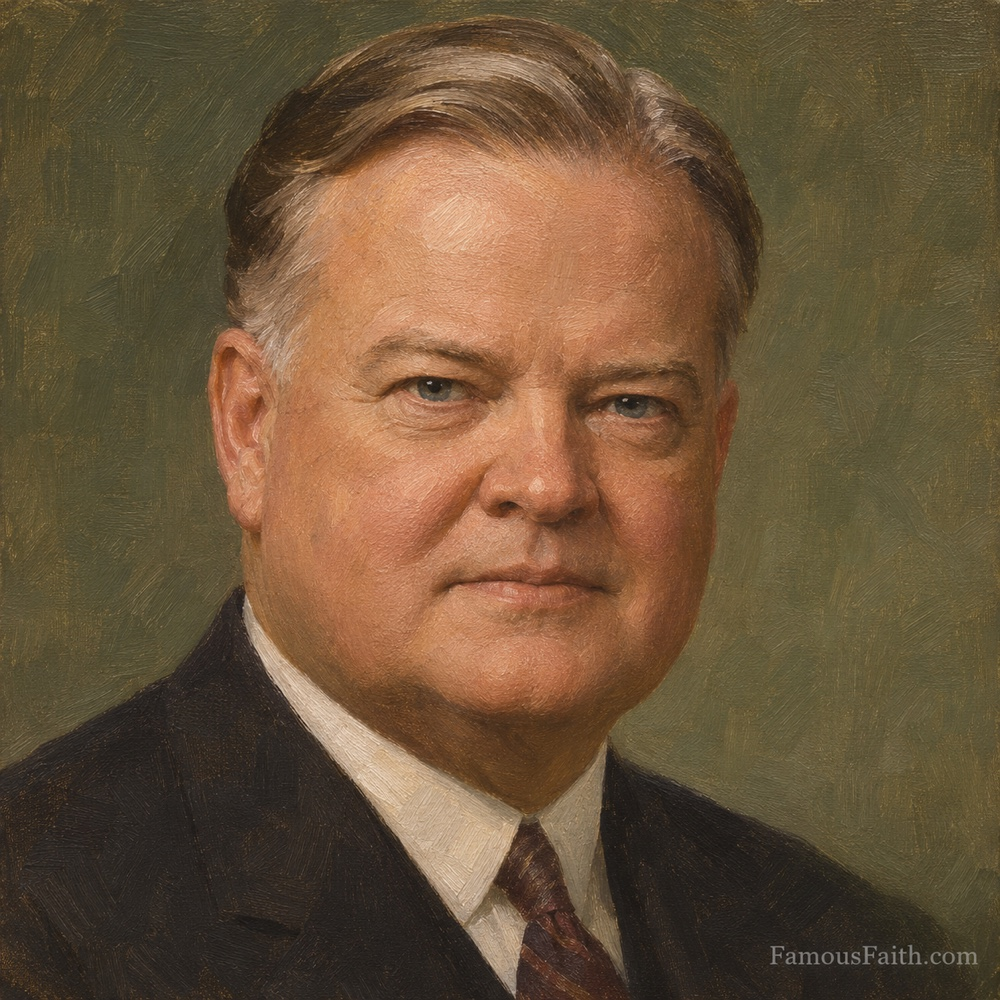
Portrait credit: Original AI-generated painted editorial illustration created for Famous Faith, with a subtle FamousFaith.com watermark. This is an artistic interpretation, not a historical photograph or an authenticated period painting.
Editorial approach: Documented actions and public statements are distinguished from Famous Faith’s biblical assessments. Public profession and church affiliation do not establish the condition of a person’s heart.