Famous Faith · U.S. Presidents
William Howard Taft
Law, reform, and a religious identity that needs precise description.
William Howard Taft pursued reform through law and administration rather than Theodore Roosevelt’s style of public confrontation. His presidency and later service as chief justice made him institutionally unusual; his Unitarianism and Masonic affiliation require separate theological attention.
PRESIDENT 27
The essentials
William Howard Taft at a glance
- Born
- September 15, 1857
- Died
- March 8, 1930
- Presidency
- March 4, 1909 – March 4, 1913
- Political party
- Republican
- Church background
- Unitarian
- Spouse
- June 19, 1886, to Helen Herron (1861–1943)
- Children
- Three: Robert, Helen, and Charles
- Other work
- Lawyer, Public Official
- Presidential number
- 27
- Freemasonry
- Documented member; made a Mason at sight
Basic biographical details: [1]. Family and religious qualifications are explained below.
The person behind the office
Life and family
Taft grew up in Cincinnati, studied at Yale and law school, and developed a career centered on legal administration. Before becoming president he served as a judge, solicitor general, civil governor in the Philippines, and secretary of war. His professional instincts favored orderly legal process and institutional responsibility more than the excitement of electoral politics. [2] Theodore Roosevelt supported Taft as his successor in 1908, but their relationship deteriorated during his presidency. Differences over party leadership and reform helped produce the Republican split of 1912. Taft lost the election to Woodrow Wilson. He later achieved the position he had long preferred when he became chief justice of the United States in 1921. [3]
Spouse and children
Taft married Helen Herron in 1886. Their children were Robert Alphonso, Helen, and Charles Phelps. Helen, known as Nellie, strongly supported his political advancement and played an important public role, although serious illness affected her early White House years. Their son Robert later became a major United States senator. The family’s political prominence extended well beyond Taft’s four years as president. [4]
A public record
Major political accomplishments and decisions
- 01
Pursued antitrust enforcement
Taft’s administration brought many antitrust cases and emphasized enforcing the law through the courts. Some important cases had begun under Roosevelt. The record challenges the simple image of Taft as a president who abandoned all Progressive reform, while preserving the differences in how the two men governed. [5]
- 02
Supported administrative and constitutional changes
Postal savings and other administrative reforms formed part of his program. The constitutional amendments establishing an income-tax power and direct election of senators moved through the political system during this period, with ratification completed at different points. These developments involved Congress and the states, not Taft acting alone. [5]
- 03
Promoted dollar diplomacy
Taft encouraged American financial and commercial influence abroad, particularly in Latin America and Asia. Investment policy was also connected with intervention and unequal power. An account of economic diplomacy must examine the rights and interests of the people affected, not only the opportunities it created for American businesses. [6]
Public evidence and its limits
Faith and documented statements
Taft was a Unitarian, a religious identity that should be reported accurately rather than replaced by a generic Protestant label. Unitarian theology differs from the historic Trinitarian understanding of God central to Famous Faith’s Christian framework. A shared vocabulary of morality or Providence does not eliminate that disagreement. [1] In his 1909 inaugural address, Taft asked the aid of Almighty God in carrying out his responsibilities. This is a documented public invocation, but it does not establish a confession of Christ’s divinity, atoning death, or resurrection. [7] Famous Faith distinguishes civic religious language from the gospel and does not claim access to Taft’s eternal condition. His Masonic affiliation creates an additional, separately documented concern about the spiritual framework with which he associated.
Famous Faith’s biblical perspective
Public virtues and serious concerns
The historical actions are sourced. Their evaluation through Scripture expresses Famous Faith’s Christian editorial perspective; it is not a claim to know anyone’s eternal destiny.
Institutions and lawful administration matter
Taft’s preference for regular legal process offers a useful counterpoint to leadership based entirely on personality. Famous Faith values impartial administration and restraints on arbitrary power. Those principles can protect neighbors from favoritism and personal retaliation. Their value depends on the justice of the laws being administered as well as the care with which officials follow procedure.
Economic opportunity does not excuse coercion
Dollar diplomacy connected government support with American investment interests and, at times, military intervention. [6] Famous Faith rejects measuring foreign policy solely by the advantages it brings to one country’s businesses. Biblical neighbor-love requires attention to the agency and welfare of people living under the pressure of a stronger nation. Orderly administration at home is not sufficient if economic power abroad disregards their dignity.
Beyond the familiar name
Interesting facts and useful distinctions
President and chief justice
Taft remains the only person to have served as both president and chief justice of the United States. His judicial service followed the presidency rather than forming part of his presidential term. [9]
The Roosevelt split needs more than a slogan
Taft’s conflict with his predecessor involved policy, appointments, political strategy, and leadership style. His antitrust activity makes the claim that he simply stopped regulating business inaccurate. [5]
A life in perspective
What this legacy asks of us
Taft’s career asks readers to value institutions without assuming that legal skill resolves every moral question. His administrative achievements deserve explanation; the coercive implications of foreign economic policy deserve scrutiny. His religious identity also needs the precision that a serious Christian profile owes both its subject and its readers.
Our hope rests in Jesus Christ, not a president, party, lodge, or record of public service. Scripture teaches that all have sinned, that Christ died for sins and rose again, and that salvation is God’s gift through faith rather than an achievement we earn (Romans 3:23; 1 Corinthians 15:3–4; Ephesians 2:8–9). His call is to repentance and trust in him.
Sources and image credit
- Miller Center: Overview
- Miller Center: Life Before The Presidency
- Miller Center: Life In Brief
- Miller Center: Family Life
- Miller Center: Domestic Affairs
- Miller Center: Foreign Affairs
- Presidential statement: original transcript
- First Kings Masonic District: Masonic Presidents
- Miller Center: Impact And Legacy
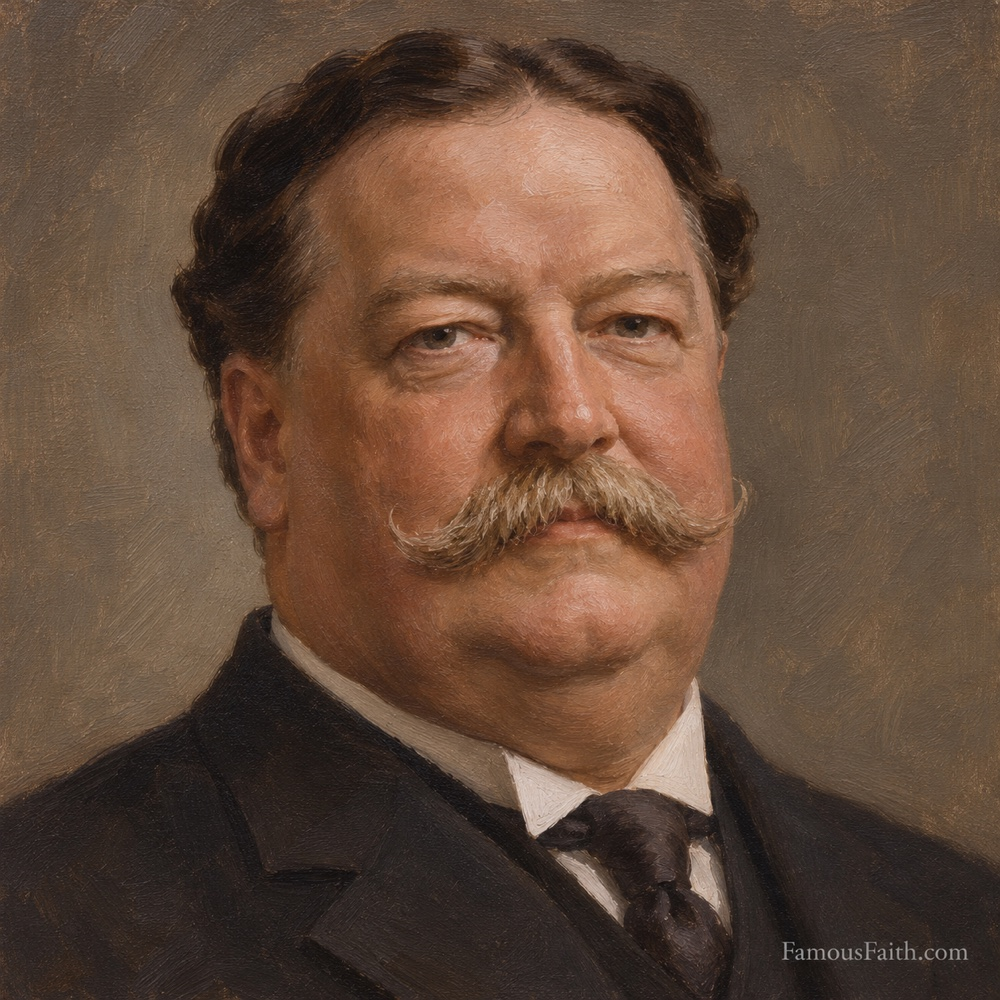
Portrait credit: Original AI-generated painted editorial illustration created for Famous Faith, with a subtle FamousFaith.com watermark. This is an artistic interpretation, not a historical photograph or an authenticated period painting.
Editorial approach: Documented actions and public statements are distinguished from Famous Faith’s biblical assessments. Public profession and church affiliation do not establish the condition of a person’s heart.