Famous Faith · U.S. Presidents
Theodore Roosevelt
Energetic reform, creation’s stewardship, and failures of impartial justice.
Theodore Roosevelt enlarged the presidency’s role in regulating business and protecting natural resources. His courage and reforming energy were accompanied by racial prejudice and an expansive view of American power that deserve equally serious examination.
PRESIDENT 26
The essentials
Theodore Roosevelt at a glance
- Born
- October 27, 1858
- Died
- January 6, 1919
- Presidency
- September 14, 1901 – March 4, 1909
- Political party
- Republican
- Church background
- Dutch Reformed
- Spouse
- October 27, 1880, to Alice Hathaway Lee (1861–1884), December 2, 1886, to Edith Kermit Carow (1861–1948)
- Children
- Six: Alice with Alice Lee; Theodore, Kermit, Ethel, Archibald, and Quentin with Edith
- Other work
- Author, Lawyer, Public Official
- Presidential number
- 26
- Freemasonry
- Documented member
Basic biographical details: [1]. Family and religious qualifications are explained below.
The person behind the office
Life and family
Roosevelt grew up in New York, studied at Harvard, and pursued an unusually varied career as a writer, legislator, rancher, reform official, police commissioner, and military officer. The deaths of his first wife and his mother on the same day in 1884 marked a major personal crisis. His time in the West and his service in the Spanish-American War helped form the vigorous public image associated with him. [2] He became governor of New York and then William McKinley’s vice president. McKinley’s assassination in 1901 made Roosevelt president at forty-two. He won a term in his own right in 1904 and used the office assertively to address the social and economic consequences of industrial growth. His later break with Republican leaders produced a Progressive presidential campaign in 1912. [3]
Spouse and children
Roosevelt married Alice Hathaway Lee in 1880. Their daughter Alice was born shortly before her mother died in 1884. He married Edith Kermit Carow in 1886, and they had five children: Theodore, Kermit, Ethel, Archibald, and Quentin. The family’s energetic White House life became a major part of its public image. Six children belonged to two marriages, a distinction worth preserving when describing the household. [4]
A public record
Major political accomplishments and decisions
- 01
Used federal power to regulate corporate abuses
Roosevelt pursued antitrust action and supported stronger regulation of railroads, food, and drugs. His Square Deal language presented government as responsible for balancing powerful interests with public welfare. The program did not eliminate corporate power, but it strengthened expectations of federal responsibility. [5]
- 02
Expanded conservation
He protected forests, wildlife, and other lands through federal action. These measures became a central part of his legacy. Stewardship of natural resources deserves recognition, while the history of conservation also requires attention to the rights and lives of Native communities affected by federal land control. [5]
- 03
Combined diplomacy with an assertive international role
Roosevelt helped mediate the Russo-Japanese War and received the Nobel Peace Prize. He also advanced the Panama Canal project and a more interventionist policy in the Americas. Diplomatic success and the coercive implications of great-power policy both belong in the record. [6]
Public evidence and its limits
Faith and documented statements
Roosevelt’s background was Dutch Reformed. His public discussion of religion included support for the practical work of Christian churches and the place of moral responsibility in civic life. The Theodore Roosevelt Center preserves material from his address commemorating John Wesley and descriptions of his concern that churches reach ordinary people. [1] [7] Those documented themes should not be inflated into an invented account of private revelation or a claim that his politics perfectly expressed Christian faith. Famous Faith also distinguishes moral energy from the gospel itself: courage, public service, and reform cannot earn salvation. His Masonic affiliation is a separate documented commitment that requires the caution stated below, regardless of the accomplishments for which he is widely admired.
Famous Faith’s biblical perspective
Public virtues and serious concerns
The historical actions are sourced. Their evaluation through Scripture expresses Famous Faith’s Christian editorial perspective; it is not a claim to know anyone’s eternal destiny.
Stewardship and resistance to abuse
Roosevelt’s concern for natural resources and some corporate abuses can be appreciated within a biblical framework of stewardship and justice. Creation is not merely material to exhaust for immediate gain, and the power to exploit a neighbor does not make exploitation right. These principles do not establish that every regulatory proposal or conservation measure was wise, but they identify worthy responsibilities of leadership.
Brownsville showed a failure of due process
In 1906 Roosevelt ordered the discharge without honor of 167 Black soldiers after the Brownsville incident without individual trials. The Theodore Roosevelt Presidential Library describes the absence of individualized hearings and the later clearing of the soldiers’ records. [8] Famous Faith regards collective punishment and racial partiality as grave failures of justice. Praising Roosevelt’s reforms does not require overlooking a decision that denied men a fair opportunity to answer accusations.
Beyond the familiar name
Interesting facts and useful distinctions
Youngest to enter the presidency
Roosevelt became president at forty-two after McKinley’s death. John F. Kennedy was younger when elected than other elected presidents, but Roosevelt was younger when he actually assumed the office. [3]
A family with two distinct Roosevelts
Theodore Roosevelt and Franklin D. Roosevelt were related, but they were different presidents from different political eras. This profile concerns Theodore, the twenty-sixth president, whose principal party was Republican. [1]
A life in perspective
What this legacy asks of us
Roosevelt’s energy made him memorable, but energy itself is not a moral standard. A Christian assessment can value reform and stewardship while criticizing racial injustice and the misuse of national power. His religious associations and achievements must be examined with the same care as those of less celebrated presidents.
Our hope rests in Jesus Christ, not a president, party, lodge, or record of public service. Scripture teaches that all have sinned, that Christ died for sins and rose again, and that salvation is God’s gift through faith rather than an achievement we earn (Romans 3:23; 1 Corinthians 15:3–4; Ephesians 2:8–9). His call is to repentance and trust in him.
Sources and image credit
- Miller Center: Overview
- Miller Center: Life Before The Presidency
- Miller Center: Life In Brief
- Miller Center: Family Life
- Miller Center: Domestic Affairs
- Miller Center: Foreign Affairs
- Theodore Roosevelt Center: John Wesley and Methodism Materials
- Theodore Roosevelt Presidential Library: The Brownsville Affair
- First Kings Masonic District: Masonic Presidents
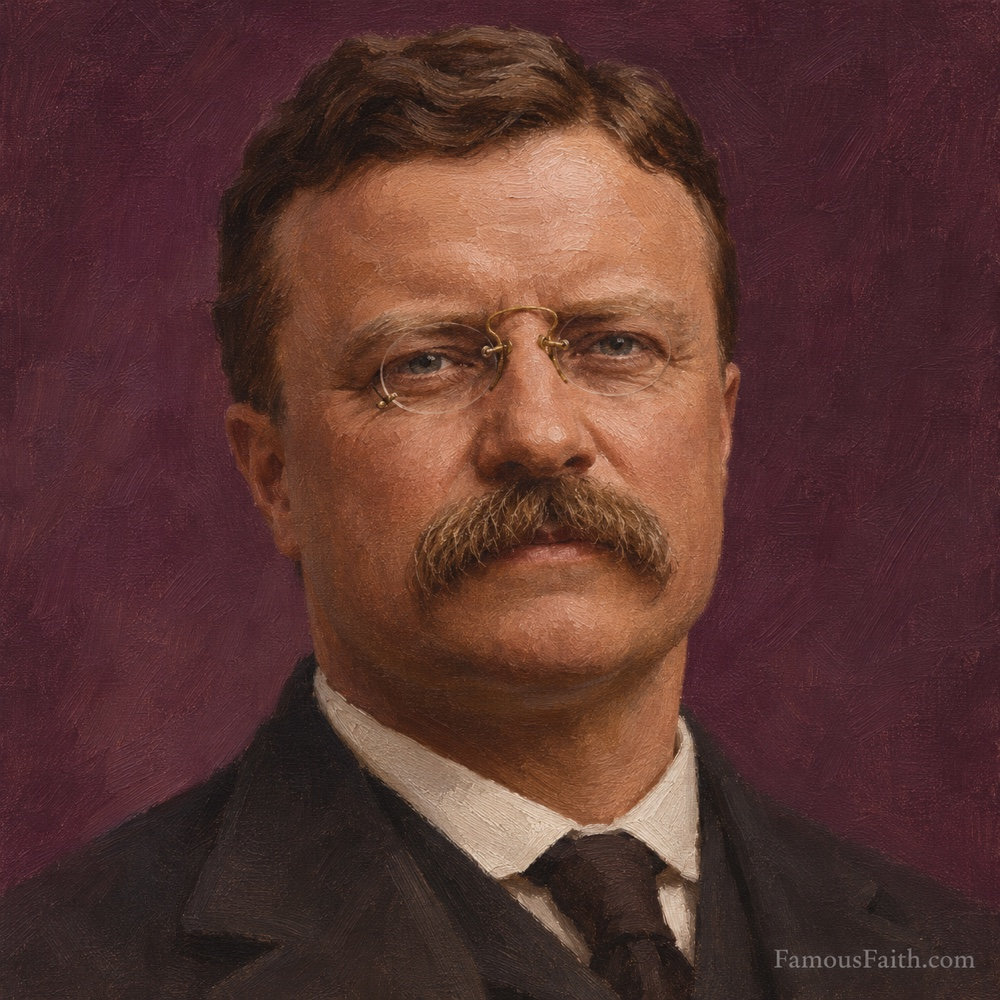
Portrait credit: Original AI-generated painted editorial illustration created for Famous Faith, with a subtle FamousFaith.com watermark. This is an artistic interpretation, not a historical photograph or an authenticated period painting.
Editorial approach: Documented actions and public statements are distinguished from Famous Faith’s biblical assessments. Public profession and church affiliation do not establish the condition of a person’s heart.