Famous Faith · U.S. Presidents
Benjamin Harrison
Faith, federal action, and promises of justice left unfinished.
Benjamin Harrison’s presidency helped establish antitrust legislation and expanded federal activity. His Presbyterian convictions and support for Black voting rights deserve attention, while the treatment of Native peoples exposes profound limits in the justice delivered during his administration.
PRESIDENT 23
The essentials
Benjamin Harrison at a glance
- Born
- August 20, 1833
- Died
- March 13, 1901
- Presidency
- March 4, 1889 – March 4, 1893
- Political party
- Republican
- Church background
- Presbyterian
- Spouse
- October 20, 1853, to Caroline Lavinia Scott (1832–1892). April 6, 1896, to Mary Scott Lord Dimmick (1858–1948)
- Children
- Three: Russell and Mary with Caroline; Elizabeth with Mary Dimmick
- Other work
- Lawyer
- Presidential number
- 23
Basic biographical details: [1]. Family and religious qualifications are explained below.
The person behind the office
Life and family
Harrison was the grandson of William Henry Harrison, but he built a public career of his own as a lawyer, Union officer, and Indiana politician. After studying at Miami University, he practiced law in Indianapolis and served during the Civil War. His later work as a senator placed him within the Republican debates over tariffs, veterans’ benefits, and federal responsibilities. [2] He defeated Grover Cleveland in the Electoral College in 1888 despite receiving fewer popular votes. His presidency operated in a period of rapid industrial development, organized corporate power, and conflict over economic policy. Congress enacted several major measures, while Harrison’s administration also confronted the continuing exclusion of Black citizens from political rights and the coercive consequences of federal policy toward Native nations. [3]
Spouse and children
Harrison married Caroline Lavinia Scott in 1853. They had two children, Russell and Mary. Caroline died in 1892, during his presidency. After leaving office, Harrison married Mary Scott Lord Dimmick in 1896, and they had a daughter, Elizabeth. His family life included grandchildren in the White House and a much warmer private manner than the formal public image suggested. The two marriages and three children should be described distinctly rather than combined into a misleading single household. [4] [1]
A public record
Major political accomplishments and decisions
- 01
Signed the Sherman Antitrust Act
The 1890 law established an important federal response to restraints on competition and corporate monopoly. Its early enforcement was limited, and later administrations developed its practical force. Harrison’s role belongs at the beginning of that history rather than as the completion of effective corporate regulation. [5]
- 02
Advanced a broad Republican economic program
His administration supported the McKinley Tariff, the Sherman Silver Purchase Act, and expanded veterans’ pensions. These policies had different beneficiaries and consequences. The scale of congressional activity does not by itself establish that every measure was prudent or that prosperity reached everyone equally. [5]
- 03
Supported protection of Black voting rights
Harrison backed federal efforts to address the suppression of Black voting in the South. The principal legislative effort failed in Congress. His support is evidence of a stated commitment, but it must not be described as a successful law that his administration enacted. [5]
Public evidence and its limits
Faith and documented statements
Harrison’s Presbyterian background and family religious formation are well documented. A church affiliation still differs from a complete record of private belief, so Famous Faith distinguishes what can be established from claims about a person’s eternal condition. [1] [2] In his 1889 inaugural address, Harrison described national power and wealth as gifts accompanied by an obligation that justice and mercy govern their use. The address also condemned unlawful methods that denied citizens the protection of law. [6] Those public statements offer a serious moral standard by which his own administration can be examined. Christians should welcome the acknowledgment of accountability without assuming that religious language guarantees faithful conduct or that a nation’s wealth demonstrates the righteousness of all its actions.
Famous Faith’s biblical perspective
Public virtues and serious concerns
The historical actions are sourced. Their evaluation through Scripture expresses Famous Faith’s Christian editorial perspective; it is not a claim to know anyone’s eternal destiny.
Voting rights and restraints on concentrated power
Harrison’s support for protecting Black voters and challenging corporate abuses involved real questions of justice. Famous Faith can recognize those concerns while distinguishing intentions, legislative enactments, and actual enforcement. Biblical impartiality requires that legal protection remain meaningful for people who cannot readily defend themselves against political or economic power.
Wounded Knee belongs in the moral record
The massacre at Wounded Knee occurred in 1890 during Harrison’s administration, when U.S. troops killed Lakota men, women, and children. The event belongs within the history of federal policy and the treatment of Native peoples. [7] Famous Faith does not equate national expansion with moral progress. A president’s appeals to justice and mercy demand scrutiny of the violence exercised by the government he leads, including toward communities with little political protection.
Beyond the familiar name
Interesting facts and useful distinctions
Grandfather and grandson
William Henry Harrison and Benjamin Harrison are the presidential grandfather-and-grandson pair. Their terms were separated by decades and involved very different national questions. [1]
Between Cleveland’s terms
Harrison’s four years in office separate Cleveland’s two presidencies. Numbering him twenty-third while Cleveland is both twenty-second and twenty-fourth reflects terms in sequence rather than a list of different individuals.
A life in perspective
What this legacy asks of us
Harrison’s presidency combines important legislation and meaningful public commitments with a deeply unequal distribution of rights and safety. His own language of justice and mercy offers a demanding standard. A Christian account should apply that standard consistently, rather than limiting praise or criticism to the interests of one party or community.
Our hope rests in Jesus Christ, not a president, party, lodge, or record of public service. Scripture teaches that all have sinned, that Christ died for sins and rose again, and that salvation is God’s gift through faith rather than an achievement we earn (Romans 3:23; 1 Corinthians 15:3–4; Ephesians 2:8–9). His call is to repentance and trust in him.
Sources and image credit
- Miller Center: Overview
- Miller Center: Life Before The Presidency
- Miller Center: Life In Brief
- Miller Center: Family Life
- Miller Center: Domestic Affairs
- Presidential statement: original transcript
- Library of Congress: Disaster at Wounded Knee
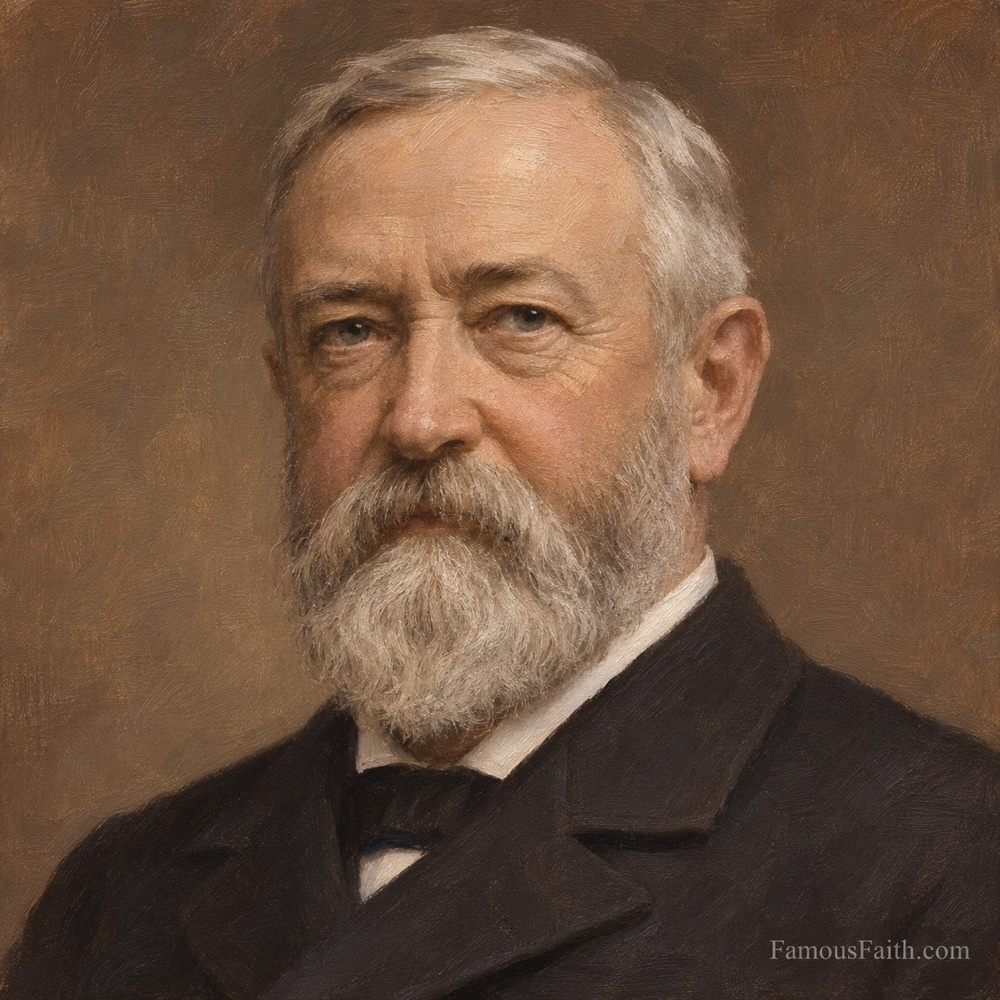
Portrait credit: Original AI-generated painted editorial illustration created for Famous Faith, with a subtle FamousFaith.com watermark. This is an artistic interpretation, not a historical photograph or an authenticated period painting.
Editorial approach: Documented actions and public statements are distinguished from Famous Faith’s biblical assessments. Public profession and church affiliation do not establish the condition of a person’s heart.