Famous Faith · U.S. Presidents
Grover Cleveland
Fiscal restraint, political independence, and unequal protection.
Grover Cleveland served two nonconsecutive terms and became known for independence and resistance to patronage. His reputation for public honesty also needs to be examined beside economic hardship, racial exclusion, and federal policies that stripped Native nations of land.
PRESIDENT 22 & 24
The essentials
Grover Cleveland at a glance
- Born
- March 18, 1837
- Died
- June 24, 1908
- Presidency
- March 4, 1885 – March 4, 1889; March 4, 1893 – March 4, 1897
- Political party
- Democrat
- Church background
- Presbyterian
- Spouse
- June 2, 1886, to Frances Folsom (1864–1947)
- Children
- Five children with Frances: Ruth, Esther, Marion, Richard, and Francis
- Other work
- Lawyer
- Presidential number
- 22 & 24
Basic biographical details: [1]. Family and religious qualifications are explained below.
The person behind the office
Life and family
Born Stephen Grover Cleveland in New Jersey, Cleveland grew up in the household of a Presbyterian minister. His father’s death interrupted plans for further education. He trained in law and built his political career in New York, serving as sheriff, mayor of Buffalo, and governor before becoming the Democratic presidential nominee in 1884. A reputation for resisting corruption helped him win support beyond his party’s usual voters. [2] He became president in 1885, lost the Electoral College in 1888, and returned to office after the election of 1892. His two terms were separated by Benjamin Harrison’s presidency. They belong in one personal profile, while retaining the official numbering that identifies Cleveland as both the twenty-second and twenty-fourth president. His second administration faced a severe depression that overwhelmed much of his program. [3]
Spouse and children
Cleveland married Frances Folsom at the White House in 1886. They had five children together: Ruth, Esther, Marion, Richard, and Francis. Frances’s youth and popularity drew considerable public attention, and Cleveland was protective of the family’s privacy. Their daughter Esther was born during his second presidency. Family facts should be distinguished from the sensational campaign claims and disputed private allegations that surrounded his earlier political life; this profile does not treat an allegation as proof simply because it was widely repeated. [4]
A public record
Major political accomplishments and decisions
- 01
Challenged patronage and unnecessary spending
Cleveland used the veto frequently and sought to distinguish public expenditure from party favor or private advantage. His approach became central to his reputation for independence. Responsible assessment must ask both whether money was honestly administered and how decisions affected people in need. [5]
- 02
Confronted the Panic of 1893
Cleveland pursued repeal of the Sherman Silver Purchase Act and defended a gold-based monetary system during a devastating depression. The response divided Democrats and did not quickly relieve unemployment or business failure. These policies were consequential even where their effectiveness and priorities remained contested. [5]
- 03
Resisted annexing Hawaii after the overthrow
Cleveland questioned American involvement in the overthrow of the Hawaiian monarchy and withdrew an annexation treaty. His administration did not restore the queen, and annexation later occurred under McKinley. The episode nevertheless records an important objection to the methods of American expansion. [6]
Public evidence and its limits
Faith and documented statements
Cleveland’s Presbyterian background began in the home of his minister father. The historical affiliation is clear, but Famous Faith does not infer a complete personal doctrine or certainty of salvation from a parent’s vocation or a denominational label. [2] [1] His 1885 inaugural address acknowledged the power and goodness of Almighty God and asked divine aid for the work of government. It also stressed responsibility in public service and the need to resist corruption. [7] These are documented moral and religious expressions. They should be assessed alongside the administration’s actual exercise of power rather than treated as proof that its choices were Christian. A reputation for fiscal honesty is meaningful, but it does not settle every question about compassion, impartiality, or the rights of people outside a leader’s principal constituency.
Famous Faith’s biblical perspective
Public virtues and serious concerns
The historical actions are sourced. Their evaluation through Scripture expresses Famous Faith’s Christian editorial perspective; it is not a claim to know anyone’s eternal destiny.
Independence can serve the public trust
Cleveland’s willingness to resist political favors offers a useful example of stewardship. Public money and office should not become resources a party distributes to its supporters. Famous Faith also insists that thrift is not the only moral measure of government. A Christian concern for honesty must remain attentive to the burdens borne by families, workers, and those with little influence.
Assimilation and exclusion inflicted serious injustice
Cleveland signed the Dawes Act, which divided Native communal lands and helped enable enormous land loss. He also supported further restrictions on Chinese immigration. [5] Famous Faith rejects paternalistic claims that a government may disregard a people’s rights because officials consider their own culture superior. Biblical human dignity requires more than promises that coercive policies will eventually improve the lives of those subjected to them.
Beyond the familiar name
Interesting facts and useful distinctions
Two numbers, one president
Cleveland’s separated terms account for his designation as both the twenty-second and twenty-fourth president. The same principle later applied to Donald Trump’s forty-fifth and forty-seventh presidencies.
A White House wedding
Cleveland married Frances Folsom inside the White House while president. That event, rather than merely a wedding during a presidency, is the distinctive setting associated with their marriage. [4]
A life in perspective
What this legacy asks of us
Cleveland’s record raises a recurring question: can a government be honest about money while treating some neighbors unjustly? His political independence deserves recognition, and his Native and exclusion policies deserve criticism. Neither judgment requires readers to adopt the party loyalties of his era or mistake a reputation for integrity for a complete moral verdict.
Our hope rests in Jesus Christ, not a president, party, lodge, or record of public service. Scripture teaches that all have sinned, that Christ died for sins and rose again, and that salvation is God’s gift through faith rather than an achievement we earn (Romans 3:23; 1 Corinthians 15:3–4; Ephesians 2:8–9). His call is to repentance and trust in him.
Sources and image credit
- Miller Center: Overview
- Miller Center: Life Before The Presidency
- Miller Center: Life In Brief
- Miller Center: Family Life
- Miller Center: Domestic Affairs
- Miller Center: Foreign Affairs
- Presidential statement: original transcript
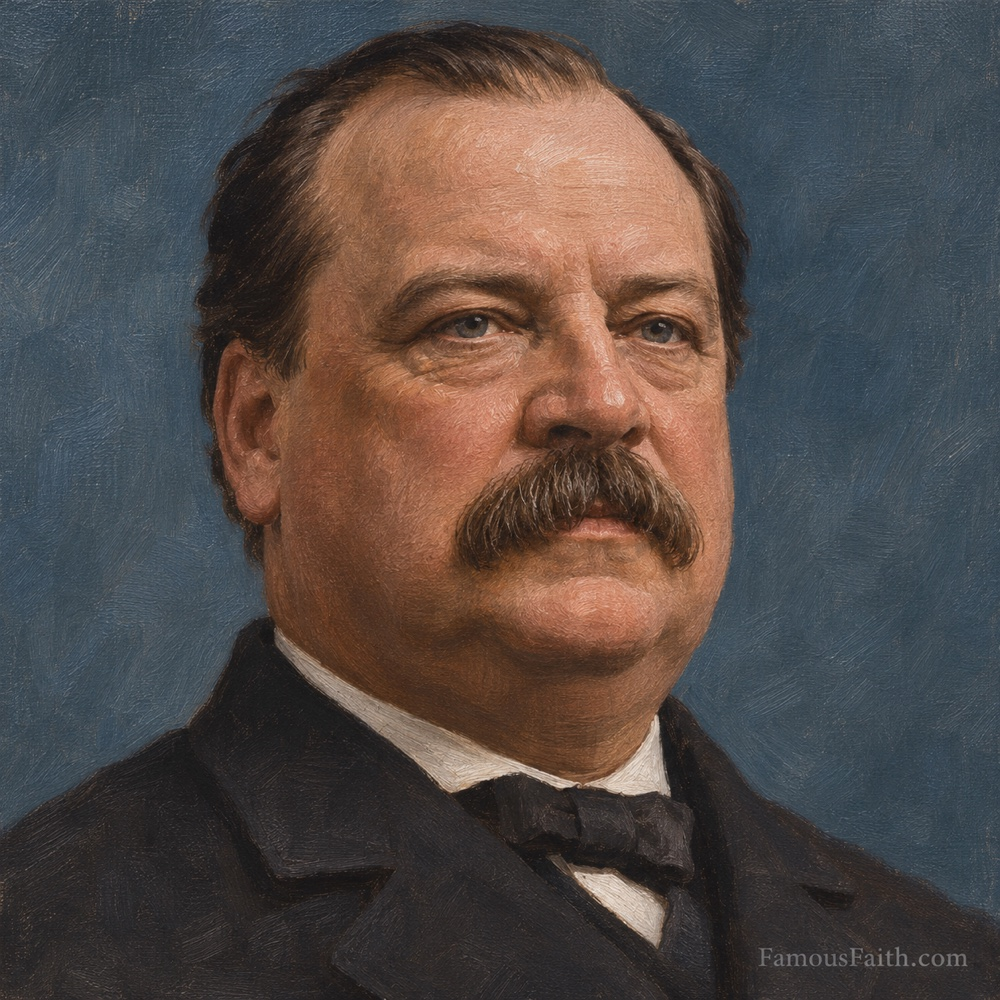
Portrait credit: Original AI-generated painted editorial illustration created for Famous Faith, with a subtle FamousFaith.com watermark. This is an artistic interpretation, not a historical photograph or an authenticated period painting.
Editorial approach: Documented actions and public statements are distinguished from Famous Faith’s biblical assessments. Public profession and church affiliation do not establish the condition of a person’s heart.