Famous Faith · U.S. Presidents
James A. Garfield
A preacher, scholar, and president whose term was cut short.
James A. Garfield brought a career in education, preaching, military service, and Congress to the presidency. Assassination ended his opportunity to govern at length, but his faith and stated commitment to equal citizenship offer more to examine than the tragedy alone.
PRESIDENT 20
The essentials
James A. Garfield at a glance
- Born
- November 19, 1831
- Died
- September 19, 1881
- Presidency
- March 4, 1881 – September 19, 1881
- Political party
- Republican
- Church background
- Disciples of Christ
- Spouse
- November 11, 1858, to Lucretia Rudolph (1832–1918)
- Children
- Seven children; five survived childhood
- Other work
- Teacher, Public Official
- Presidential number
- 20
- Freemasonry
- Documented member
Basic biographical details: [1]. Family and religious qualifications are explained below.
The person behind the office
Life and family
Garfield grew up in poverty in Ohio and pursued education through work and study. He attended the Western Reserve Eclectic Institute and Williams College, became a teacher and educational leader, and preached within the Disciples of Christ tradition. His intellectual interests and religious work were substantial parts of his life rather than decorative additions to a political career. [2] He served as a Union officer during the Civil War and then spent many years in the House of Representatives. His abilities as a debater and his role among competing Republican factions helped bring him the presidential nomination in 1880. He entered office in March 1881, was shot in July, and died in September. The period in which he could actively govern was therefore much shorter than his already brief term. [3]
Spouse and children
Garfield married Lucretia Rudolph in 1858. They had seven children: Eliza, Harry, James, Mary, Irvin, Abram, and Edward. Eliza and Edward died as young children. The surviving children were still young when their father was killed. Lucretia helped preserve his papers and memory, but their family life should not be reduced to the role of a presidential widow or to the public rituals surrounding his death. [4]
A public record
Major political accomplishments and decisions
- 01
Combined teaching and public service
Before becoming president, Garfield led an educational institution, preached, served in the Army, and developed an influential congressional career. These achievements explain his national standing, but they should not be presented as policies he enacted during his short presidency. [2]
- 02
Resisted the control of party bosses
Garfield challenged demands from the Stalwart faction over federal appointments. The struggle involved whether a senator or party leader could effectively dictate the president’s choices. His resistance became part of the wider movement toward a less patronage-driven federal service. [5]
- 03
Affirmed equal citizenship in his inaugural address
Garfield defended the citizenship and political rights of Black Americans and connected education with the meaningful exercise of those rights. The address sets out a public commitment, but the brevity of his administration limits what can be claimed about its implementation. [6]
Public evidence and its limits
Faith and documented statements
Garfield’s connection with the Disciples of Christ was active and documented. He experienced a religious conversion, was baptized, and preached before entering the higher levels of national politics. The National Park Service describes him as a preacher as well as an educator. This is stronger evidence of direct religious activity than a family denomination alone. [7] His inaugural address connected emancipation, equal protection, and the country’s future, while also defending religious liberty and addressing the relationship between civil authority and religious organizations. [6] Famous Faith recognizes the importance of his public Christian commitments without treating a preaching career as proof of perfect conduct or certainty about salvation. His separate Masonic membership must also be acknowledged rather than omitted because his church work appears more reassuring.
Famous Faith’s biblical perspective
Public virtues and serious concerns
The historical actions are sourced. Their evaluation through Scripture expresses Famous Faith’s Christian editorial perspective; it is not a claim to know anyone’s eternal destiny.
Equal protection and education were important commitments
Garfield’s defense of Black citizenship and access to education deserves recognition. Famous Faith sees a connection with impartial justice and the dignity of neighbors. Public rights become fragile when citizens are left without protection against intimidation or without the means to exercise them meaningfully. His words were important, even though assassination prevented a long test of his administration’s performance.
Religious service does not settle every spiritual question
Garfield’s preaching and church leadership provide real evidence about his religious life. They do not make theological discernment unnecessary. Famous Faith believes Christ’s gospel must remain distinct from the spiritual framework of a lodge, and that admirable public service cannot make conflicting religious commitments harmless. Our caution concerns those teachings and affiliations, not permission to invent hidden motives or conspiracies.
Beyond the familiar name
Interesting facts and useful distinctions
A preacher before a president
Garfield’s work in the Disciples tradition was an actual part of his career, not a nickname invented after his death. Care is still needed when later retellings attach picturesque quotations to him without a traceable source. [7]
A short term, an even shorter period of active government
Garfield was shot on July 2, 1881, and died on September 19. Those months of incapacity mean his presidential record cannot fairly be evaluated as if he had enjoyed a full four years to carry out a program. [3]
A life in perspective
What this legacy asks of us
Garfield’s death created understandable sympathy and a reputation shaped by unrealized promise. Historical care requires separating intentions from results. His intellectual gifts, Christian public activity, and commitment to civil rights deserve notice, while his Masonic affiliation remains a serious concern within Famous Faith’s biblical framework.
Our hope rests in Jesus Christ, not a president, party, lodge, or record of public service. Scripture teaches that all have sinned, that Christ died for sins and rose again, and that salvation is God’s gift through faith rather than an achievement we earn (Romans 3:23; 1 Corinthians 15:3–4; Ephesians 2:8–9). His call is to repentance and trust in him.
Sources and image credit
- Miller Center: Overview
- Miller Center: Life Before The Presidency
- Miller Center: Life In Brief
- Miller Center: Family Life
- Miller Center: Domestic Affairs
- Presidential statement: original transcript
- National Park Service: James Abram Garfield
- First Kings Masonic District: Masonic Presidents
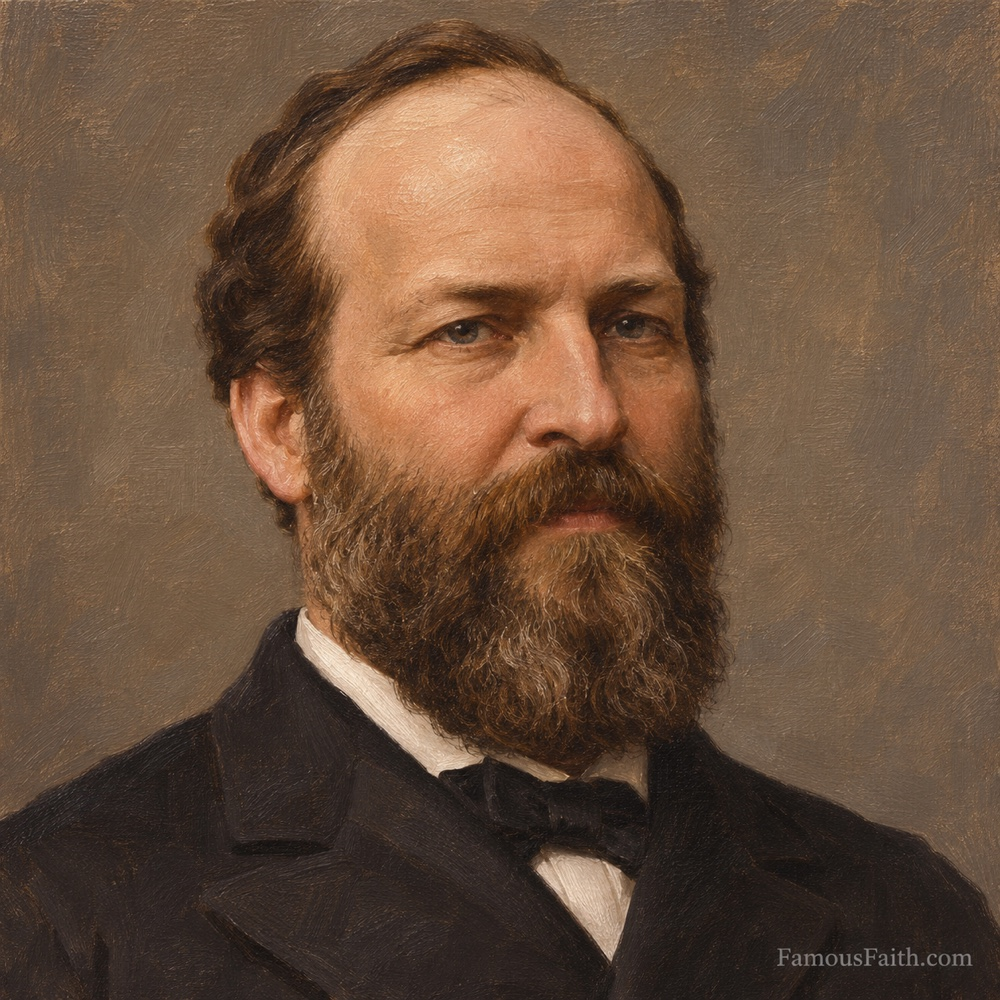
Portrait credit: Original AI-generated painted editorial illustration created for Famous Faith, with a subtle FamousFaith.com watermark. This is an artistic interpretation, not a historical photograph or an authenticated period painting.
Editorial approach: Documented actions and public statements are distinguished from Famous Faith’s biblical assessments. Public profession and church affiliation do not establish the condition of a person’s heart.