Famous Faith · U.S. Presidents
Abraham Lincoln
Emancipation, the Bible, and humility in a divided nation.
Abraham Lincoln preserved the Union and helped make the destruction of slavery a national purpose. His biblical language is among the most searching in presidential history, but a responsible profile must also examine the limits of his policies and resist turning him into a flawless religious figure.
PRESIDENT 16
The essentials
Abraham Lincoln at a glance
- Born
- February 12, 1809
- Died
- April 15, 1865
- Presidency
- March 4, 1861 – April 15, 1865
- Political party
- Republican; reelected on the National Union ticket in 1864
- Church background
- No formal affiliation
- Spouse
- November 4, 1842, to Mary Todd (1818–1882)
- Children
- Four sons: Robert, Edward, William, and Thomas; only Robert reached old age
- Other work
- Lawyer
- Presidential number
- 16
Basic biographical details: [1]. Family and religious qualifications are explained below.
The person behind the office
Life and family
Lincoln grew up with limited formal schooling, educated himself through reading, and developed a career as a lawyer and politician in Illinois. He served in the state legislature and one term in the House of Representatives. His early political home was the Whig Party; he later became a leading Republican opponent of slavery’s extension. His debates with Stephen Douglas helped make him a nationally recognized figure. [2] His election in 1860 was followed by secession and civil war. Lincoln initially emphasized preservation of the Union, but emancipation became an increasingly central part of federal war policy. The change involved military necessity, the actions of enslaved people seeking freedom, pressure from abolitionists, and Lincoln’s own developing judgment. No single presidential document captures that entire process. [3]
Spouse and children
Lincoln married Mary Todd in 1842. Their sons were Robert Todd, Edward Baker, William Wallace, and Thomas, known as Tad. Edward died as a young child, and William died during Lincoln’s presidency. Tad died after his father, leaving Robert as the only son to live into old age. The family’s bereavements form part of the context of Lincoln’s reflections on suffering, though they do not authorize a simple story about how or when his private beliefs changed. [4] [1]
A public record
Major political accomplishments and decisions
- 01
Led the federal government through civil war
Lincoln sustained the Union’s war effort through military reverses, political opposition, and enormous loss of life. His decisions involved selecting commanders, managing a coalition, mobilizing resources, and seeking public support. Preserving the constitutional republic did not make every wartime measure beyond criticism. [3]
- 02
Issued the Emancipation Proclamation
Effective January 1, 1863, the proclamation applied to designated areas in rebellion. It did not immediately abolish slavery everywhere, including the loyal slave states. It nevertheless transformed the war’s purpose and supported the enlistment of Black soldiers in the Union cause. [5]
- 03
Supported the Thirteenth Amendment
Lincoln pressed for the constitutional abolition of slavery, and Congress approved the amendment before his death. Ratification by the states occurred later in 1865. Keeping those stages distinct honors the achievement without suggesting that emancipation was completed by one signature or by Lincoln acting alone. [5]
Public evidence and its limits
Faith and documented statements
Lincoln did not formally join a church. That fact does not make his later religious language meaningless, but it does call for care about confident claims of a fully documented denominational or conversion story. He read and used the Bible extensively. [1] [4] His Second Inaugural Address in March 1865 observed that both sides read the same Bible and prayed to the same God, while neither could assume complete possession of God’s purposes. He interpreted slavery and the war within a framework of divine judgment and urged charity and care for those wounded by the conflict. [6] Famous Faith sees unusual moral seriousness in this refusal to make Providence a convenient endorsement of one’s own innocence. We distinguish that public theological reflection from a claim that historians can establish the condition of Lincoln’s soul.
Famous Faith’s biblical perspective
Public virtues and serious concerns
The historical actions are sourced. Their evaluation through Scripture expresses Famous Faith’s Christian editorial perspective; it is not a claim to know anyone’s eternal destiny.
Ending slavery was a profound moral achievement
Lincoln’s support for emancipation and constitutional abolition deserves recognition. Famous Faith regards freedom from hereditary racial bondage as consistent with the dignity of neighbors created in God’s image. His willingness to connect national suffering with national wrongdoing also challenges a self-righteous account in which a nation’s successes prove its innocence. Gratitude for this achievement should include the many people whose courage helped make it possible.
Wartime power still required accountability
Lincoln’s administration restricted civil liberties during the war. [5] His record also includes authorizing executions after the U.S.-Dakota War of 1862; he rejected most death sentences, but thirty-eight Dakota men were ultimately hanged. [7] Famous Faith believes these actions require scrutiny of due process, justice, and the treatment of vulnerable people. Emancipation does not remove the obligation to examine other uses of power, and context should inform moral judgment without becoming an automatic excuse.
Beyond the familiar name
Interesting facts and useful distinctions
The proclamation did not free everyone at once
The Emancipation Proclamation had a specific wartime scope. Nationwide constitutional abolition required the Thirteenth Amendment and its ratification. The distinction corrects a common simplification without diminishing the proclamation’s importance. [5]
A carefully prepared speaker
The Gettysburg Address was not casually invented on the train to the ceremony. Lincoln worked carefully on his speeches, drawing on long habits of reading, revision, and argument. [4]
A life in perspective
What this legacy asks of us
Lincoln’s assassination in April 1865 helped turn him into a national symbol. That symbolism should not replace history or Christian discernment. His work against slavery and his biblical reflections deserve serious attention; his mistakes and coercive policies deserve examination. Christians can learn from a president without making a president their savior.
Our hope rests in Jesus Christ, not a president, party, lodge, or record of public service. Scripture teaches that all have sinned, that Christ died for sins and rose again, and that salvation is God’s gift through faith rather than an achievement we earn (Romans 3:23; 1 Corinthians 15:3–4; Ephesians 2:8–9). His call is to repentance and trust in him.
Sources and image credit
- Miller Center: Overview
- Miller Center: Life Before The Presidency
- Miller Center: Life In Brief
- Miller Center: Family Life
- Miller Center: Domestic Affairs
- National Park Service: Lincoln’s Second Inaugural Address
- Minnesota Historical Society: U.S.-Dakota War of 1862
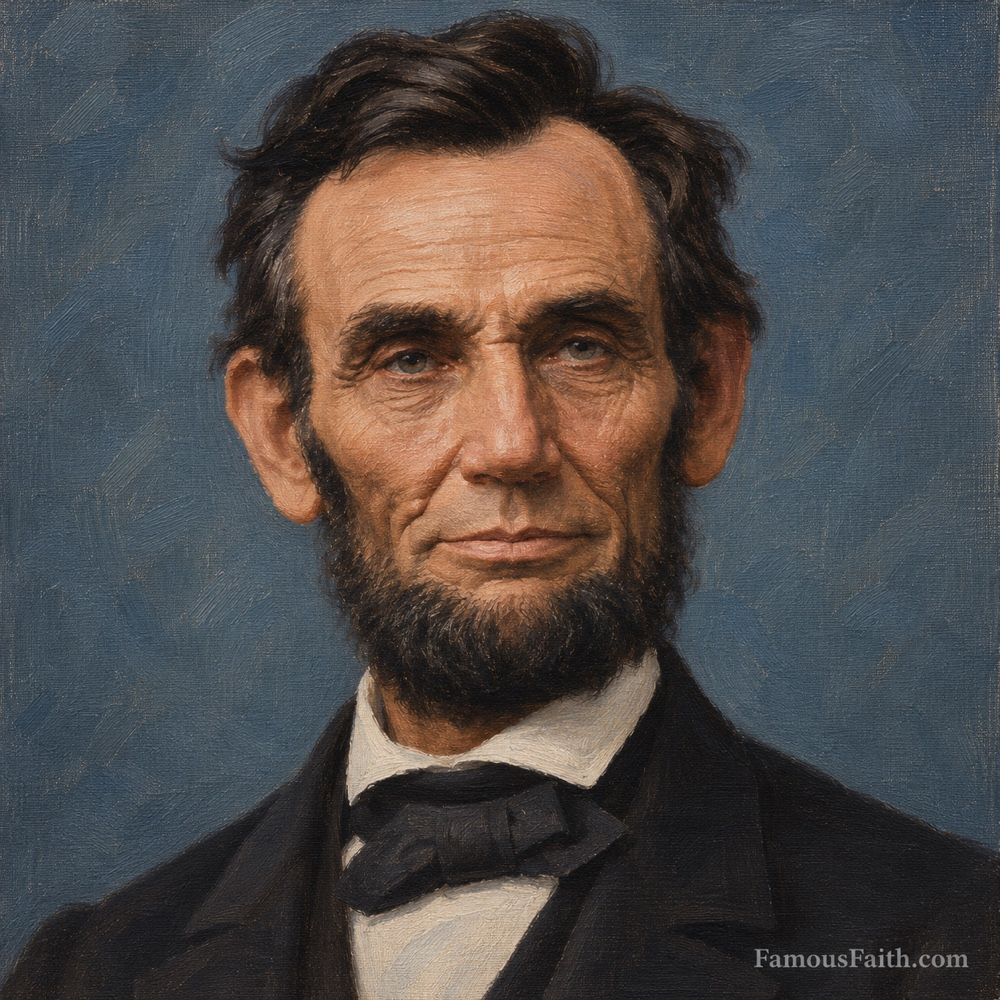
Portrait credit: Original AI-generated painted editorial illustration created for Famous Faith, with a subtle FamousFaith.com watermark. This is an artistic interpretation, not a historical photograph or an authenticated period painting.
Editorial approach: Documented actions and public statements are distinguished from Famous Faith’s biblical assessments. Public profession and church affiliation do not establish the condition of a person’s heart.