Famous Faith · U.S. Presidents
James Buchanan
Extensive experience and a failure of justice at the nation’s breaking point.
James Buchanan reached the presidency with a long record in law, Congress, and diplomacy. His administration nevertheless deepened the slavery crisis and failed to prevent secession. Experience in office did not produce the moral clarity or leadership the moment required.
PRESIDENT 15
The essentials
James Buchanan at a glance
- Born
- April 23, 1791
- Died
- June 1, 1868
- Presidency
- March 4, 1857 – March 4, 1861
- Political party
- Democrat
- Church background
- Presbyterian association; formally joined after leaving office
- Spouse
- Never married
- Children
- No children
- Other work
- Lawyer
- Presidential number
- 15
- Freemasonry
- Documented member
Basic biographical details: [1]. Family and religious qualifications are explained below.
The person behind the office
Life and family
Buchanan trained as a lawyer in Pennsylvania and became a successful public official over many decades. His service included the House, the Senate, diplomatic assignments, and the State Department. He had extensive familiarity with national politics before winning the presidency in 1856. His career makes it difficult to explain his failures simply as the mistakes of an inexperienced outsider. [2] He took office amid violent conflict in Kansas and mounting controversy over the future of slavery. He hoped existing constitutional arrangements and political negotiation could settle the dispute. Instead, his support for slaveholding interests alienated many northerners, divided his party, and weakened his authority. The secession crisis unfolded during the final months of his administration after Abraham Lincoln’s election. [3]
Spouse and children
Buchanan never married and had no children. His niece Harriet Lane served as White House hostess and became a prominent public figure in her own right. His unmarried status should be reported as a biographical fact, not treated as a moral failure or used as permission for unsupported claims about private relationships. The responsibilities and influence of women in presidential households often extended beyond the role of a president’s spouse. [4]
A public record
Major political accomplishments and decisions
- 01
Brought a long diplomatic career to office
Before the presidency, Buchanan represented the United States abroad and served as secretary of state. These positions gave him substantial experience, although experience cannot be equated with wise judgment in a different crisis. His diplomatic reputation helped make him an appealing Democratic nominee in 1856. [2]
- 02
Backed the proslavery Lecompton Constitution
Buchanan supported admitting Kansas under a constitution that protected slavery despite serious disputes about whether it represented the territory’s residents. The controversy split Democrats and intensified sectional mistrust. It illustrates the difference between claiming respect for a political process and ensuring that process is legitimate. [5]
- 03
Presided over the onset of secession
Buchanan denied that secession was lawful but argued that the federal government lacked the power to coerce a state back into the Union. His response failed to halt the crisis. The war itself began under Lincoln, but the presidential transition cannot be separated from Buchanan’s months of indecision. [6]
Public evidence and its limits
Faith and documented statements
Buchanan’s Presbyterian connection should be distinguished from the date of formal membership. The Library of Congress timeline records his joining the Presbyterian Church after his presidency. A religious label in a summary table does not by itself describe his membership status throughout his earlier public life. [7] In his 1857 inaugural address, Buchanan invoked God for wisdom, spoke of Christian benevolence in foreign relations, and asked the blessing of Providence. These are documented expressions of public religion. [8] Famous Faith does not treat them as an assurance that his conduct toward enslaved people was Christian. Religious words must be tested against actions, and a profession of benevolence is especially demanding when the government’s decisions leave some neighbors without basic rights.
Famous Faith’s biblical perspective
Public virtues and serious concerns
The historical actions are sourced. Their evaluation through Scripture expresses Famous Faith’s Christian editorial perspective; it is not a claim to know anyone’s eternal destiny.
Constitutional language needs honest application
Respect for constitutional order is important, but it is not enough to announce that principle while favoring outcomes that deny others a fair hearing or equal protection. The Lecompton dispute shows how legal procedures can be used to advance an unjust interest. [5] Famous Faith regards impartiality and truthfulness as duties of leadership, not optional virtues to be suspended when party unity is threatened.
Support for Dred Scott compounded injustice
Buchanan welcomed the Supreme Court’s Dred Scott decision, which denied the citizenship claimed by Black Americans and struck at federal restrictions on slavery in the territories. The ruling was the Court’s decision, not an order issued by Buchanan, but his support remains part of his record. [5] Famous Faith rejects treating people created in God’s image as outside the circle of rights and protection. Neither a judicial majority nor presidential approval makes racial bondage just.
Beyond the familiar name
Interesting facts and useful distinctions
An experienced president can still fail
Buchanan had held more major national and diplomatic positions than many presidents before him. His record is a useful warning against assuming that a long résumé guarantees wisdom in a new moral crisis. [2]
Harriet Lane’s public role
His niece performed White House hostess duties. A presidential household did not require a married president for a woman to exercise substantial social and public influence within it. [4]
A life in perspective
What this legacy asks of us
Buchanan’s presidency exposes the danger of moral evasion dressed in constitutional respectability. His political experience and religious language did not prevent his support for policies that protected slavery. A Christian assessment must judge that failure clearly while avoiding speculative claims about private matters the evidence does not establish.
Our hope rests in Jesus Christ, not a president, party, lodge, or record of public service. Scripture teaches that all have sinned, that Christ died for sins and rose again, and that salvation is God’s gift through faith rather than an achievement we earn (Romans 3:23; 1 Corinthians 15:3–4; Ephesians 2:8–9). His call is to repentance and trust in him.
Sources and image credit
- Miller Center: Overview
- Miller Center: Life Before The Presidency
- Miller Center: Life In Brief
- Miller Center: Family Life
- Miller Center: Domestic Affairs
- Miller Center: Impact And Legacy
- Library of Congress: James Buchanan Timeline
- Presidential statement: original transcript
- First Kings Masonic District: Masonic Presidents
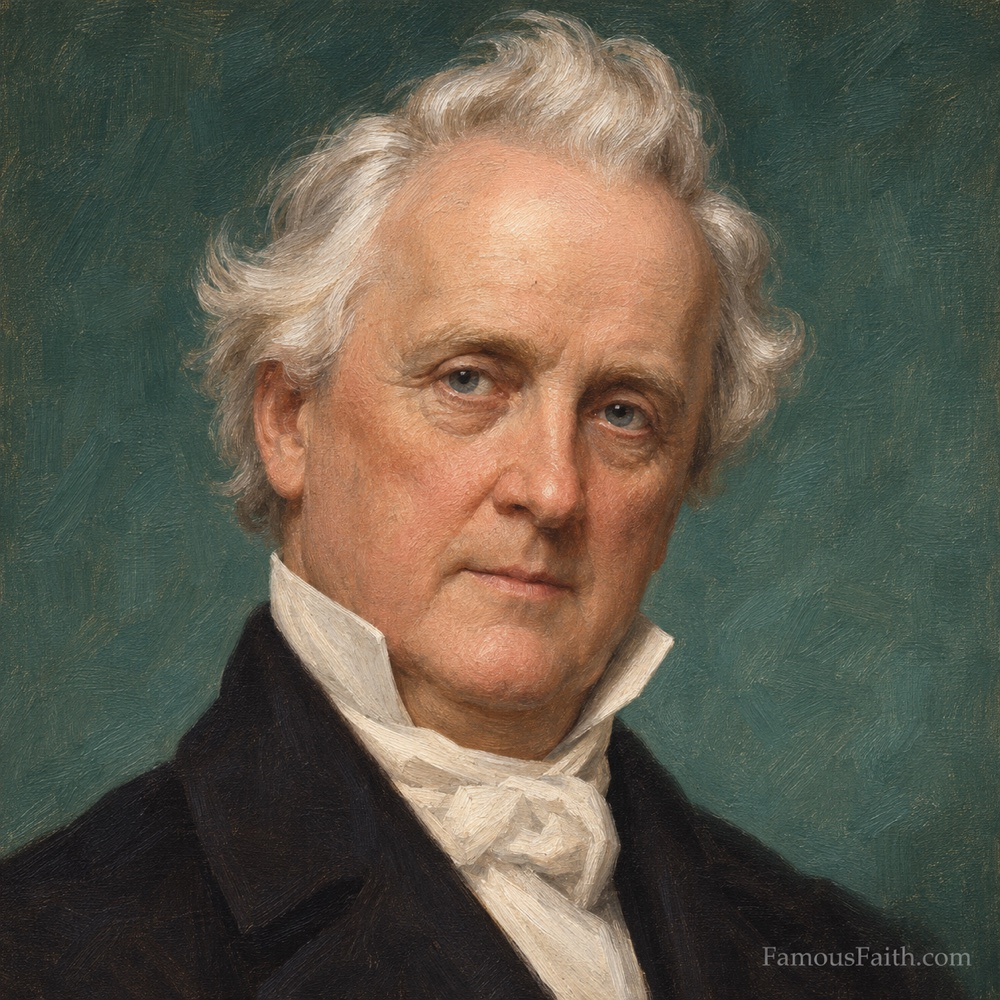
Portrait credit: Original AI-generated painted editorial illustration created for Famous Faith, with a subtle FamousFaith.com watermark. This is an artistic interpretation, not a historical photograph or an authenticated period painting.
Editorial approach: Documented actions and public statements are distinguished from Famous Faith’s biblical assessments. Public profession and church affiliation do not establish the condition of a person’s heart.