Famous Faith · U.S. Presidents
James Madison
Constitutional liberty, religious conscience, and a wartime presidency.
James Madison helped shape the Constitution and Bill of Rights, defended religious liberty, and led the country through the War of 1812. His public principles also stand beside the reality that his own household depended on enslaved labor.
PRESIDENT 4
The essentials
James Madison at a glance
- Born
- March 16, 1751
- Died
- June 28, 1836
- Presidency
- March 4, 1809 – March 4, 1817
- Political party
- Democratic-Republican
- Church background
- Episcopalian
- Spouse
- September 15, 1794, to Dolley Payne Todd (1768–1849)
- Children
- No biological children; stepfather to John Payne Todd
- Other work
- Politician, Planter
- Presidential number
- 4
Basic biographical details: [1]. Family and religious qualifications are explained below.
The person behind the office
Life and family
Madison’s importance began long before his presidency. Educated at the College of New Jersey, now Princeton, he became an unusually influential student of republican government. He helped prepare for the Constitutional Convention, argued for the proposed Constitution, and served in the first federal Congress. His contributions earned the familiar description Father of the Constitution, although the document was the work of many people and difficult compromises. [2] As a congressional leader, Madison helped develop the amendments that became the Bill of Rights. He later served as Thomas Jefferson’s secretary of state before succeeding him in 1809. He belonged to the early Democratic-Republican Party; a modern Republican or Democratic label would obscure the political setting in which he worked. [3]
Spouse and children
Madison married Dolley Payne Todd, a widow, in 1794. They had no biological children together, but he became stepfather to her son John Payne Todd. Dolley made the presidential household an important place of social and political contact. The household included free workers, relatives, and enslaved people. Accounts of entertaining and wartime resilience should therefore include the people whose forced labor supported that public life. [4]
A public record
Major political accomplishments and decisions
- 01
Helped establish constitutional protections
Madison contributed to the Constitution’s design, its ratification, and the introduction of a bill of rights. His defense of conscience developed within debates over government-supported religion in Virginia. Those achievements should be attributed carefully rather than treating him as the Constitution’s sole author. [2] [5]
- 02
Led during the War of 1812
Madison asked Congress to confront British maritime violations and signed the declaration of war in 1812. The conflict brought military failures, the burning of Washington, and eventual peace under the Treaty of Ghent. A survival story is more accurate than a claim of uninterrupted military success. [6]
- 03
Accepted a new national bank
The financial difficulties of war helped change Madison’s approach to a national bank. He signed the charter for the Second Bank of the United States in 1816, while continuing to insist on constitutional limits in other areas, including federal internal-improvement spending. [7]
Public evidence and its limits
Faith and documented statements
The Miller Center identifies Madison’s religious background as Episcopalian. His private convictions are not fully established by that label, and Famous Faith does not substitute speculative claims of deism or evangelical conversion for evidence. [1] In his 1809 inaugural address, he expressed gratitude to the Almighty and asked for guidance and protection. His public religious language is documented, even where a complete personal doctrinal statement is unavailable. [8] His Memorial and Remonstrance against religious assessments argued that religion involves duties toward the Creator and cannot be governed by coercion. The Library of Congress treats the document as a major statement in the history of religious liberty. It should not be flattened into either hostility toward religion or an endorsement of every theology. [5]
Famous Faith’s biblical perspective
Public virtues and serious concerns
The historical actions are sourced. Their evaluation through Scripture expresses Famous Faith’s Christian editorial perspective; it is not a claim to know anyone’s eternal destiny.
Conscience and limited government
Madison’s defense of conscience offers an important protection against rulers who would compel religious profession. From Famous Faith’s perspective, faith cannot be manufactured by taxation or enforced religious participation. We can value constitutional safeguards while still affirming that the gospel makes definite claims about Jesus. Legal liberty and theological agreement are different questions.
A household contradiction he did not resolve
Madison continued to enslave people, including during his presidency. Paul Jennings and other enslaved workers formed part of the household celebrated in accounts of the early republic. [4] Famous Faith regards that exercise of ownership over neighbors as a grave failure measured against human dignity and the Golden Rule. Madison’s intellectual contribution to rights does not cancel the rights denied to those who served him, nor does the complexity of his era remove personal responsibility.
Beyond the familiar name
Interesting facts and useful distinctions
The White House story includes overlooked workers
The rescue of objects from the burning presidential mansion involved household workers as well as Dolley Madison. Celebrating her role should not erase the contributions of Paul Jennings and others. [4]
A changed position on banking
Madison had opposed Alexander Hamilton’s earlier bank proposal but later signed a new bank charter. The reversal shows the pressure that wartime administration placed on earlier constitutional and financial arguments. [7]
A life in perspective
What this legacy asks of us
Madison’s legacy calls for gratitude without hero worship. His defense of conscience and contribution to constitutional government remain significant. His failure to extend the freedom he described to the people he enslaved remains equally relevant to a Christian assessment of his life.
Our hope rests in Jesus Christ, not a president, party, lodge, or record of public service. Scripture teaches that all have sinned, that Christ died for sins and rose again, and that salvation is God’s gift through faith rather than an achievement we earn (Romans 3:23; 1 Corinthians 15:3–4; Ephesians 2:8–9). His call is to repentance and trust in him.
Sources and image credit
- Miller Center: Overview
- Miller Center: Life Before The Presidency
- Miller Center: Life In Brief
- Miller Center: Family Life
- Library of Congress: Demand for a Bill of Rights
- Miller Center: Foreign Affairs
- Miller Center: Domestic Affairs
- Presidential statement: original transcript
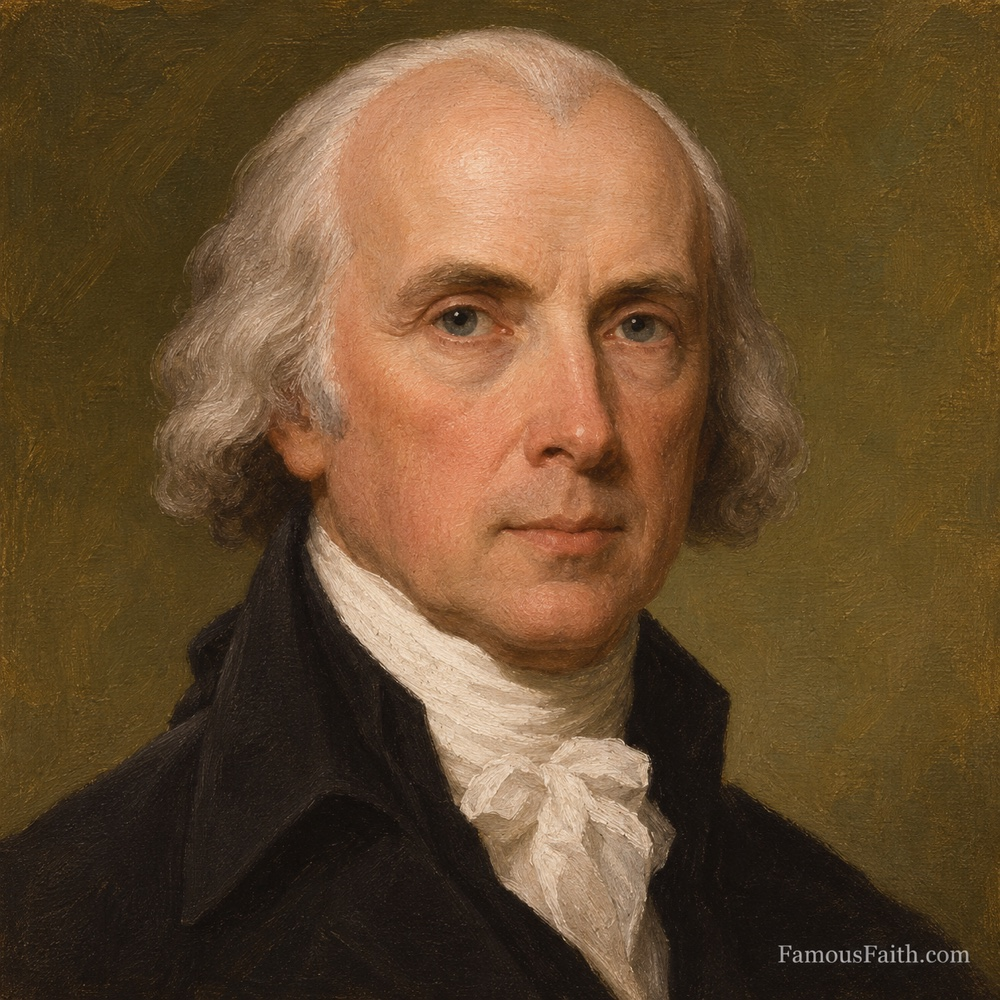
Portrait credit: Original AI-generated painted editorial illustration created for Famous Faith, with a subtle FamousFaith.com watermark. This is an artistic interpretation, not a historical photograph or an authenticated period painting.
Editorial approach: Documented actions and public statements are distinguished from Famous Faith’s biblical assessments. Public profession and church affiliation do not establish the condition of a person’s heart.