Famous Faith · U.S. Presidents
John Adams
Independence, conscience, and the responsibilities of power.
John Adams helped argue a new nation into existence, then faced the harder work of governing it. His record combines courageous diplomacy, damaging restrictions on dissent, and a religious outlook that deserves more precision than a simple Christian label.
PRESIDENT 2
The essentials
John Adams at a glance
- Born
- October 30, 1735
- Died
- July 4, 1826
- Presidency
- March 4, 1797 – March 4, 1801
- Political party
- Federalist
- Church background
- Unitarian
- Spouse
- October 25, 1764, to Abigail Smith (1744–1818)
- Children
- Five children who lived past birth; a sixth was stillborn
- Other work
- Lawyer
- Presidential number
- 2
Basic biographical details: [1]. Family and religious qualifications are explained below.
The person behind the office
Life and family
Adams trained as a lawyer in Massachusetts before becoming a leading voice for independence. He worked in the Continental Congress, served on the committee responsible for the Declaration of Independence, and spent important years representing the United States in Europe. He was an advocate and diplomat rather than a battlefield commander. His contribution lay in argument, negotiation, institution building, and an insistence that Americans could govern themselves. [2] Before winning the presidency, he served two terms as George Washington’s vice president. The constitutional machinery was still new, and political parties were forming around competing visions of federal power. Adams belonged to the Federalist side, although his independence repeatedly brought him into conflict with Alexander Hamilton and other leaders of his own party. Calling him a modern Republican would misstate that history. [3]
Spouse and children
Adams married Abigail Smith in 1764. Their children included Abigail Amelia, John Quincy, Susanna, Charles, and Thomas Boylston; the family also suffered a stillbirth. Susanna died very young, and Charles died in adulthood. John Quincy later became the sixth president. Abigail was an unusually perceptive political correspondent, but their partnership also involved long separations while John served abroad and in public office. Her letters reveal the personal cost of the founding generation’s service. [4]
A public record
Major political accomplishments and decisions
- 01
Helped secure independence diplomatically
Adams represented American interests in Europe and helped negotiate the peace that concluded the Revolutionary War. His work belongs beside the better-known military victories when explaining how independence became an internationally recognized reality. He later became the first American minister to Britain. [3]
- 02
Chose negotiation during the confrontation with France
The XYZ Affair and an undeclared naval conflict produced intense pressure for a larger war. Adams strengthened American defenses but also pursued another diplomatic mission. The Convention of 1800 ended the Quasi-War and released the United States from its earlier alliance with France. [5]
- 03
Oversaw an early transfer between rival parties
Adams lost the election of 1800 to Thomas Jefferson and relinquished the presidency. The campaign was bitter and the transfer imperfect, but the government survived a change in party control. That outcome mattered to the republic’s developing constitutional habits. [6]
Public evidence and its limits
Faith and documented statements
The Miller Center identifies Adams as Unitarian. He had a Congregational upbringing, and his mature beliefs should not be silently equated with the Trinitarian convictions of an evangelical church. A denominational description is historical information, not a complete account of every belief he held. [1] In his 1797 inaugural address, Adams attributed the nation’s survival to an overruling Providence and concluded by asking divine favor for the country and its government. These are documented expressions of religious belief and public dependence on God. They do not, on their own, establish what he believed about Christ’s atoning death or prove his salvation. Famous Faith therefore reports the words without turning an invocation into a conversion testimony. [7]
Famous Faith’s biblical perspective
Public virtues and serious concerns
The historical actions are sourced. Their evaluation through Scripture expresses Famous Faith’s Christian editorial perspective; it is not a claim to know anyone’s eternal destiny.
Peace required resistance to political pressure
Adams’s willingness to pursue a negotiated settlement with France offers a useful example of restraint. From our Christian perspective, Romans 12:18 encourages the pursuit of peace, while Proverbs 15:1 warns against needless escalation. A president still has responsibilities to protect people, but national honor need not require every possible war. Recognizing that restraint does not endorse every Federalist policy.
The Sedition Act was a serious misuse of power
Adams signed the Alien and Sedition Acts, and the Sedition Act was used to punish political criticism. The danger was particularly acute when officials could treat opposition to themselves as a threat to the country. [8] Famous Faith sees a warning here about partiality, pride, and the suppression of truthful rebuke. Biblical accountability applies to rulers as well as their critics; office does not make a leader’s reputation more important than justice.
Beyond the familiar name
Interesting facts and useful distinctions
A father and son in the presidency
John and John Quincy Adams became the first father and son to serve as president. Their political careers followed different paths, and the son’s achievements should not simply be attributed to his father. [1]
A striking shared date
Adams and Jefferson both died on July 4, 1826, the fiftieth anniversary of the Declaration of Independence. Their late correspondence had renewed a friendship damaged by party conflict. [2]
A life in perspective
What this legacy asks of us
Adams’s life shows how an advocate of liberty can also participate in restrictions on it. His diplomatic courage deserves recognition, and the treatment of dissent deserves criticism. A Christian reading of his record should hold both judgments together, resist flattering legends, and remember that political independence is a different question from reconciliation with God.
Our hope rests in Jesus Christ, not a president, party, lodge, or record of public service. Scripture teaches that all have sinned, that Christ died for sins and rose again, and that salvation is God’s gift through faith rather than an achievement we earn (Romans 3:23; 1 Corinthians 15:3–4; Ephesians 2:8–9). His call is to repentance and trust in him.
Sources and image credit
- Miller Center: Overview
- Miller Center: Life In Brief
- Miller Center: Life Before The Presidency
- Miller Center: Family Life
- Miller Center: Foreign Affairs
- Miller Center: Impact And Legacy
- Presidential statement: original transcript
- Miller Center: Domestic Affairs
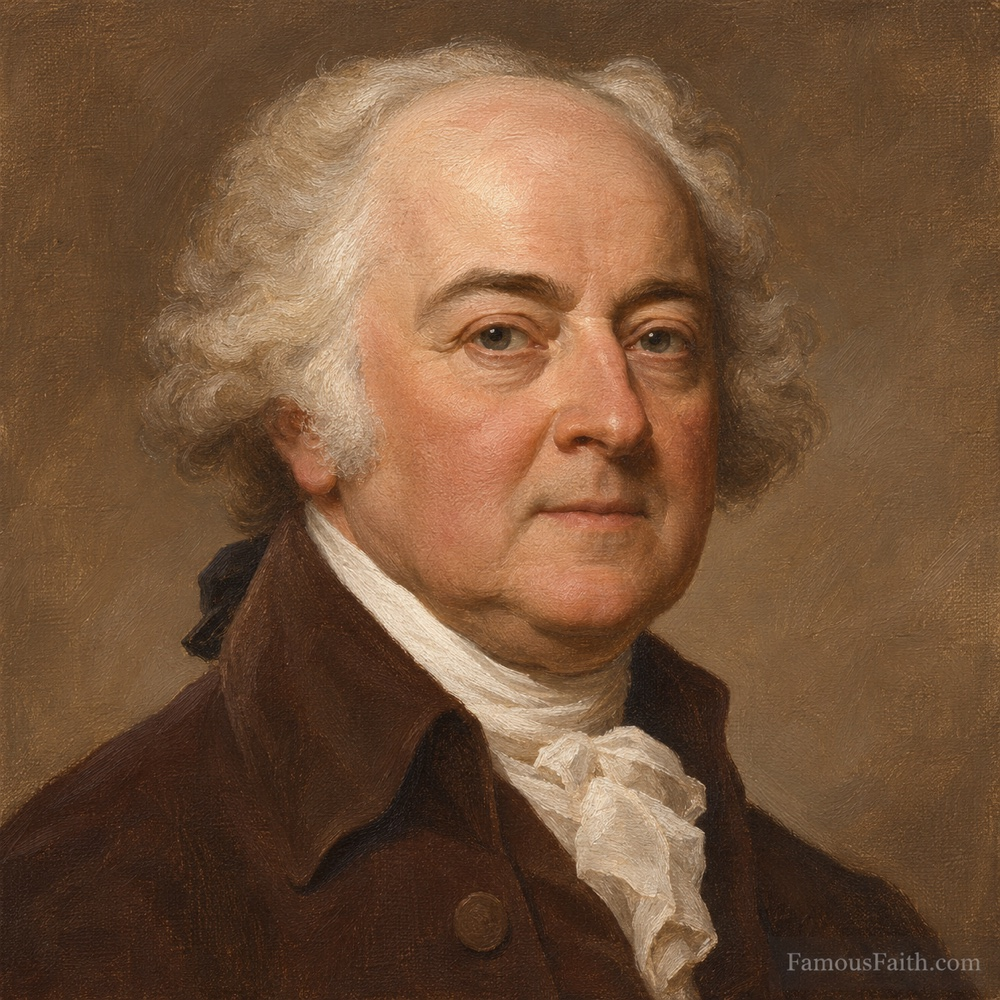
Portrait credit: Original AI-generated painted editorial illustration created for Famous Faith, with a subtle FamousFaith.com watermark. This is an artistic interpretation, not a historical photograph or an authenticated period painting.
Editorial approach: Documented actions and public statements are distinguished from Famous Faith’s biblical assessments. Public profession and church affiliation do not establish the condition of a person’s heart.